
Feeling stuck on LinkedIn? You're not alone. It's a common roadblock. The platform can feel incredibly crowded, and it's easy to think the answer is just to post more. But the secret to real growth isn't about volume—it's about being smarter.
This guide cuts through the noise and gives you a simple, actionable framework to completely rethink your approach.
Why Your LinkedIn Growth Has Stalled

If your follower count is flatlining and your posts are getting nothing but crickets, I get it. I’ve seen countless professionals hit this exact plateau, getting frustrated when all their effort leads nowhere. The problem usually isn't a lack of trying; it's a misaligned strategy. On a platform this big, just "showing up" isn't going to cut it anymore.
And it's only getting bigger. As of January 2025, LinkedIn is home to over 1.2 billion registered members. That's a massive jump from 644 million back in 2019. This explosive growth means more eyeballs, but it also means a ton more noise to compete with. You can dig into more LinkedIn stats over at Cognism.com.
To break through this wall, you have to stop thinking about individual tactics and start using a holistic framework. It's what I call the LinkedIn Growth Trinity.
Introducing The Growth Trinity Framework
The Growth Trinity is a dead-simple model that breaks your LinkedIn efforts down into three core pillars. They all work together, and if you neglect one, the others will suffer. Getting this framework is the first step to figuring out why your growth has stalled and how to build a strategy that actually works.
The three pillars are:
- Profile Authority: Your profile needs to scream credibility. It has to instantly tell people who you are, what you do, and the value you bring to the table.
- Content Resonance: Your content has to actually connect with the people you want to reach. It should solve their problems, offer unique insights, or spark a meaningful conversation.
- Network Engagement: You can't just post and ghost. You have to actively jump into conversations, build real relationships, and expand your circle.
I see this all the time: people obsess over creating content but completely ignore their profile and networking. It's like building a beautiful storefront on a deserted street—no one will see it unless you guide them there and make the store look inviting.
This entire guide is built around these three pillars, giving you a clear roadmap. We'll break down exactly why an unoptimized profile is a dead end, how generic content falls flat, and why passive scrolling will get you absolutely nowhere.
Moving From Passive To Active Growth
So many people treat their LinkedIn profile like a dusty, digital resume they only touch up when they’re job hunting. That right there is the root cause of stagnation. To actually grow, you have to shift your mindset. Your profile isn't a static document; it’s a dynamic hub for your personal brand.
It's about turning your presence into an active tool that consistently pulls in opportunities, whether that's new clients, project collaborators, or your next big career move.
The table below breaks down how this framework tackles the most common pitfalls I see.
The LinkedIn Growth Trinity Framework
This framework is your blueprint for turning isolated actions into a powerful, self-reinforcing system. By focusing on these three pillars, you create a growth engine where each part fuels the others.
| Pillar | Objective | Key Actions |
|---|---|---|
| Profile Authority | Build trust and clarity | Nail your headline, tell a compelling story in your "About" section, and add proof in the "Featured" area. |
| Content Resonance | Create value and connection | Define your content pillars, pick the right formats for your message, and master the art of the hook. |
| Network Engagement | Build relationships and visibility | Leave thoughtful comments, send personalized connection requests, and be proactive in your networking. |
Master these three areas, and you'll create a flywheel effect. A strong profile makes your content more credible. Resonant content drives engagement. And active engagement sends a steady stream of the right people back to your profile. That's the real blueprint for how to grow on LinkedIn.
Turn Your Profile Into an Opportunity Magnet
Your LinkedIn profile isn't a digital resume gathering dust. Far from it. Think of it as your personal landing page, your digital handshake, and the central hub for your entire professional brand.
When the right person—a potential client, a recruiter, or a future collaborator—lands on your page, you have just a few seconds to grab their attention. You have to convince them you’re worth their time, and you have to do it fast.
An unoptimized profile is a silent growth killer. All the hard work you pour into creating content and networking can go to waste if visitors arrive at a confusing or incomplete page. The goal here is to shift your profile from being a passive summary of your past into an active magnet for future opportunities.
Go Beyond Your Job Title
Your headline is the most valuable piece of real estate on your entire profile. It follows you everywhere on LinkedIn—in comments, connection requests, and search results. Just listing your job title, like "Marketing Manager," is a massive missed opportunity.
Instead, your headline needs to scream your value proposition. Who do you help, and how do you help them?
- Before: "Sales Director at ABC Corp"
- After: "Sales Leader Driving 7-Figure Revenue Growth for SaaS Startups"
See the difference? The second example immediately tells a visitor what you do and the results you deliver. It’s specific, compelling, and packed with keywords a potential client might actually search for. This simple tweak is one of the quickest wins you can get.
Your profile is doing the talking when you're not around. Make sure it's saying the right things. A strong headline, a compelling 'About' section, and tangible proof of your skills work together to build trust before you ever send a single message.
Tell a Compelling Story in Your About Section
This is your chance to connect on a human level. The "About" section isn't the place for a dry, third-person bio written like a press release. Write in the first person. Tell a story that outlines your expertise, your passion, and the real-world problems you solve for your audience.
I've found this simple structure works wonders for readability:
- The Hook: Start with a strong opening that speaks directly to your ideal visitor's pain points.
- The Backstory: Briefly explain your background and what led you to your current expertise.
- The Value: Clearly state who you help and the specific outcomes you deliver.
- The Ask: End with a clear call to action. Invite them to connect, check out your work, or send you a message.
Crafting an effective profile story is the bedrock of building a personal brand. To really nail this, check out our complete guide on how to build a personal brand that pulls in opportunities.
Showcase Proof with Skills and Featured Content
Words are great, but proof is better. The "Skills" and "Featured" sections are where you back up every claim you just made.
Don't just list a few skills; be thorough. LinkedIn's own data shows that users who list at least five skills get 17 times more profile views than those who don't. That number alone should tell you how much the algorithm values a complete profile.
But the "Featured" section is where the magic really happens. It lets you pin your best work right to the top of your profile, creating your own mini-portfolio.
Here are a few ideas for what to showcase:
- Links to articles you've written or been featured in.
- Case studies that show off tangible client results.
- A link to a podcast interview you did.
- Your company website or a personal project you're proud of.
By providing this kind of tangible evidence, you erase doubt and build instant credibility. This is what completes the transformation of your profile from a simple resume into a powerful conversion tool, making it a critical step in optimizing your LinkedIn profile to attract the right people.
Create a Content Strategy That Resonates
An optimized profile gets people to the door, but it’s your content that invites them in and makes them stay. If you’re just posting randomly whenever inspiration hits, you’re setting yourself up for burnout and getting nowhere fast. To really see growth, you need a system.
This isn't about locking yourself into a rigid, month-long content calendar. It's about building a simple framework that makes creating high-value content repeatable, sustainable, and actually effective. And it all begins with getting laser-focused on your core topics.
Define Your Content Pillars
Your content pillars are the 3-5 core topics you want to be known for. These are the subjects you could talk about for hours with genuine authority and excitement. If you try to be an expert in everything, you’ll end up being known for nothing. A narrow focus is what attracts the right audience and cements your reputation.
Put it this way: when someone in your network needs an answer on a specific topic, your name should pop into their head first.
Here’s a quick way to nail down your pillars:
- Expertise: What do you know inside and out from your actual work experience?
- Passion: What topics genuinely fire you up? People can feel that energy through the screen.
- Audience Need: What are the biggest headaches or questions your target audience is dealing with? Your content should be their painkiller.
For a freelance copywriter, this might look like 'Brand Storytelling,' 'Conversion Copywriting,' and 'Freelance Business Growth.' For a software engineer, it could be 'Scalable System Design,' 'Mentoring Junior Devs,' and 'AI in Software Development.'
By being intentional with your topics, you create a content library that reinforces your expertise with every post. This consistency is what builds trust and turns casual viewers into loyal followers who see you as a go-to resource in your field.
Choose The Right Format for Your Message
Once you know what you're talking about, you need to decide how you'll say it. Different LinkedIn formats are built for different things. The key is matching your message to the right format to maximize its impact.
Some posts are designed to spark a quick debate, while others are better for teaching something complex. Mixing it up is crucial. For a deeper look at the nuts and bolts of writing great posts, check out our guide on how to write LinkedIn posts that actually get read.
Your main options are pretty straightforward.
- Text-Only Posts: Perfect for storytelling, sharing a personal take, or posing a question that makes people think. They’re super scannable and fantastic for starting conversations.
- Image Posts: A great visual can literally stop someone's scroll. Use quality photos, simple infographics, or even annotated screenshots to give your text more punch.
- Carousels (PDFs): These are your best friend for educational content. Break down a big idea into bite-sized, step-by-step slides. They keep people engaged longer, and the LinkedIn algorithm tends to love that.
- Polls: The easiest engagement you'll ever get. Polls are brilliant for taking the temperature of your audience, validating an idea, or just starting a fun, low-stakes discussion.
This chart breaks down when to use each format to get the best results.
Choosing The Right LinkedIn Content Format
A comparison of different LinkedIn post formats to help you decide which one best suits your content goals and audience.
| Format Type | Best For | Engagement Potential | Pro Tip |
|---|---|---|---|
| Text-Only | Storytelling, asking questions, sharing quick insights or opinions. | High | Keep paragraphs short (1-2 lines). Use a strong opening hook to grab attention immediately. |
| Image Post | Showcasing data (infographics), behind-the-scenes content, or adding visual context to a story. | Medium-High | Use high-quality, original images. Avoid generic stock photos. Ensure the image supports the text, not just decorates it. |
| Carousel (PDF) | In-depth tutorials, step-by-step guides, lists, and repurposing longer content. | Very High | Design a compelling cover slide. Keep each slide focused on one key point with minimal text. End with a clear call-to-action. |
| Poll | Gathering audience feedback, starting debates, and quick, low-effort engagement. | High | Keep the question simple and the options clear. Follow up with a post sharing the results and your own analysis. |
Choosing the right format isn't about what's trendy; it's about what will deliver your message most effectively to your audience.
The diagram below shows how the different parts of your profile—the foundation for all this content—should work together.
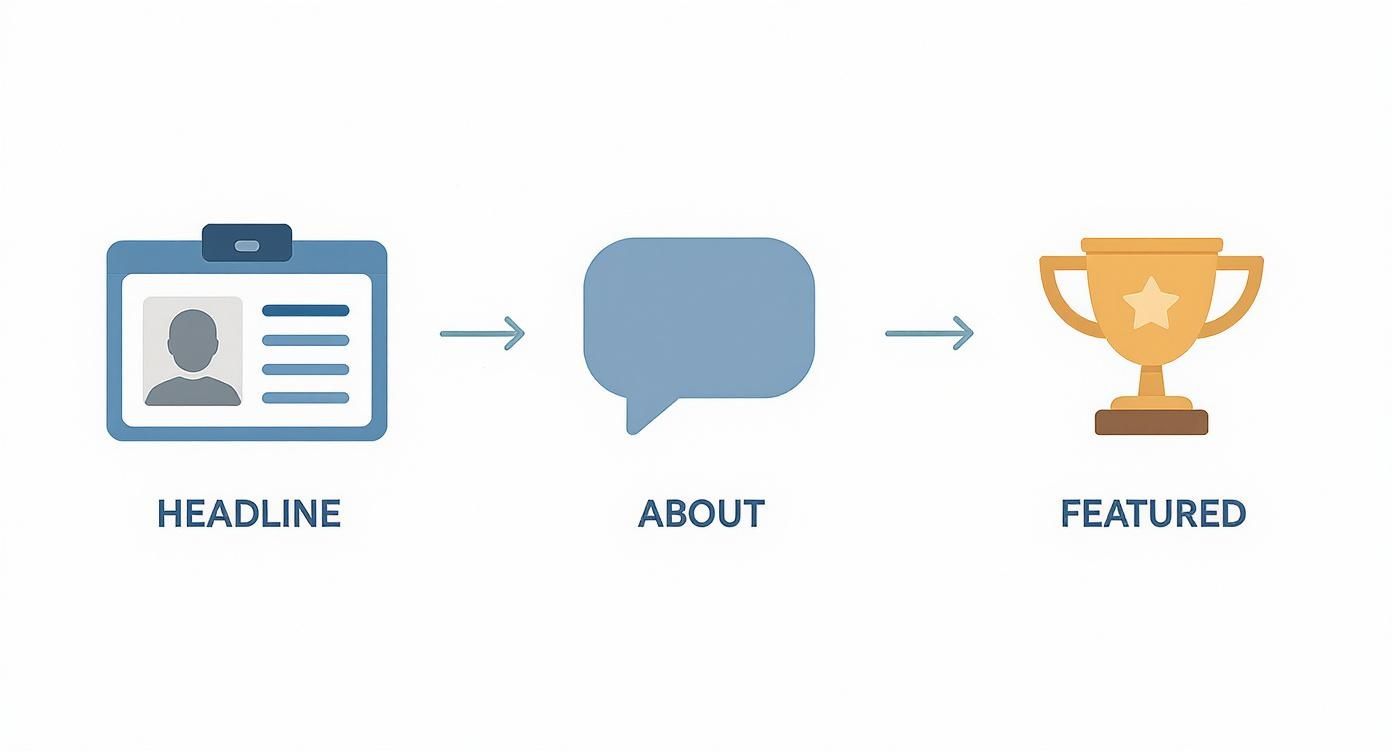
Think of your Headline, About, and Featured sections as a one-two-three punch that sets the stage. When these are sharp, people are way more likely to pay attention to the content you publish.
Build a Sustainable Content Workflow
A great strategy means nothing if you don't have a system to execute it. So many creators burn out because they’re constantly trying to come up with ideas on the fly. A simple workflow will save your sanity and keep you consistent.
1. Idea Capture
Good ideas rarely show up on schedule. Have a single place—a notes app, a voice memo, whatever—to dump every random thought, question, or observation. Don't judge them, just capture them.
2. Content Batching
Block out a couple of hours one day a week to just write. It's so much easier to get into a creative flow and knock out three or four posts in one sitting than it is to force yourself to write from a blank slate every morning.
3. Schedule Ahead
Use a scheduling tool to get your posts queued up for the week. This frees up your headspace to focus on the important stuff: actually talking to people and building relationships in the comments.
This kind of system turns content from a daily stress into a manageable, structured process. And that consistency is what really fuels growth on LinkedIn.
Master Strategic Networking and Engagement
Look, putting out great content is a fantastic start, but it's only half the equation. If you hit "post" and immediately close the tab, you're missing the whole point of LinkedIn. This isn't a billboard; it's a social network. Your growth is directly tied to how well you show up for the community.
Real growth on LinkedIn is a conversation, not a monologue. You can't just publish into the void and expect results. You have to roll up your sleeves and participate. That means getting out of the passive scroll and becoming a visible, valuable member of your professional circle.
Go Beyond Generic Comments
Want to know the fastest way to get noticed? Leave thoughtful, insightful comments on other people's posts. I'm not talking about the generic "Great post!" or "Thanks for sharing." Those are completely invisible. They add zero value and do nothing to establish you as an expert.
Your goal is to genuinely add to the conversation.
- Ask a smart question: "This is a great point on team morale. Have you seen this approach work differently in fully remote teams versus hybrid ones?"
- Share a quick, related experience: "I saw a similar outcome when we implemented a new feedback system last quarter. The key for us was consistent follow-up."
- Offer a different (but respectful) perspective: "Interesting take. I've always found that focusing on leading indicators provides a clearer picture, though I see the value in tracking lagging metrics as well."
This type of engagement gets you on the radar of not just the original poster, but everyone else scrolling through the comments. It instantly positions you as a thoughtful pro who's actually in the trenches.
Think of every comment as a mini-post. It's a chance to showcase your expertise, share your perspective, and connect with people interested in the same things you are. This is how you turn passive connections into a real community.
Send Connection Requests That Actually Get Accepted
Blindly smashing the "Connect" button is a surefire way to get ignored. When you want to connect with someone—especially an industry leader or potential client—you need to give them a reason to say yes. Always, always add a personalized note.
Your note doesn't need to be an essay. Just keep it brief and get straight to the point: why do you want to connect with them specifically?
Here’s a real-world example:
Let's say you're a B2B SaaS marketer and want to connect with a VP of Marketing you admire.
- Weak Request (No Note): [Crickets]
- Strong Request (Personalized Note): "Hi Sarah, I really enjoyed your recent post on product-led growth. Your point about user onboarding being a marketing function was spot-on. I'm also in the B2B SaaS marketing space and would love to connect and follow your insights."
See the difference? That simple, personalized message shows you've done your homework and have a genuine interest. It’s a tiny bit of effort that makes a huge impact on your acceptance rate.
Build Your Network Proactively
Don't sit around waiting for people to find you. Spend 15-20 minutes every single day identifying and engaging with key people in your niche.
This isn't just about sending connection requests. The real magic happens when you build genuine rapport before you connect. Find a few key people and engage with their content for a week or two. Leave those thoughtful comments we just talked about.
By the time you send the request, they’ll already recognize your name. This "warm" approach feels far more authentic than a cold pitch out of the blue. The foundation here is knowing who you want in your network and what they care about. If you really want to level this up, it's worth exploring some modern prospecting strategies on LinkedIn.
Remember, active engagement is a massive signal to the LinkedIn algorithm. With 40% of LinkedIn's active users engaging with content weekly, being active is the norm. When you join the conversation, the platform rewards you by showing your content to a much wider audience.
Use Analytics to Accelerate Your Growth

Posting content without checking your data is like driving with your eyes closed. Sure, you might be moving, but you have no idea if you're headed in the right direction. Data is your roadmap for sustainable LinkedIn growth, helping you turn random guesses into a smart, repeatable strategy.
You don't need a Ph.D. in data science to make sense of your analytics. It's all about homing in on a few key numbers that tell you what’s hitting the mark and what's falling flat. This simple loop of posting, analyzing, and tweaking is the secret to speeding up your growth and making sure your effort actually pays off.
The Key Metrics That Actually Matter
When you first open up your LinkedIn Analytics, it's easy to feel overwhelmed. Don't be. To keep it simple, just focus on the metrics that directly influence your growth and ignore the noise. Your goal is to understand what your audience wants, not track every single number.
Here are the essentials to keep an eye on:
- Impressions: This is just the number of times your post appeared in someone's feed. It's a solid measure of your content's initial reach.
- Engagement Rate: This is the magic number. It’s your total likes, comments, and reposts divided by your impressions. A high engagement rate is a signal to the algorithm that your content is valuable, which earns you even more reach.
- Follower Demographics: Pay attention to the job titles, industries, and locations of your followers. Are these the people you're trying to attract? If there’s a mismatch, it might be time to revisit your content pillars.
Tracking these metrics helps you diagnose your content's health. For example, if you see high impressions but a low engagement rate, it often means your hook was strong enough to stop the scroll, but the rest of the post didn't quite deliver on the promise.
Decoding Your Top-Performing Posts
The best clues for what to create next are hidden inside your most successful posts. I recommend setting aside 30 minutes every month to do a quick content audit. This simple habit helps you double down on what works and ditch what doesn't.
Just pull up your top three to five posts from the last month and ask yourself a few questions about each one. We break this down even further in our guide on how to analyze content performance, but here’s the gist.
1. What was the core topic?
Did you share a personal story, a tactical tip, or commentary on an industry trend? Look for patterns in the subjects that get the most traction.
2. What format did you use?
Was it text-only? A carousel? A poll or an image? Different formats work for different messages, and your audience definitely has preferences. Video, for instance, is a powerhouse—users are 20 times more likely to share video than other formats. You can find more data-backed insights on LinkedIn content trends on SproutSocial.com.
3. What was the hook?
Look closely at the first sentence or two of your best posts. Did you ask a provocative question, make a bold statement, or highlight a relatable problem? A killer hook is often the single biggest reason a post takes off.
Once you spot these patterns, you can stop guessing what your audience wants and start creating content you know will perform well. This data-driven approach is how you build a content engine that consistently delivers.
For instance, you might find that your audience of startup founders absolutely devours carousels that break down complex marketing frameworks but completely ignores your text-only posts on leadership. That insight is gold. It tells you exactly where to focus your creative energy for maximum impact.
A Few Common Questions About Growing on LinkedIn
Even with a solid game plan, you're going to hit a few snags. The day-to-day grind of growing on LinkedIn throws curveballs, and knowing how to handle them can save you a ton of frustration.
I get asked these questions all the time by professionals who are finally getting serious about their LinkedIn presence. Think of this as your go-to FAQ for fine-tuning your approach and making smarter moves.
So, How Often Should I Really Be Posting?
This is the big one, isn't it? But the answer is probably simpler than you think. Consistency beats frequency, every single time.
My advice? Aim for 3-5 high-quality posts a week. That’s the sweet spot for most people. It's enough to stay on your network's radar and show the algorithm you’re an active contributor, but not so much that you burn out.
Seriously, it's far better to share three genuinely helpful posts than to push out five mediocre ones just to hit a quota. Burnout is real. Find a rhythm you can actually stick with for the long haul.
What’s the Magic Time to Post?
You’ve seen the articles: "Post at 9 AM on Tuesdays!" While those studies can be interesting, the only time that truly matters is when your audience is online and scrolling.
Your LinkedIn Analytics is your new best friend.
- Dive into your post analytics and look at the impression data.
- Start experimenting. Try posting at different times—early morning, over lunch, maybe even in the evening.
- After a couple of weeks, look for the patterns. Are your 9 AM posts consistently getting more eyeballs right away compared to your 4 PM ones?
Let your own data be your guide. What works for a tech founder in San Francisco is going to be completely different from what works for a finance exec in London.
The "best time to post" isn't some universal secret. It’s a personal metric you have to discover for yourself. Stop following generic advice and start listening to your own audience.
Are Hashtags Still a Thing?
Yep, they absolutely are. Hashtags are like little signposts for the LinkedIn algorithm. They help categorize your content and get it in front of people who are interested in those topics but don't follow you yet.
But don't go crazy. More is definitely not better here.
- Stick to a strategic mix of 3-5 relevant hashtags for each post.
- Use a combo of broad tags (like
#Marketing) and more niche ones (like#B2BContentStrategy). - It's also a good idea to create a personal or branded hashtag (like
#YourNameInsights) to group all your killer content together.
This keeps your post looking clean and focused while still maximizing its reach.
Should I Just Accept Every Connection Request?
It's tempting to accept every request to pump up your follower count, but trust me, that's a shortsighted move. The real goal is to build a relevant network, not just a massive one. A smaller, engaged network of the right people is worth infinitely more.
Before you hit "Accept," take ten seconds to vet the profile. Ask yourself:
- Are they in my industry or a field I care about?
- Could this person be a potential client, partner, or someone I can learn from?
- Does their profile look legitimate and interesting?
If you're getting a "no" on all fronts, it's perfectly fine to hit ignore. Quality over quantity, always. This is especially true in the B2B world, where a targeted network is everything. It's no wonder that 97% of B2B marketers use LinkedIn for their content marketing—the platform is proven to generate leads 277% more effectively than other social networks. You can dig into more of this data on LinkedIn's power in B2B marketing over at SproutSocial.com.
At PostFlow, we take your raw expertise and turn it into a steady stream of high-quality LinkedIn content. Our AI strategist, Emilia, helps you capture your ideas effortlessly and transforms them into posts that build your brand and attract the right opportunities. Stop guessing and start growing with a smarter workflow. Explore PostFlow and start your journey today.