
Let's get one thing straight: becoming a thought leader isn't about chasing a vanity metric or racking up followers. It's about methodically carving out a niche, creating content that actually makes people think, building a real community, and showing up with relentless consistency.
The goal isn't to be a big voice; it’s to become the go-to expert for a specific group of people wrestling with a specific problem. That’s how you transform your professional reputation from just another name in the feed into an authoritative, trusted resource.
What It Really Means to Be a Thought Leader Today
Forget the buzzword for a second. True thought leadership is a strategic asset that builds trust, drives revenue, and accelerates your career. There’s a huge difference between being an expert—someone who knows a topic—and a thought leader, who shapes how others think about that topic. You're not just commenting on industry news; you're driving the conversation.

This jump from knowledge to influence is what separates the real leaders from the crowd. It’s more than just having an online presence; it becomes a core part of your professional identity. When you get this right, your insights don't just get seen—they get sought out.
The Business Impact of Genuine Influence
This isn't just a "nice-to-have" for your marketing strategy anymore. It’s a critical driver of business performance, and there’s data to back it up.
The Edelman-LinkedIn B2B Thought Leadership Impact Report found that 54% of C-suite executives spend at least one hour a week consuming this kind of content. Even more telling, nearly 7 in 10 of them develop a more positive view of companies that consistently publish high-quality insights.
The message here is crystal clear: decision-makers are actively using thought leadership to vet potential partners long before they ever talk to a sales rep. Your content acts as your digital handshake, proving your credibility before you even enter the room.
Core Pillars of Thought Leadership
So, how do you actually do this? It all boils down to executing on four core pillars. Each one builds on the last, creating a powerful engine for your personal brand.
This table breaks down the essentials you need to focus on.
| Pillar | Core Action | Primary Goal |
|---|---|---|
| Niche Definition | Sharpen your focus from a broad topic to a hyper-specific area of expertise. | Become the undeniable authority in a smaller, more relevant pond. |
| Original Content | Develop and share unique perspectives, contrarian views, or personal stories. | Move beyond regurgitating facts to shaping industry conversations. |
| Community Building | Actively engage in dialogue, answer questions, and build real relationships. | Turn a passive audience into an active, engaged community. |
| Relentless Consistency | Establish and maintain a predictable content schedule. | Train your audience and the platform algorithms to see you as a reliable source. |
Each of these pillars is non-negotiable. Skipping one will undermine the others, but mastering all four creates a foundation for genuine, sustainable influence.
Here's a closer look at what each one involves:
- Define Your Niche: Stop talking about "sales." Start talking about "outbound sales strategies for early-stage fintech." Getting specific is how you go from being a generalist to a specialist.
- Create Original Content: Don't just report the news. Share a unique perspective, a personal failure, or a contrarian take that challenges the status quo. If you need inspiration, check out these powerful thought leadership content examples.
- Engage Your Community: Thought leadership is a dialogue, not a monologue. Jump into the comments, ask questions, and build real relationships. Your network is your amplifier.
- Be Relentlessly Consistent: Showing up once in a while won't cut it. A consistent schedule trains your audience to anticipate your content and signals to platforms like LinkedIn that you're a serious contributor.
The goal isn't just to share what you know. It's to build a platform where your ideas spark conversations, solve real problems, and ultimately, position you as an indispensable resource in your field.
Finding Your Niche and Authentic Voice
Let's get one thing straight: you can't be a thought leader for everyone. Trying to do so is the fastest way to get lost in the noise. The real journey to influence starts when you get sharp—almost uncomfortably specific—with your focus.
Generic labels like "marketing expert" or "sales guru" are a dime a dozen. Real authority isn't built on a broad field; it's carved out in a well-defined niche where your specific insights actually matter. Think of it this way: being a generalist is like shouting into a packed stadium. Finding your niche is like pulling up a chair and having a direct conversation with the exact person who needs to hear what you have to say.
From Broad Expertise to a Defensible Niche
So, how do you find this magical niche? It’s not about pulling a topic out of a hat. It’s a strategic intersection of three things. A huge part of this is intentionally how to build your personal brand, and that brand has to be anchored in something solid.
Your sweet spot is where these three circles overlap:
- Your Deep Expertise: What problems can you solve better than 99% of people? This comes from your time in the trenches—your skills, experience, and hard-won lessons.
- Your Genuine Passion: What topics could you talk about for hours without getting bored? Thought leadership is a marathon, not a sprint. Passion is the fuel that keeps you going when the initial excitement fades.
- A Clear Market Need: Who actually cares about this? More importantly, who is willing to listen, engage, and maybe even pay for this expertise? Your insights have to solve a real, nagging problem for a specific group of people.
Let’s see this in action. A freelance marketer might start with a huge topic like "content marketing." It's a good start, but it's way too broad.
Niche-Finding in Action:
- Initial Field: Content Marketing
- Adding Expertise: Content Marketing for B2B Tech
- Adding Passion: Content Marketing for B2B Tech using long-form, data-driven guides
- Pinpointing Market Need: Long-form, data-driven content marketing guides for early-stage SaaS founders struggling with lead generation.
See the difference? That last one is a powerful, defensible niche. It instantly tells people what you do, how you do it, and who you do it for. You’re no longer just another marketer; you’re the person for a very specific problem.
Developing Your Authentic Voice
Okay, you've figured out what you’re going to talk about. Now comes the tricky part: how you're going to talk about it. Your voice is your fingerprint. It’s that unique blend of your personality, perspective, and professional experience that makes people choose to listen to you over someone else.
One of the biggest mistakes I see is people trying to sound like another thought leader they admire. Your audience can smell a fake a mile away. The goal isn't to create a persona; it's to amplify the professional version of who you already are.
Are you analytical and love digging into the data? Let that shine through. Are you a natural storyteller who uses personal anecdotes to make a point? Lean into it. Your voice is the bridge connecting your expertise to your audience, making complex ideas feel human and relatable.
Key Insight: Your authentic voice isn't about being unprofessional; it's about being human. It's having the courage to share not just the wins, but the messy failures and what you learned from them.
To start dialing in your voice, ask yourself a few questions:
- What's My Core Perspective? Am I the one who challenges conventional wisdom, or do I excel at making complicated things simple?
- How Do I Naturally Communicate? Am I direct and punchy, or more reflective and narrative?
- What Stories Can Only I Tell? What unique experiences have shaped my point of view on my industry?
Answering these helps you craft a style that’s both authoritative and genuinely you. That combination is what builds trust, turning passive scrollers into a real community that actually seeks you out. It’s the foundation for everything else you’ll do.
Your High-Impact LinkedIn Content Strategy
This is where the rubber meets the road. A killer niche and an authentic voice are your foundation, but without a smart content strategy, your best ideas will just gather dust. For anyone serious about thought leadership, LinkedIn is the ultimate playground to test, refine, and amplify what you have to say.
The goal here is simple: stop curating and start creating. Anyone can hit the 'share' button on an article. A true thought leader offers an original take that solves a problem, busts a myth, or opens up a completely new perspective. It’s all about creating value from what you know.
Adopting the Content Pyramid Model
Feeling the pressure to come up with fresh, brilliant ideas every single day? It’s a fast track to burnout. The secret is to work smarter, not harder, using a framework I call the Content Pyramid. It's all about getting maximum impact with minimum friction.
Instead of staring at a blank screen trying to brainstorm a daily post, you start with one big, foundational piece of content. This is your "pillar."
- Pillar Content: Think of a meaty asset like a detailed industry report, a webinar you hosted, a keynote speech, or a deep-dive client case study. It's something rich with data, stories, and your unique insights.
From that one pillar, you can strategically slice and dice it into dozens of smaller "micro-content" pieces that are perfect for LinkedIn. This simple shift ensures your daily posts are always rooted in something substantial and original.
Here’s how it works: Let's say your pillar content is a webinar on "AI for Sales Teams." You can spin that one piece of work into:
- A text-only post dropping a surprising statistic you shared.
- A carousel breaking down the 3-step framework you taught.
- A quick video clip of you explaining a key concept.
- A poll asking your network about their biggest AI implementation challenge.
See? One big effort can fuel a whole month's worth of consistent, high-value content. It’s the key to maintaining momentum without losing your mind.
Choosing Formats That Actually Drive Engagement
Not all LinkedIn posts are created equal. To really establish yourself as a leader, you need to mix up your formats. Different people consume content in different ways, and the LinkedIn algorithm rewards posts that get people talking.
This whole process starts with knowing that your content is hitting a real market need, which is what this flow illustrates.
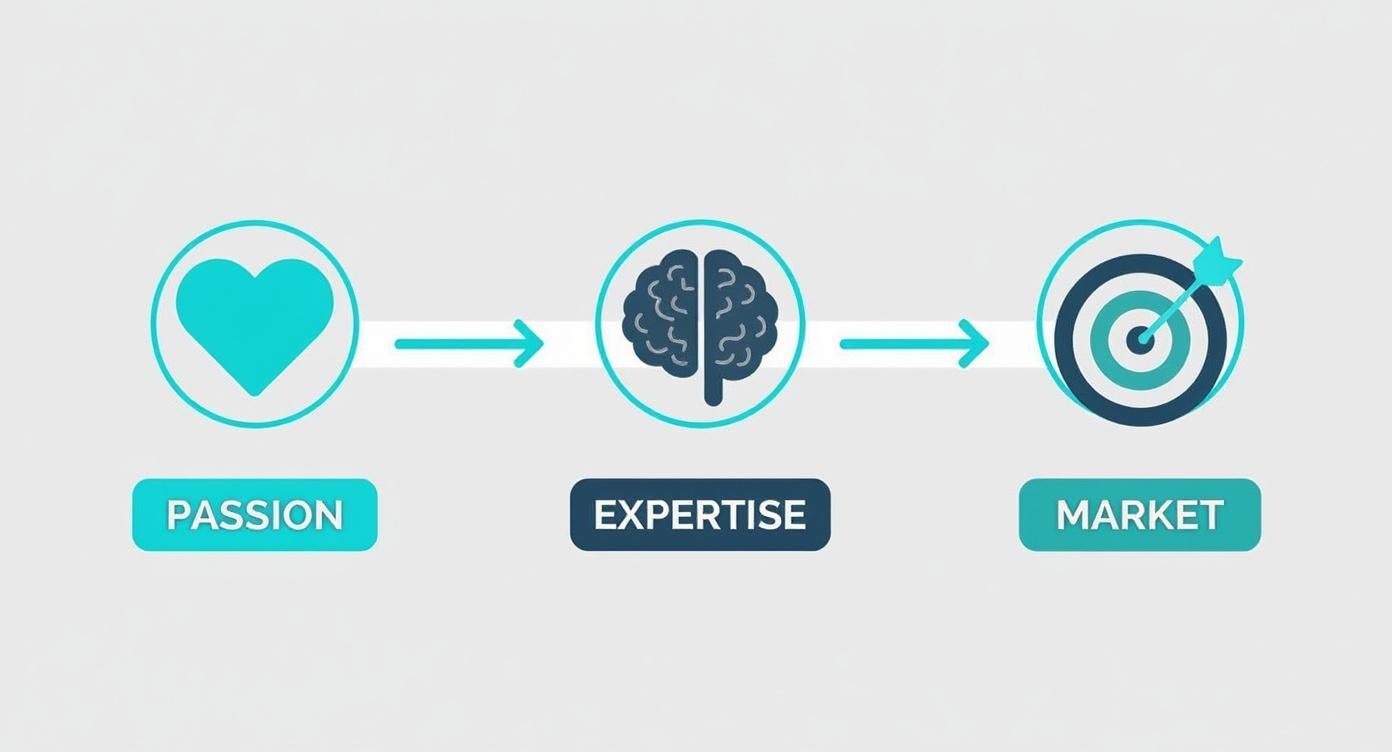
Powerful content lives at the intersection of what you're an expert in and what people genuinely need help with.
Here are the formats I see working best right now:
- Text-Only Posts: These are your bread and butter for sharing personal stories, contrarian takes, or quick, punchy tips. They feel raw and authentic, and they’re incredibly easy for people to scan.
- Carousels (PDFs): Perfect for breaking down complex ideas into simple, visual steps. Use them for frameworks, checklists, or to tell a story with data. They stop the scroll.
- Short-Form Video: Nothing builds a human connection faster. Use video to share off-the-cuff thoughts, answer common questions, or give a behind-the-scenes peek at your work.
- Data-Driven Visuals: A simple chart or graph can make a powerful point in an instant. They’re super shareable and immediately position you as someone who knows their numbers.
For more practical tips on building these out, check out our guide on how to write engaging LinkedIn posts.
Creating Original Insights, Not Just Content
This is the final, most important mindset shift. You have to move from just producing content to generating original insights. This is the absolute core of becoming a thought leader. The demand for quality thinking is exploding.
Don't just take my word for it. A massive 76% of professionals say that thought leadership content helps them make better business decisions. Seeing this trend, B2B marketers recently upped their thought leadership budgets by 53%, with some high-growth companies dedicating up to $140,000 a year to it.
Your job isn't to report the news; it's to interpret it. Don't just share a statistic; explain what it actually means for your audience. Don't just describe a trend; predict where it's going next.
This is where your unique experience becomes your superpower. When you combine your focused niche, your authentic voice, and a smart content system like the pyramid, you create a powerful engine for sharing insights that get noticed and genuinely help people.
That consistent delivery of real value is what builds your reputation, earns trust, and ultimately makes you a leader in your field.
Mastering Content Distribution and Community Building
Creating a brilliant piece of content is a great first step, but it’s only half the battle. I’ve seen countless experts with incredible ideas fail to get any traction, and it almost always comes down to one thing: distribution. The most insightful post in the world means nothing if no one sees it.
This is where a smart, intentional strategy separates the aspiring thought leaders from those who actually make an impact. It's about getting your ideas in front of the right people, and then—this is the important part—turning those viewers into a real community.
Platforms like LinkedIn aren't just billboards; they're conversation hubs. The algorithm is designed to reward engagement, which means your primary goal should be to spark meaningful dialogue, not just to collect passive likes.

The "Engage to Be Engaged" Strategy
Here’s a little secret: visibility on a crowded platform doesn't just come from what you post. It comes from where you show up. One of the most effective ways to build your authority is to proactively engage with other established leaders in your niche.
Think of it as joining the conversation before you try to lead it.
This means more than just dropping a "great post!" comment and moving on. To do it right, you need to add genuine value every single time.
- Offer a unique perspective: Add a complementary point or even a respectful counterargument to their post.
- Share a relevant personal story: Connect their idea to a real-world experience of your own.
- Ask a thoughtful follow-up question: Show you've actually absorbed their content and are curious to learn more.
By consistently adding value in other people's comments, you accomplish two critical goals. First, you put your name and expertise directly in front of their highly relevant audience. Second, you start building genuine relationships with peers and mentors in your space, which is absolutely invaluable.
Key Takeaway: Your comments are mini-pieces of content. Treat them as opportunities to showcase your expertise and build your network, one thoughtful interaction at a time.
Turning Your Comments Section into a Micro-Community
Once your own content starts getting traction, the real community-building work begins right under your nose—in your own comments section. Every comment is an invitation to deepen a relationship and reinforce your position as a helpful, accessible expert.
Your goal should be to respond to every single meaningful comment. This signals to both your audience and the algorithm that your post is a hub of active discussion. But don't just thank people.
To turn your comments into a thriving micro-community:
- Ask Questions Back: When someone agrees with you, ask them why or how they've seen this play out in their own work. Keep the ball rolling.
- Tag Other Experts: If a question is better suited for someone else in your network, tag them. This shows confidence and a commitment to providing the best answer, not just your answer.
- Acknowledge and Validate: Make people feel heard. A simple, "That's a fantastic point, I hadn't considered it from that angle" can go a long way.
Beyond just posting, truly mastering this involves actively employing strategies to improve social media engagement. This proactive approach transforms your profile from a simple content feed into a destination for industry dialogue.
Smart Content Repurposing for Maximum Reach
Finally, don't let your best ideas live and die on a single platform. Becoming a thought leader means reinforcing your authority across multiple channels where your audience might be hanging out.
Smart repurposing isn't about copy-pasting; it's about adapting your core message for different formats and platforms.
Here are a few simple but powerful tactics I use all the time:
- LinkedIn Post to Blog Article: Take a high-performing text post and expand on its core ideas to create a comprehensive article for your personal website or company blog.
- Carousel to Twitter Thread: Break down each slide of a successful LinkedIn carousel into a punchy, engaging Twitter thread.
- Video Insight to Quote Graphic: Pull a powerful soundbite from a short video and turn it into a shareable image for Instagram or Twitter.
This approach maximizes the return on your initial content creation effort. It ensures your key messages reach a wider audience and reinforce your expertise across the digital ecosystem, solidifying your status as the go-to voice in your field.
How to Measure Your Influence and Avoid Common Mistakes
So, you've defined your niche, mapped out a content strategy, and started putting yourself out there. But how do you actually know if any of it is working? The path to thought leadership is paved with data, but chasing vanity metrics like likes and follower counts is a classic rookie mistake. They just don't tell the full story.
True influence isn't measured in applause; it's measured in impact. Are you sparking conversations that lead to real business opportunities? Are the right people—potential clients, partners, and industry peers—finding their way to your profile? These are the questions that really matter.
Tracking Metrics That Truly Matter
To see if you're making real progress, you need to shift your focus from broad, surface-level numbers to specific, actionable indicators. These are the metrics that signal you're moving from just another voice in the crowd to a recognized authority.
Here are the key performance indicators I always tell people to track:
- Inbound Connection Requests: Are people in your target audience reaching out to connect with you first? This is a huge signal that your content is hitting the mark.
- Profile Views: A steady increase in profile views, especially from people in your desired industry, means your content is compelling enough to make them want to learn more about you.
- Direct Messages (DMs): Are your posts generating private conversations? One DM from a prospect asking a follow-up question is worth a thousand likes, easy.
- Comment Quality: Look past the sheer number of comments. Are people asking thoughtful questions, sharing their own experiences, or tagging colleagues? Deep engagement is a much stronger indicator of influence than a bunch of "great post!" comments.
The goal isn't to be popular; it's to be influential. A single message from a decision-maker saying, "Your post on X made me rethink our strategy," is a more powerful sign of thought leadership than a post that goes viral with the wrong audience.
Getting this data-driven approach right is essential. To really get the most out of your efforts, it helps to understand how to analyze your content performance with a structured process.
Navigating the Common Pitfalls
The journey to becoming a thought leader is filled with common traps that can derail even the most knowledgeable experts. I've seen it happen time and time again. Being aware of these pitfalls is the first step to avoiding them. It’s all about playing the long game and staying true to your mission of providing genuine value.
The business impact of getting this right is immense. The use of thought leadership in B2B purchasing has skyrocketed—a recent study found 86% of companies now use it to vet suppliers. That’s a massive jump from just 45% a few years ago. On top of that, 73% of decision-makers find this type of content more trustworthy than traditional marketing. If you want to dig into the numbers, you can discover the full findings on Column Content.
Here are four of the most common mistakes to watch out for:
- Fear of Having a Real Opinion: Too many aspiring leaders play it safe, sharing generic advice to avoid ruffling feathers. Real thought leadership requires a point of view. Don't be afraid to challenge conventional wisdom or share a contrarian take, as long as you can back it up.
- Aggressive Selling: Your content is for building trust, not for jamming sales pitches down people's throats. A constant stream of "buy my stuff" posts will alienate your audience fast. Focus 90% of your effort on educating and helping, and the business opportunities will follow.
- Forgetting It’s a Two-Way Street: Thought leadership is a dialogue, not a monologue. If you ignore comments, fail to engage with others, or only talk about yourself, you’re missing the entire point of community building.
- Inconsistency: This is the silent killer of momentum. Posting amazing content sporadically is way less effective than posting good content consistently. This is the exact problem tools like PostFlow were built to solve, helping you maintain a steady presence and stay top-of-mind.
Of course. Here is the rewritten section, crafted to sound completely human-written and natural, following the provided style guide and examples.
Your Biggest Questions, Answered
Alright, let's get into the real talk. You get the strategy—find a niche, create killer content, build a community—but what does this journey actually feel like day-to-day?
These are the questions that pop up when you're in the trenches, the ones that can make or break your momentum. I’ve heard them all, so let’s tackle them head-on.
So, How Long Does This Actually Take?
This is always the first question, and I'll be straight with you: this is a marathon, not a sprint. Building real authority doesn't happen overnight.
You can definitely start seeing the early signs of traction—more profile views, a spike in connection requests—within 3-6 months of consistent effort. But to become that widely recognized, go-to name in your space? You’re likely looking at 12-24 months.
The timeline really boils down to a few things:
- How Niche You Go: The tighter your niche, the faster you can become a big fish in a small pond. It's just that simple.
- The Quality of Your Content: One truly original, hard-hitting post a week will do more for your reputation than five generic ones. Quality beats quantity every single time.
- Your Consistency: This one is non-negotiable. Showing up a few times every week builds momentum. Sporadic bursts of activity just don't cut it.
Focus on the process of consistently showing up and sharing value. If you do that, the recognition will follow. It’s a natural byproduct of doing the work.
Do I Need a Ton of Followers to Be a Thought Leader?
Absolutely not. In fact, getting hung up on follower count is one of the fastest ways to get discouraged. Influence is what matters, not audience size.
A small, dialed-in community of the right people—your peers, potential clients, and industry decision-makers—is worth a hundred times more than a huge, passive audience. The goal isn't to be internet-famous; it’s to be the person people turn to for a specific topic.
Deep engagement with a few hundred key people will drive more business than broadcasting to thousands of uninterested followers. It's about depth, not just reach.
Think about it. Would you rather have 10,000 followers who scroll past your content, or 500 who jump into the comments, share your ideas, and actually start conversations with you? The answer is pretty obvious.
What If I Run Out of Things to Say?
I get it. The fear of the blank page is real. But burnout usually comes from a lack of a system, not a lack of expertise.
Here’s a dead-simple, three-part system to make sure your idea well never runs dry:
- Build an "Idea Bank": Keep a note on your phone. Any time a thought hits you—during a client call, while reading an article, or after solving a tricky problem—jot it down. No filter, just capture it.
- Listen to Your Audience: Your community is an absolute goldmine for content ideas. What questions are they asking in your comments? What are their biggest headaches? Turn their problems into your posts.
- Lean on Content Frameworks: You don’t have to reinvent the wheel every time you post. Use proven structures like a personal story, a controversial take, a "how-to" guide, or a myth-busting post. These frameworks give your expertise an engaging shape.
And remember, that great insight you shared six months ago? It’s brand new to most people seeing your content today. Don't be afraid to revisit and reframe your best ideas.
How Do I Give Away Value Without Sounding Salesy?
This is where the 90/10 rule comes in. It’s a simple framework that builds massive trust and keeps you from feeling like a walking advertisement.
- 90% of Your Content is Pure Value: This is where you educate, inspire, and help your audience solve problems with no strings attached. You're just building authority and goodwill.
- 10% of Your Content Connects to Your Business: This is where you can be more direct, but it should still be framed as a solution. Ditch the hard sell.
Instead of a post that screams, "Buy my thing!", you can take a much softer approach. Something like, "We recently helped a client solve [the exact problem I wrote about last week] using our framework. Here’s a quick look at how we did it."
When you follow this model, the right clients just naturally gravitate toward you. Your "promotional" content becomes a helpful extension of the value you're already providing, not an annoying interruption.
Ready to turn your expertise into a consistent flow of high-impact content without the burnout? PostFlow is your AI content strategist. Our platform helps you capture your best ideas, transform them into engaging LinkedIn posts, and schedule them with ease, so you can focus on what you do best—leading the conversation. Stop letting great ideas fade away. See how PostFlow can amplify your voice today.