
Tired of throwing content at LinkedIn and hoping something sticks? I get it. If you're here, it’s probably because the "just post more" advice isn't cutting it, and you're ready to get serious.
Let's ditch the random acts of content and build a real framework—a repeatable system that actually drives growth.
Move Beyond Random Posts with a Real Framework
A content strategy framework is your roadmap. It’s the structured system that guides how you plan, create, and measure everything you publish. It’s what turns scattered ideas into a predictable engine for building authority and, more importantly, generating opportunities.
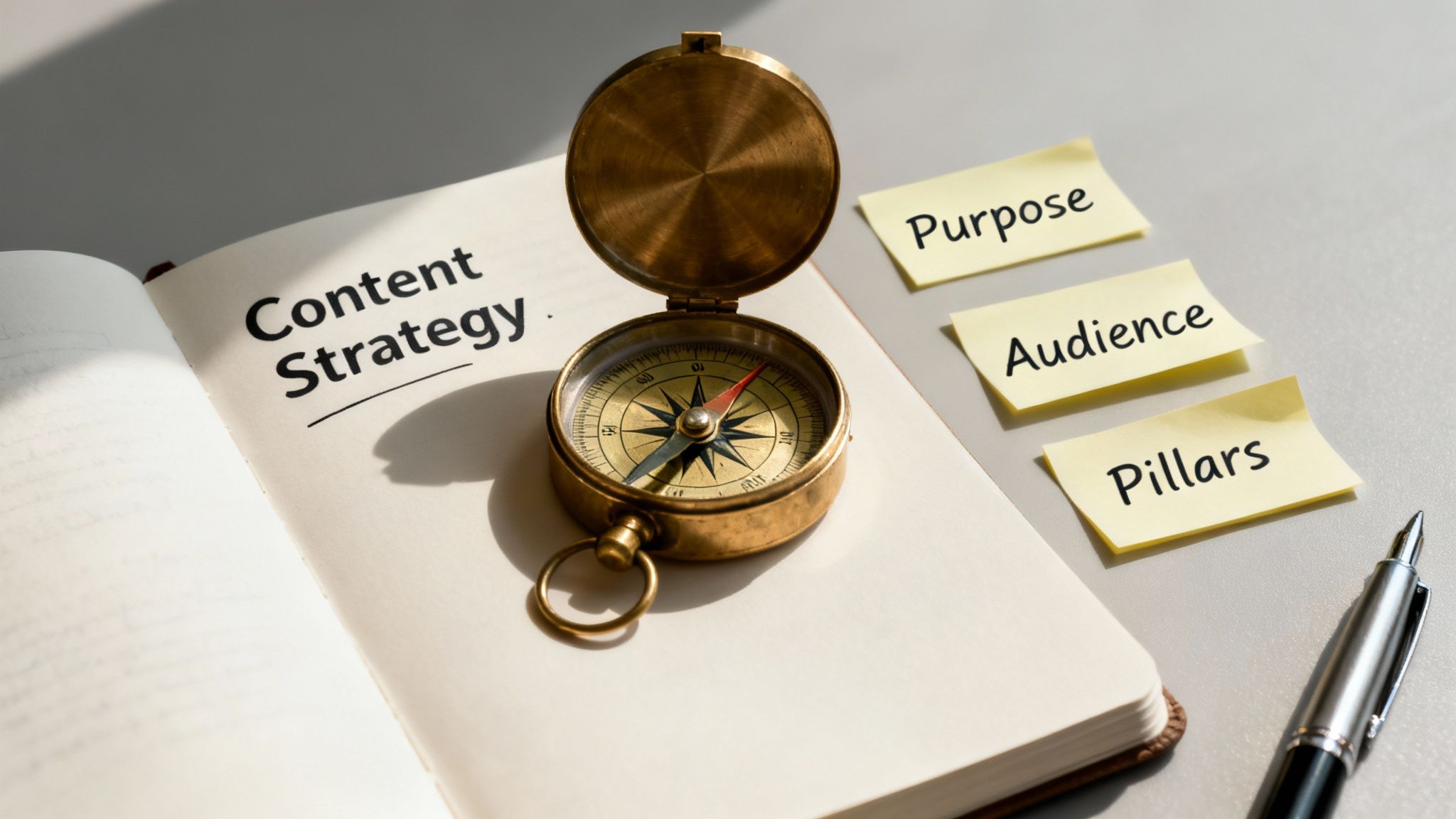
This isn’t some new, flashy concept. The idea of using valuable content to grow a business has been around forever. Think back to 1732 with Benjamin Franklin's Poor Richard’s Almanack. He sold 10,000 copies a year by offering genuinely useful advice that also happened to promote his printing business. Smart, right? The core principles haven't changed.
The goal of this guide is to help you build a system that works for you. It's about shifting your mindset from just being a content creator to becoming a content strategist with a clear vision. It doesn't matter if you're on LinkedIn or another platform; for example, knowing how to create YouTube videos with a clear strategy is the only way to win there, too.
To help you get there, this guide breaks down the essential components of a powerful content framework. Take a look at the table below for a quick overview of what we'll be building together.
Core Components of a LinkedIn Content Framework
| Framework Component | Primary Goal | Key Question to Answer |
|---|---|---|
| Clear Objectives | To align content with specific business outcomes. | What do I want my content to achieve for my business? |
| Audience Definition | To create content that resonates deeply. | Who am I talking to, and what do they really care about? |
| Content Pillars | To establish expertise and stay focused. | What are the 3-5 core topics I want to be known for? |
| Formats & Cadence | To create a sustainable publishing rhythm. | How will I deliver my message, and how often? |
| KPIs & Measurement | To track progress and make data-driven decisions. | How will I know if my content is actually working? |
Each of these pieces builds on the last, creating a comprehensive system that brings clarity and purpose to your content efforts.
A strong framework brings order to the chaos. It keeps your messaging consistent, ensures every post supports your goals, and helps you stay on track. It's the difference between being busy and being effective.
Ready to build your own? Let's dive into the first, and most important, step: defining what you actually want to achieve.
Get Clear on Your Mission and Your Audience
Look, before you even think about writing a single post, you have to nail down two things: why you're posting and who you're talking to. This isn't just fluffy marketing-speak; it's the absolute foundation of a content strategy that actually works. Without it, you’re basically just shouting into the LinkedIn void, hoping someone, somewhere, hears you.
Let's get past the vague, feel-good goals. "Building a brand" is not a strategy. We need to tie your content directly to a business outcome you can actually measure. What's the real point of all this effort?
Instead of being generic, get sharp with your objectives:
- Vague: I want to get more leads.
- Specific: My goal is to generate 10 qualified inbound messages a month from SaaS startup founders.
- Vague: I want to build authority.
- Specific: I need to increase my profile views from FinTech C-level execs by 25% this quarter.
See the difference? This kind of precision turns your content from a random creative task into a focused business driver. Every single post now has a job to do.
Go Deeper Than a Persona
Once you know your why, it's time to get obsessed with your who. And I don't mean surface-level personas like "Marketing Manager." That's not nearly enough. You need to understand their professional world inside and out to create content they can't ignore.
You have to uncover their real-world headaches and ambitions. What are the problems they're venting about in private Slack channels? What skills are they trying to learn on the sly to snag that next promotion?
Your audience isn't looking for more content; they're looking for answers. They want to feel seen. Your goal is to write a post that makes them stop scrolling and think, "Wow, it's like this person is in my head."
This is the secret sauce. It's what separates the content that gets a polite "like" from the content that gets bookmarked, shared, and discussed. It’s how you stop talking at them about your solutions and start talking with them about their problems.
A killer way to keep this organized is with a content matrix. It's an old-school tool, been around since the late 90s, but it works. It helps you map specific content ideas to actual user needs and your business goals. This ensures nothing you create feels random. You can read more about the history of these content strategy tools over at rubicon.cx.
With a rock-solid mission and a crystal-clear picture of your audience, you've just built the two core pillars of your entire strategy. You know where you're going and who you're taking with you. Everything else—from your topics to your post formats—will now fall into place naturally.
Alright, you’ve got your mission and you know who you’re talking to. Now it's time to get tangible and figure out what you’re actually going to talk about. This is where we build your core content pillars.
Think of these as the 3-5 foundational topics you want to own on LinkedIn. These are the subjects that, over time, become completely synonymous with your name and your brand.
Content pillars are the sweet spot where three things meet: what you genuinely know (your expertise), what your audience is dying to figure out (their needs), and what you're trying to achieve professionally (your goals). Get this right, and every post builds your authority. Get it wrong, and you're just making noise.

Brainstorming Your Pillars
Let’s get practical. The whole idea of a content strategy framework isn't some new-age marketing fluff. It actually dates back to the late 1990s when the first digital agencies realized they couldn't just dump information online and hope for the best. They needed a plan. We're just applying that same smart thinking to your LinkedIn presence.
So, grab a notebook and start brainstorming at the intersection of these three questions:
- What am I an expert in? Seriously, what are your skills? What unique experiences do you have? What do people already pull you aside to ask for advice on? List it all out.
- What does my audience really need? Think about the person you defined earlier. What are their biggest headaches, their nagging questions, their biggest career aspirations?
- What topics actually support my goals? Which subjects will naturally steer conversations toward your products, your services, or your next career move?
I once worked with a financial advisor who was targeting startup founders. After a quick brainstorming session, here’s where she landed:
- Wealth Management for Founders (This one’s a no-brainer, ties directly to her service.)
- Investment Psychology (This hits on a massive pain point for her audience—making decisions under pressure.)
- Exit & Succession Planning (This speaks to a founder's ultimate long-term goal.)
See how that works? Suddenly, she has guardrails for her creativity.
The shift is subtle but powerful. You stop asking, "What should I post today?" and start asking, "What can I say about Wealth Management for Founders today?" It completely eliminates the blank-page problem.
From Pillars to Post Ideas
Once your pillars are locked in, the real fun begins. Now you break down each pillar into dozens of smaller, specific ideas or themes. This is the secret sauce to never, ever running out of things to say. It's also a massive part of creating engaging social media content day after day.
Let's stick with our financial advisor and her "Investment Psychology" pillar. Look at how many different posts can spring from that one topic:
- A quick text post about the #1 mental trick to avoid panic-selling during a market dip.
- A carousel breaking down the concept of "loss aversion" with real-world founder examples.
- A poll asking, "Which cognitive bias trips you up the most when making financial decisions?"
- A short video telling the story of a client who tuned out the noise and made a brilliant, emotion-free investment.
By doing this for each pillar, you're not just creating a strategy—you're building an entire content library before you even write a single post. You go from a vague idea to a concrete, actionable plan that gives you the confidence to show up consistently and become the person everyone thinks of for your specific niche.
Choose Your Formats and Find Your Rhythm
Alright, you've got your content pillars locked in. Now comes the fun part: deciding how you'll actually deliver your message and when. A brilliant idea can fall completely flat if it’s wrapped in the wrong package. This is where we match your content format to your goals and find a posting rhythm you can actually stick with for the long haul.
Let's be real: not all content formats are created equal, and each has its own job to do on LinkedIn. Text-only posts are absolute gold for telling stories and sparking conversations in the comments. Carousels? They're perfect for breaking down complex ideas into bite-sized, visual steps. And things like short-form video let you connect on a much more personal level, while a quick poll is an easy win for boosting engagement and peeking into your audience's mind.
The secret here is to build a diverse mix. If all you do is post text, your feed will start to feel monotonous. Instead, let's map different formats to your content pillars to keep things fresh and interesting for your audience.
Map Your Content Formats
Before you create anything, ask yourself: what am I trying to achieve with this specific post? Am I teaching, entertaining, or sharing a personal win? Your goal should be the deciding factor for the format you choose.
Here’s how I think about it:
- To Teach a Concept: Go for a carousel or a detailed text post with clear bullet points. Think about breaking down a complicated industry trend into a simple, 5-slide visual guide.
- To Share a Personal Story: Nothing beats a text-only post or a simple selfie-style video. These formats feel raw and authentic, which is exactly what you need to build a genuine connection.
- To Get Quick Feedback: A poll is your best friend. Ask a simple, relevant question tied to one of your content pillars and see what your network has to say.
- To Showcase a Result: A short case study, either as a text post or a clean graphic, works wonders. Just highlight the problem, your solution, and the tangible outcome.
A simple visual planner, like this one in PostFlow, can be a lifesaver for mapping this all out and making sure you stick to a consistent schedule.
Seeing your content rhythm laid out on a calendar like this is a game-changer for staying consistent.
Find Your Sustainable Rhythm
Listen, consistency beats intensity every single time on LinkedIn. Posting five times in one week and then ghosting your audience for a month is a surefire way to kill your momentum. The real goal is to find a cadence—a posting frequency—that you can maintain without burning out.
For most professionals I work with, posting 3-4 times per week is the sweet spot.
This is where content repurposing becomes your superpower. You don’t need a brand-new, earth-shattering idea for every single post. One solid idea can easily fuel an entire week's worth of content.
Think of it this way: one in-depth blog post, case study, or even a podcast episode is your "pillar" piece of content. From that single asset, you can pull out dozens of "micro" pieces for LinkedIn. This isn't about being lazy; it's about working smarter and reinforcing your key message across multiple touchpoints.
For example, take a single client success story. You could easily turn that into:
- A text post sharing the single biggest takeaway from the project.
- A carousel detailing the step-by-step process you followed.
- A short video testimonial you recorded with the client.
- A poll asking your audience if they've ever faced a similar challenge.
This approach saves an unbelievable amount of time and is a cornerstone of an effective content strategy framework. And don't forget to think about when you post. While every audience is a little different, knowing the best time to post on LinkedIn can give your content that critical initial boost in visibility.
Bring Your Framework to Life with PostFlow
A solid content strategy framework is a fantastic start, but let's be honest—a plan is only as good as its execution. This is where a platform like PostFlow comes in. It's the engine that takes your well-crafted pillars and themes and turns them into actual LinkedIn content that gets people talking.
So, let's walk through how you can take your entire framework from a document to a dynamic, results-driven content machine using PostFlow's features.
From Fleeting Thought to Content Gold
Ideas have a funny way of showing up at the worst times—in the shower, on a walk, right before you fall asleep. Instead of fumbling for a notebook or making a mental note you'll forget, you can grab your phone and use PostFlow’s voice recording feature.
Just speak your mind. The app transcribes your thoughts into organized notes, instantly capturing that spark of genius before it vanishes. It’s a simple shift, but it turns content creation from a scheduled task into something that flows naturally from your daily expertise.
Unpacking Your Expertise with AI Interviews
Okay, you've got your core topics. Now what? The real magic happens when you go deep, and that’s precisely what the AI Interview feature is for. Think of Emilia, your AI content strategist, as a creative partner who knows exactly what questions to ask to pull the best insights out of you.
Let’s say you're a sales consultant and one of your content pillars is "Effective Prospecting." Emilia might prompt you with questions like:
- "What's the biggest mistake you see new sales reps make when prospecting?"
- "Can you share a story about a time a counterintuitive prospecting method worked surprisingly well?"
- "What's one piece of advice you'd give a founder who has to do their own sales prospecting?"
This isn’t about generating generic AI text. This conversational process helps you tap into your own unique experiences and stories, producing authentic, high-value content that no one else can replicate.
You are the expert. PostFlow is just the system designed to extract and structure that expertise. It pulls the content out of you, so you can share what you already know.
Building Your Content Rhythm
Now you have a library of transcribed ideas and interview answers. This is where things get efficient. PostFlow's idea generation tools can take a single voice note and help you spin it into multiple post concepts—a short text post, a detailed carousel outline, or even a script for a quick video. This is the heart of smart repurposing.
You're not just creating content; you're multiplying its impact.
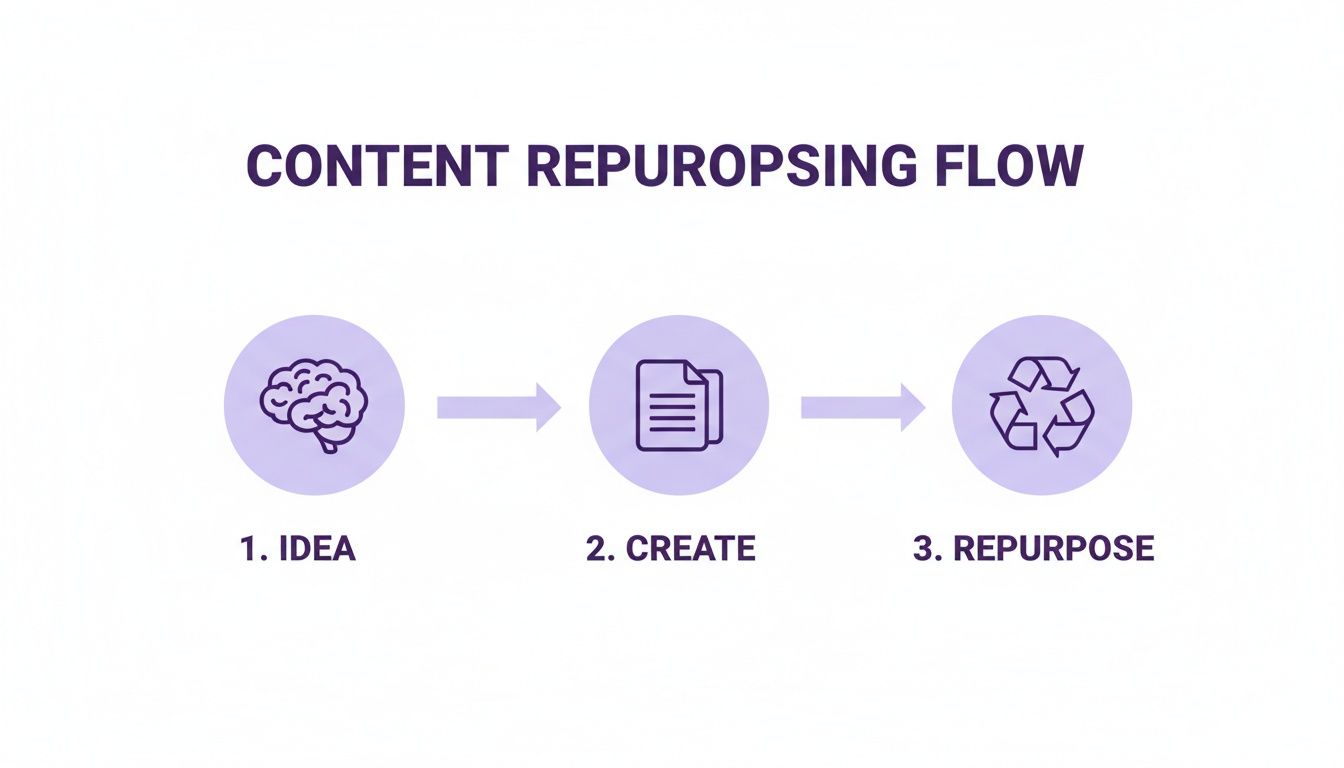
This is how you stop the content treadmill and start working smarter.
Once your posts are drafted, the high-speed scheduler makes it a breeze to batch and plan your content for the week or month ahead. It even provides smart time suggestions to help you post when your audience is most active.
Finally, the built-in analytics close the loop. You can see what’s working (and what’s not) by tracking impressions and engagement right inside the platform. This data is gold—it shows you which pillars are resonating and which formats are getting the most love, allowing you to refine your strategy based on hard numbers, not just guesswork.
Implementing Your Strategy with PostFlow
Here’s a quick breakdown of how PostFlow’s features align directly with the steps we’ve covered, turning your strategy into a seamless workflow.
| Strategy Step | PostFlow Feature | How It Helps |
|---|---|---|
| Idea Capture | Voice Recording | Instantly save thoughts and ideas on the go by simply speaking them into the app. |
| Content Generation | AI Interview | Uncover unique angles and personal stories by answering targeted, insightful questions. |
| Topic Expansion | Idea Generation | Turn a single concept into multiple post ideas and formats (text, carousel, video script). |
| Planning & Scheduling | High-Speed Scheduler | Batch and schedule your content for the week or month with smart time suggestions. |
| Measurement & Refinement | Built-in Analytics | Track post performance (impressions, engagement) to see what’s working and optimize. |
This integrated approach transforms your content framework from a static document into a living, evolving system that consistently improves and drives real results for your brand on LinkedIn.
Measure What Matters and Optimize Your Strategy
So, you’ve planned your content down to the last detail. How do you actually know if it's working? Here’s a hard truth: creating great content is only half the battle. The real magic happens when you understand its impact.
It’s time we moved past the vanity metrics. Sure, likes and impressions feel good, but they don’t pay the bills. A truly great strategy is measured by its progress toward the goals you set from day one. Your KPIs should be a direct reflection of that mission.
Aligning KPIs with Your Goals
The right metrics tell you a story about how your audience is really interacting with your brand. You need to pick the KPIs that actually connect to your specific objectives.
- Growing Brand Awareness? Keep a close eye on profile views and follower growth. A steady increase here means your content is successfully reaching new, relevant people.
- Building a Community? Then engagement rate is your north star—specifically comments and shares. This shows you’re sparking genuine conversations, not just shouting into the void.
- Focused on Lead Generation? Track the hard numbers like inbound DMs or website clicks coming from your profile. These are clear buying signals from potential clients.
This focused approach makes sure your measurement is just as strategic as your content creation.
A powerful feedback loop is the engine of any successful content strategy. You have to let real data inform your next moves. This is how you turn guesswork into a predictable system for continuous improvement.
The Monthly Content Review
Block out some time every single month to review what’s working and what isn’t. This doesn't have to be some soul-crushing, spreadsheet-heavy task. The goal is simple: spot the patterns in your best-performing content.
If you're just starting out, you can learn the basics of how to analyze your content performance and build from there.
During your review, just ask yourself a few simple questions:
- Which content pillar drove the most engagement?
- Did a specific format, like carousels or text-only posts, kill it this month?
- What topics sparked the best conversations in the comments?
The answers are your roadmap. If you notice posts under your "Investment Psychology" pillar get double the engagement, that's a massive clue. It’s a clear signal from your audience to create more of that.
This data-driven optimization is what keeps your strategy sharp. It ensures you evolve with your audience, delivering better results over time.
Alright, let's tackle a few of the questions that always come up when I'm helping people build out their LinkedIn strategy. These are the little roadblocks that can feel huge when you're just getting started, but trust me, they have simple answers.
"How Often Do I Really Need to Post on LinkedIn?"
This is probably the number one question I get. Everyone's chasing an algorithm, but the real answer is simpler: consistency beats frequency.
Sure, you'll see some creators posting every single day, but for most of us, that's a one-way ticket to burnout. A solid, sustainable goal is 3-4 high-quality posts a week. That’s enough to stay on your audience's radar without sacrificing the quality that actually builds your reputation.
The whole point of a content strategy framework isn't to force you to post more; it's to make posting consistently feel easy. When you have a plan, you're not just filling a slot on a calendar—you're strategically sharing value.
"Can I Just Copy-Paste My Posts to Other Socials?"
You can, but you really shouldn't. While the core idea can travel, the delivery needs to change for each platform.
Think about it: LinkedIn is the professional conference room. It’s where you share deeper insights, unpack career lessons, and talk shop. That same idea, when it moves to Instagram, might become a quick visual carousel. On X (formerly Twitter), it could be a punchy, conversational thread.
Blasting the exact same post everywhere feels impersonal, almost robotic. I prefer to think of it as "cross-promoting" an idea. You’re not just syndicating content; you're tailoring the story to fit the room you're in.
"What Happens When I Run Out of Things to Say?"
This fear is universal, but it's completely avoidable if you've done the work upfront with your content pillars. Seriously, this is your safety net.
Feeling stuck? Go back to your 3-5 core topics. Pick one and ask a few simple questions:
- What's a common mistake people make here?
- What’s a recent win I had related to this?
- What's a contrarian take I have on this pillar?
Your pillars are the well you can always draw from. By exploring each one from different angles and through different formats, you've got a practically infinite source of relevant, valuable content. A solid framework means you'll never truly stare at a blank page again.
Ready to stop guessing and start building a real content system on LinkedIn? PostFlow is designed to help you capture those fleeting ideas, turn them into polished posts with an AI strategist, and get everything scheduled in minutes. It's time to build your authority, consistently.