
Imagine you’re at a networking event. Content marketing is the person in the room who’s genuinely helping everyone, offering brilliant advice without asking for anything in return. It’s not the person shouting the loudest about their services.
The whole point is to attract and retain your ideal clients by being consistently, ridiculously helpful. You're building a relationship, not just pushing for a transaction.
What Is Content Marketing And Why Does It Matter
Forget interrupting people with ads. Content marketing is about pulling them in with information they’re actively looking for. It's the difference between a cold call that makes you cringe and a genuinely useful conversation that solves a problem.
You’re offering answers, guidance, and expertise before you ever ask for the sale. This simple shift is how you become a trusted authority, and it's an absolute game-changer for founders, freelancers, and consultants.
At its heart, content marketing is a strategic exchange. You share your knowledge through articles, videos, or posts. In return, you earn something far more valuable than a quick buck: your audience’s attention, trust, and loyalty.

The Power of Pulling, Not Pushing
Traditional advertising shoves a message in front of an audience, whether they want it or not. Content marketing, on the other hand, pulls people toward you right when they need you most. This is a key reason why a staggering 97% of marketers now see content as a core part of their entire strategy.
To really get it, you have to see content as the engine of a bigger machine called inbound marketing. While outbound marketing interrupts, inbound marketing attracts. Your content—the blog posts, the guides, the videos—is the magnet.
The core idea is simple: if your business provides consistent, valuable information to buyers, they will ultimately reward you with their business and loyalty.
This isn’t just a new tactic; it's a completely different way of thinking. You stop being a vendor and start becoming a partner in your client’s success.
To make this crystal clear, let's break down the fundamental differences between the old way and the new way.
Content Marketing Vs Traditional Advertising
| Aspect | Content Marketing | Traditional Advertising |
|---|---|---|
| Approach | Pulls customers in with valuable, helpful information. | Pushes a sales message out to a broad audience. |
| Goal | To educate, inform, and build long-term trust. | To persuade and generate immediate sales. |
| Format | Blog posts, videos, podcasts, ebooks, social media. | TV/radio commercials, print ads, billboards, pop-ups. |
| Communication | Two-way conversation; builds a community. | One-way broadcast; monologue from the brand. |
| Asset Value | Content is a long-term asset that appreciates over time. | Ads are a short-term expense with a limited lifespan. |
| Audience Mindset | Actively seeking solutions and information. | Passive; often interrupted and potentially annoyed. |
The takeaway is simple: one builds a lasting relationship, while the other chases a fleeting transaction.
Turning Expertise into a Client Magnet
For anyone whose business is their expertise—I'm looking at you, consultants, freelancers, and agency owners—content marketing is non-negotiable. It’s how you take the brilliant stuff in your head and make it tangible, proving your worth long before a contract is signed.
Here’s why it works so well, especially for those just starting out:
- It Builds Unshakeable Trust: When you consistently solve small problems for free, people naturally trust you to handle their bigger, paid ones.
- It Establishes Authority: Every helpful article is like a mini-case study for your expertise. You become the go-to person in your niche.
- It Generates Qualified Leads: Your content works for you 24/7, attracting people who are already looking for exactly what you offer.
The numbers don't lie. The global content marketing industry was valued at $413.2 billion in 2022 and is projected to hit $2 trillion by 2032. Why? Because it’s insanely efficient. It generates three times more leads than traditional marketing while costing 62% less.
For a founder on a tight budget, that’s not just a nice-to-have. It’s everything. This isn't a fleeting trend; it’s the new foundation for building a business that lasts.
Alright, let's get down to it. Before you even think about writing a blog post or a LinkedIn update, we need to address two massive questions:
- Who are you actually talking to?
- What do you sound like when you talk to them?
Get these wrong, and your content will just be noise. It’s like a stand-up comedian telling the perfect joke to an empty theater. The delivery might be flawless, but if no one’s there to hear it, did it even happen?
Great content never feels like a marketing broadcast. It feels like a real conversation with someone who genuinely gets it. It connects because it’s aimed at a specific person dealing with a specific problem. That’s why we don't start with keywords or algorithms. We start with empathy.
Getting Inside Your Audience's Head
Forget generic stuff like "Marketing Managers, aged 30-45." That tells you nothing. We need to dig into the real, human struggles they face every day. You want to understand what keeps them up at night.
To create content that people actually save and share, you need to know their internal monologue. What are they secretly typing into Google when their boss isn't looking?
Here's where to start digging:
- What are their biggest frustrations at work? Think about the annoying tasks, the recurring roadblocks, and the things that make them sigh at their desk.
- What are they trying to achieve? Are they gunning for a promotion? Trying to get their startup off the ground? Desperate to look smart in the next team meeting?
- What do they secretly search for? This is gold. It reveals their real knowledge gaps and the solutions they’re already looking for.
- What content would make them look like a hero? Is it a checklist they can use immediately? A guide that solves a nagging problem? An expert take that makes them sound brilliant?
When you answer these questions, your whole mindset shifts. You stop creating content for a demographic and start creating a solution for a person. It's a game-changer.
Your content becomes valuable the moment you understand your reader's problem better than they do. When you can articulate their pain points perfectly, they'll instinctively trust you have the answer.
Once you know who you’re talking to, it’s time to figure out how you’ll talk to them.
Finding Your Authentic Brand Voice
Your brand voice is simply the personality that comes through in your writing. It’s not just what you say; it’s how you say it. A consistent voice builds trust and makes you instantly recognizable in a sea of generic corporate-speak.
So many people default to a stiff, formal tone because they think it sounds "professional." The result? They sound like everyone else. The trick is to find a voice that’s authentic to you but also resonates with the audience you just defined.
A simple way to think about this is to pick an archetype. What role do you naturally play for your clients?
- The Expert: You’re the data-driven authority. Your voice is confident, direct, and always backed by proof. You don't guess; you know.
- The Mentor: You’re the wise, encouraging guide. Your voice is supportive and patient. You’re less about showing off how much you know and more about helping others grow.
- The Innovator: You're the one challenging the status quo. Your voice is provocative, exciting, and full of bold ideas that make people rethink everything.
Picking an archetype doesn't lock you in a box; it just gives you a north star. This voice should echo through every post, email, and comment you write. That's how you stop being just another "content creator" and start building a brand that people actually want to follow.
How to Build Your First Content Strategy
Jumping into content marketing without a strategy is like starting a road trip without a map. You might end up somewhere interesting, but you definitely won't reach your destination on purpose.
A content strategy doesn’t need to be some 50-page document locked away in a Google Drive folder. It just needs to be a simple, clear guide that keeps you from chasing shiny objects. To get started, I use a dead-simple framework called Pillars, Posts, and Platforms. It breaks the whole intimidating process into three manageable chunks, so you can build momentum without getting buried in spreadsheets.
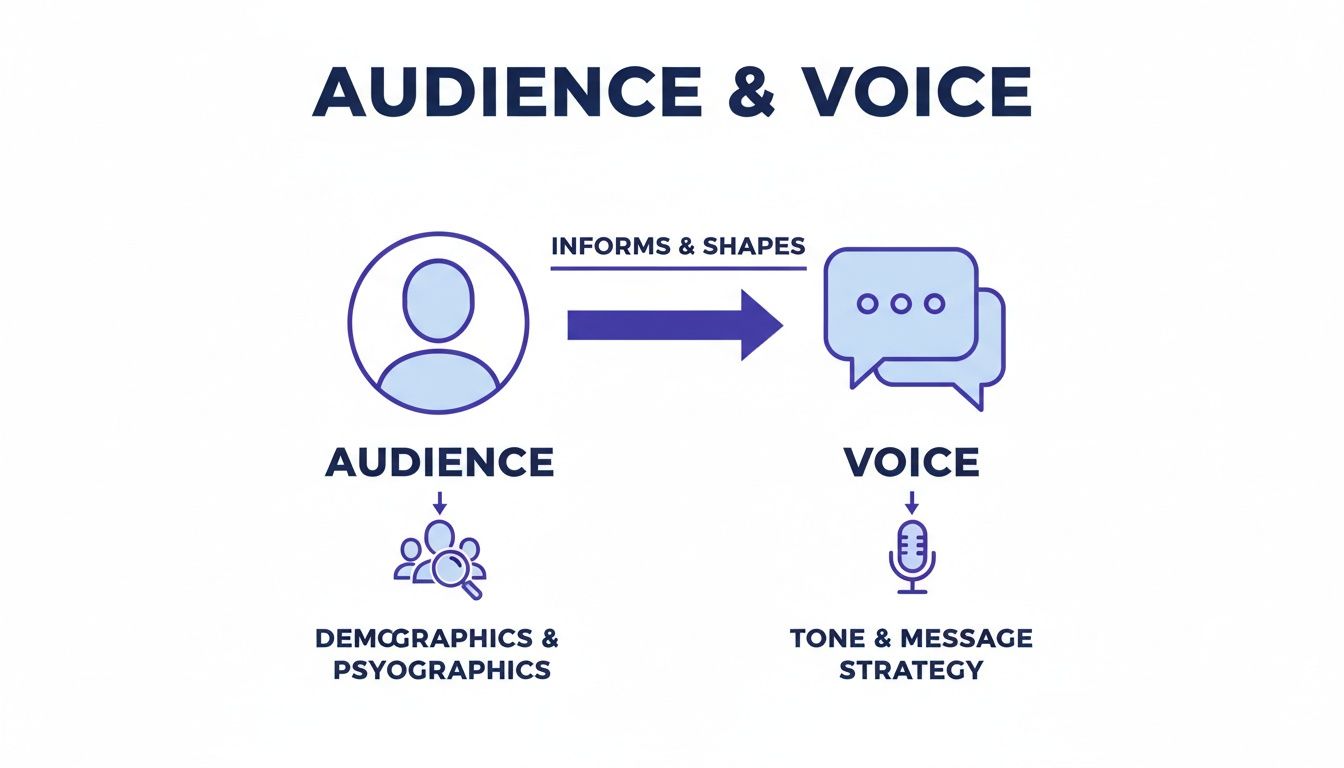
This whole process starts with knowing who you're talking to. Once you understand your audience, you can figure out how you should sound to them, which is the absolute foundation of a solid plan.
Defining Your Content Pillars
Think of your content pillars as the 3-5 core topics you want to own. These aren’t just random ideas you pluck from the air; they're the big-picture subjects that live at the intersection of what you know and what your audience desperately needs. They're the main categories on your blog, the core themes of your personal brand.
For a freelance web developer, these pillars could look something like this:
- Website Performance Optimization: All about site speed, user experience, and those lovely core web vitals.
- Small Business SEO: Practical, no-fluff tips for local shops trying to rank on Google.
- Headless CMS Technology: Breaking down the benefits of modern content management systems for non-techies.
These pillars are your guardrails. Before you create a single piece of content, just ask: "Does this fit under one of my pillars?" If the answer is no, it's a distraction. Period. This kind of focus is how you build a brand that people actually remember.
Turning Pillars Into Post Ideas
Once your pillars are locked in, coming up with ideas gets ridiculously easy. Each pillar is a deep well you can draw from again and again. The game is to break down your big, broad expertise into bite-sized, valuable pieces of content.
A content strategy is simply a plan to turn what you know into what your audience needs to hear. The "Pillars, Posts, and Platforms" model provides a structure for that transformation.
Let’s stick with the “Small Business SEO” pillar. From that one theme, you could spin out dozens of actual posts:
- A "how-to" guide on claiming and optimizing a Google Business Profile.
- A simple checklist for on-page SEO basics.
- A 60-second video debunking a common SEO myth.
- A LinkedIn carousel post explaining the difference between local and organic search.
This system ensures you never have that "what do I post today?" panic again. If you need a little spark to get started, checking out effective content marketing strategies from other successful companies is a great way to see what works.
Choosing Your Primary Platform
The last piece of the puzzle is deciding where to post. The biggest mistake I see beginners make is trying to be everywhere at once. Don't do it. Instead, pick one primary platform where your ideal customer actually hangs out and commit to mastering it.
For most founders, consultants, and B2B freelancers, that platform is LinkedIn. It's the world's biggest professional network, built for exactly these kinds of conversations. If you want to go deeper on this, we've got a whole guide on building a powerful content strategy framework.
Your platform choice ties the whole strategy together. For a sales consultant, a finished plan might be as simple as:
- Pillar: Sales Pipeline Management
- Posts: Weekly tips on lead qualification, closing techniques, and CRM best practices.
- Platform: LinkedIn
That's it. This simple structure gives you all the direction you need to start creating content with purpose. And businesses are catching on—in fact, 46% of B2B organizations are planning to increase their content budgets because they see how a clear plan drives real growth.
Choosing The Right Content Formats And Channels
Once you've got a simple strategy sketched out, the next question is always the same: what should I actually create, and where the heck do I post it?
This is where most beginners go wrong. They think they need to be everywhere, all at once. They try to launch a blog, a podcast, and five social media accounts in the same week. I’ve seen it a hundred times, and it’s a surefire recipe for burnout.
The real secret to content marketing for beginners isn’t hustle; it's focus. Pick one channel and master one or two content formats. Get good at it, build some momentum, and then you can think about expanding.
For founders, consultants, and anyone in the B2B space, there's one platform that's not just an option—it's a massive advantage.
Why LinkedIn Is Your Unfair Advantage
Let’s be honest. If you’re trying to build professional authority and land high-value clients, LinkedIn is the main event. It’s home to over a billion members, making it the biggest professional network on the planet. It was literally designed for business conversations.
Unlike other platforms where people scroll for cat videos and vacation photos, users on LinkedIn are already in a business mindset. They’re looking for industry insights, career advice, and real solutions to their work problems. That makes them incredibly receptive to valuable content.
When you show up there consistently, you can:
- Target with Precision: You can connect directly with the exact decision-makers you want to reach—by industry, company size, or job title.
- Build Real Authority: Sharing what you know turns you from just another service provider into a credible, go-to expert.
- Generate Inbound Leads: Your content acts like a magnet, pulling in potential clients who are already looking for what you offer.
The goal isn't to go viral. It’s to start real conversations with the right people. By focusing your energy on LinkedIn, you're putting your expertise right in front of an audience that’s ready to listen.
Mastering Beginner-Friendly Content Formats
So, what should you actually post on LinkedIn? Good news: you don't need a fancy video studio or a design degree. The most effective formats are often the simplest ones, built on clarity and value, not production quality.
Your first few pieces of content will probably feel a little clunky. That's okay. The point is to just start sharing, see what your audience responds to, and build the habit. Progress always beats perfection.
Let’s walk through the key formats you can start with. Just master one or two of these, and you'll be miles ahead.
1. Text-Only Posts This is the easiest place to start, and honestly, it’s often the most powerful. A well-written text post can stop the scroll cold and get people talking.
- Goal: Share a strong opinion, a quick tip, or a personal story that teaches a lesson.
- Best For: Storytelling, asking challenging questions, and sharing bite-sized, actionable advice.
- Pro Tip: Use short sentences and tons of white space. Breaking your text into one- or two-sentence paragraphs makes it incredibly easy to read on a phone.
2. Image or Carousel Posts Visuals are attention magnets. A simple graphic or a multi-slide carousel can break down complex ideas into something anyone can understand in seconds.
- Goal: Educate your audience with a step-by-step process or present data in a clean, visual way.
- Best For: How-to guides, checklists, debunking common myths, or pulling out the key points from a longer blog post.
- Pro Tip: Stick to one single idea per slide. Use a big, bold headline and keep the text minimal. Clarity is key.
3. Simple Videos Video sounds intimidating, but it doesn't have to be. A simple 60-90 second video shot on your phone can create a surprisingly strong personal connection with your audience.
- Goal: To put a face to the name and share your insights in a more personal, human way.
- Best For: Answering a common question you get from clients, sharing a quick industry update, or explaining one concept clearly.
- Pro Tip: Forget about professional editing. Just make sure you have decent lighting, clear audio, and always add captions—most people watch videos with the sound off.
Starting with these formats makes content creation feel manageable, not overwhelming.
Beginner-Friendly Content Formats For LinkedIn
To make it even clearer, here’s a quick-glance table summarizing where to start. Pick one from this list and commit to it for your first month.
| Format | Primary Goal | Best For | Pro Tip |
|---|---|---|---|
| Text-Only Post | Spark Conversation | Sharing opinions, telling stories, asking questions | Use short paragraphs and lots of white space for mobile readers. |
| Carousel Post | Educate & Simplify | How-to guides, checklists, summarizing key data | One core idea per slide. Keep it clean and visually simple. |
| Simple Video | Build Connection | Answering FAQs, sharing quick takes, explaining concepts | Shoot on your phone, ensure good light/audio, and always add captions. |
By focusing on these, you create a sustainable system. Down the road, you can get more advanced. A really smart technique is learning how to get more mileage out of a single idea. For a deeper look, check out our guide on powerful content repurposing strategies.
Your First 90-Day Content Marketing Action Plan
Alright, theory is great, but execution is what lands clients. Let's map out a practical, step-by-step plan that turns what you've learned into consistent action. This roadmap is designed to keep you from feeling overwhelmed and prove how small, daily efforts build unstoppable momentum.
Think of the first month as just building the core habit. We're not aiming for perfection or viral hits; we're just focused on showing up.

Month 1: The Foundation (Days 1-30)
Your one and only goal this month is consistency. It’s all about creating a repeatable system you can stick with even on the busiest days. This is the bedrock of any successful content strategy, especially when you're just starting.
Week 1: Strategy and Setup Your first week is all about prep work, not posting. Get these foundational pieces locked in so you can hit the ground running without scrambling for ideas later.
- Define Your 3 Content Pillars: Solidify the core topics you'll talk about. Write them down and keep them visible.
- Create Your First 4 Posts: Don't publish them yet! Batch-create your first couple of weeks' worth of content. This single move kills the pressure of daily creation.
- Optimize Your LinkedIn Profile: Make sure your headline and "About" section scream exactly who you help and how you do it. Your profile is the destination all your content points to.
Weeks 2-4: Build the Habit Now, we execute. Here’s your simple, repeatable weekly schedule.
- Post 2-3 Times Per Week: Use the content you already created. If you can, schedule it in advance to free up mental space.
- Engage for 15 Minutes Daily: Spend a little time in the trenches. Leave thoughtful comments on posts from potential clients or industry peers. Don't just type "great post"—add to the conversation.
The most powerful growth hack in content marketing isn't a secret algorithm trick—it's showing up consistently when everyone else gives up after two weeks.
By the end of this month, you'll have a solid routine dialed in. You'll have a small body of work on your profile and a real sense of the time commitment.
Month 2: The Analysis (Days 31-60)
With a month of data in your pocket, it's time to get a little smarter. This month is about figuring out what’s working and doubling down on it. You’ll keep your posting and engagement schedule from Month 1, but with a couple of key additions.
1. Conduct a Simple Performance Review At the start of the month, look back at everything you posted. Don't get lost in complicated analytics. Just ask yourself two simple questions:
- Which posts got the most engagement (comments and likes)?
- Which posts sparked the most conversation or DMs?
These are your winners. They show you what your audience actually finds valuable, not what you think they find valuable.
2. Repurpose Your Best Content Take one of your top-performing posts from Month 1 and give it a new life. This is a pro move for getting more mileage out of ideas you already know work.
- Example: If a simple text post about a common client mistake did really well, turn its key points into a quick 3-slide carousel. You've already validated the idea; now you're just presenting it in a new, engaging format.
This small step teaches you the crucial skill of repurposing, which will save you a ton of time and effort down the line.
Month 3: The Expansion (Days 61-90)
Time to stretch your creative muscles. You've built a consistent habit and you've learned from your data. The goal for this final month is to introduce one new element to see how your audience responds.
You’ll keep your core schedule, but you’ll add one important experiment.
- Experiment with One New Format: Pick a format you haven't tried. If you've only written text posts, try recording a simple 60-second video on your phone answering a common client question.
- Continue Analyzing Performance: Keep tracking which topics and formats are hitting the mark. Your understanding of your audience should be getting sharper every week.
- Plan Your Next 90 Days: Based on everything you've learned, what will your next set of content pillars be? How will you tweak your strategy?
After 90 days, you're not a beginner anymore. You're a content creator with a proven system, real-world data, and the momentum to turn your expertise into a reliable source of business growth.
Measuring The Metrics That Actually Matter
Hitting 'publish' on a piece of content without ever checking the numbers is like yelling into the void. You might be saying brilliant things, but if nobody hears you—or worse, nobody reacts—you’re just wasting your breath.
Success in content marketing isn't about chasing giant, vanity numbers. It's about tracking the right numbers, the ones that tell you if your strategy is actually connecting with people.
I know, I know. The word "analytics" can feel overwhelming, especially when you're just starting out. It’s easy to get lost in a sea of graphs and data points. The good news? You only need to focus on a few key areas to get a crystal-clear picture of what’s working.
The Three Pillars of Content Measurement
To keep things dead simple, let's break your analytics down into three core categories. Think of these as the vital signs for your content's health. By keeping an eye on these, you can spot what’s wrong and make smarter calls on what to create next.
Reach: This is the most basic question: Are people even seeing my content? On a platform like LinkedIn, this is your Impressions or Views. It’s a decent starting point, but on its own, it doesn’t tell you much.
Engagement: Now we’re getting somewhere. Engagement answers the real question: Are people interacting with my content? This is all about Likes, Comments, and Shares. High engagement is a massive signal that your message is hitting a nerve and sparking a real reaction.
Conversion: This is the bottom line. It answers: Are people taking the next step? A conversion could be something small, like clicking a link in your post, or something bigger, like visiting your profile, sending a connection request, or even sliding into your DMs.
The magic is in seeing how these three pillars work together. Sky-high reach but crickets on the engagement front? That could mean your headline was great, but the content itself didn't deliver enough to earn a reaction.
The point of measuring isn't just to report what happened. It’s to understand why it happened so you can do more of what works and ditch what doesn't. Data is a direct line into your audience’s brain.
Once you start collecting this feedback, you can stop posting and praying, and start refining your approach like a pro.
Turning Data Into Actionable Insights
Looking at numbers is one thing; knowing what to do with them is a whole different ballgame. The real power comes from spotting patterns and using them to sharpen your content marketing for beginners strategy. Don't let the technical side scare you off—it’s mostly just common sense.
Here are a few practical examples of how you can turn raw data into smarter decisions:
You post something that gets a flood of comments: Ding ding ding! You've just hit on a hot-button issue for your audience. Your next move should be to create more content around that specific theme. Maybe a deeper dive blog post or a quick video?
You notice your carousels get way more shares than simple text posts: Your audience clearly loves visual, step-by-step guides. Lean into that format. Use it to break down other complex ideas from your main content pillars.
You see a big spike in profile views after a specific post: Whatever you did in that post made people curious about you and what you offer. Go back and dissect it. What was your call to action? How did you frame your expertise? Bottle up that formula and use it again.
This simple feedback loop—post, measure, learn, adjust—is how you stop guessing and start building a content engine fueled by real-world proof. For a more detailed walkthrough, you can learn more about how to analyze content performance in our in-depth guide.
This is the process that turns your content from a hopeful shot in the dark into a reliable tool for growing your business.
Still Have Questions About Content Marketing?
Even with the best plan in hand, you're going to hit a few roadblocks. It happens to everyone. Here are some quick, no-fluff answers to the questions that come up most often when you're just starting out.
How Often Should I Be Posting Content?
Let's clear this up right now: consistency is way more important than frequency. For most people starting out, posting 2-3 high-quality pieces of content a week is the sweet spot. It’s enough to build momentum and stay on your audience's radar without burning yourself out.
A huge mistake I see beginners make is trying to post every single day from the get-go. That's a recipe for disaster. Focus on a rhythm you can actually maintain for the long haul. Trust me, a few thoughtful posts will always beat a dozen rushed ones.
What Should I Do If I Run Out Of Content Ideas?
This is the big one, isn't it? The fear of the blank page. But it’s a problem that’s easily solved with a simple system. Remember those three content pillars we defined earlier? They're your new best friends. Whenever you feel stuck, just go back to them and ask, "What's one specific problem I can solve for my audience within this theme?"
Every question a client asks you, every challenge discussed in your industry, and every unique opinion you hold is a potential piece of content waiting to be created.
The trick is to always be listening. Keep a running note on your phone to jot down ideas as they pop into your head. Before you know it, you'll have a backlog of topics you know your audience actually wants to hear about.
How Long Until I See Real Results?
I'll be straight with you: content marketing is a marathon, not a sprint. This isn't about getting a quick win; it's about building genuine trust and authority over time. While you can definitely see early positive signs—like more engagement and follower growth—within the first 30-60 days, the real business results take a bit longer.
Typically, you can expect a steady stream of inbound leads and opportunities to start trickling in after about 3-6 months of consistent, focused effort. In the early days, pay close attention to leading indicators like comments, shares, and profile views. They're the proof that you're on the right track.
Ready to stop guessing and start posting with confidence? PostFlow uses AI to turn your expertise into consistent, high-quality LinkedIn content. Emilia, your AI strategist, helps you capture ideas, generate posts, and schedule everything in minutes.
Transform your knowledge into business growth. Get started with PostFlow today!