Crowdfire Review

Table of Contents
- What Was Crowdfire and Why Does It Matter Today?
- Core Value Proposition: Simple Social Media Growth for Creators and Small Teams
- Key Features and Capabilities Crowdfire Used to Offer
- Crowdfire Pricing: Historical Plans and Tiers (Now Discontinued)
- Customer Feedback and Reviews on Crowdfire
- Our Take: Crowdfire’s Legacy Strengths and Weaknesses
- Final Verdict: Crowdfire’s Place in Social Media Tool History
What Was Crowdfire and Why Does It Matter Today?
Crowdfire was a social media management platform designed to help creators, brands, and businesses grow their online presence across multiple networks. It started life as a follower‑management tool for Twitter and evolved into a full content scheduling and curation suite supporting platforms like Twitter, Instagram, Facebook, LinkedIn, Pinterest, and more. Over time, it added features for post scheduling, content discovery, analytics, and basic social inbox capabilities, making it a popular choice for budget‑conscious users.
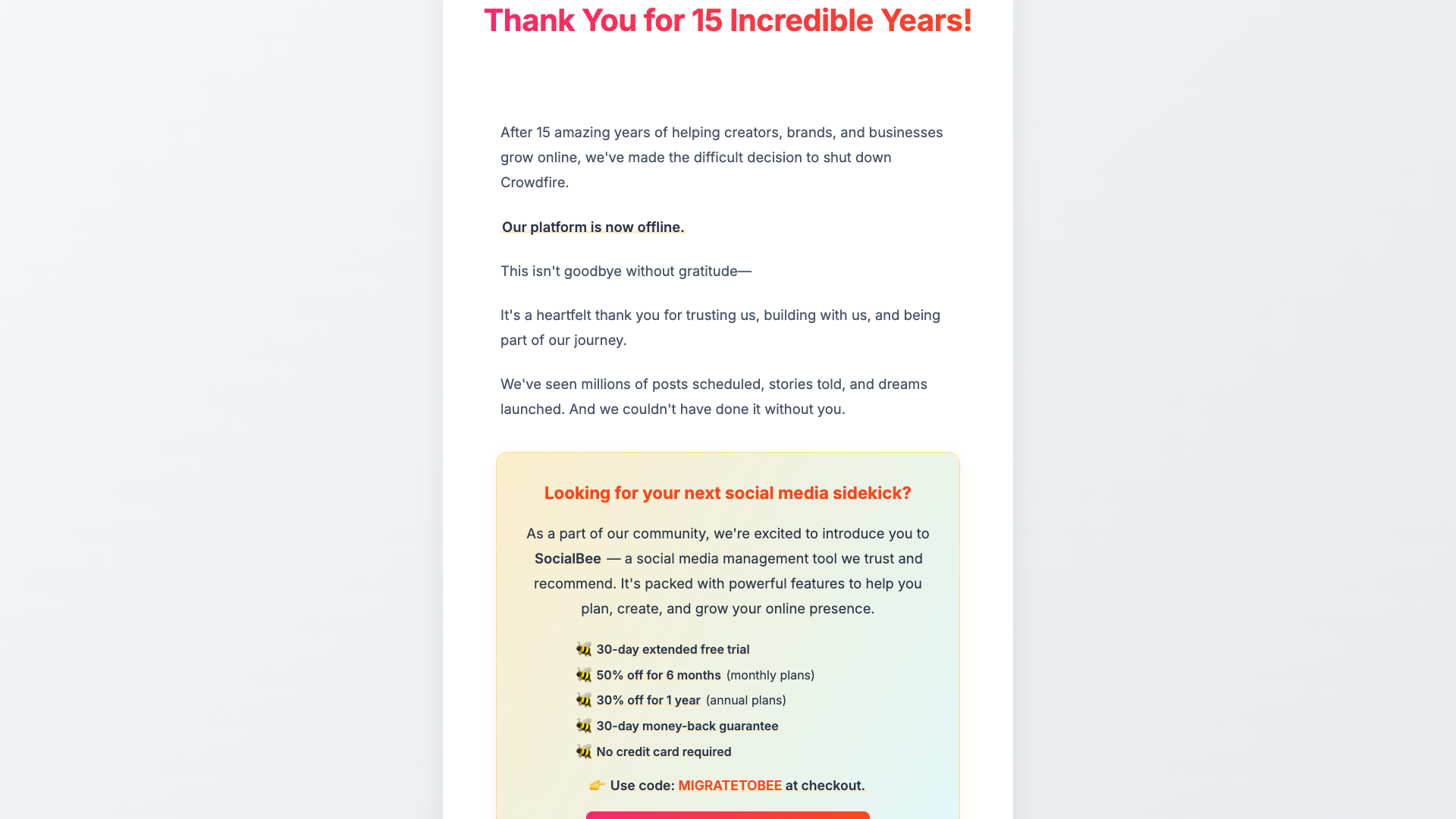
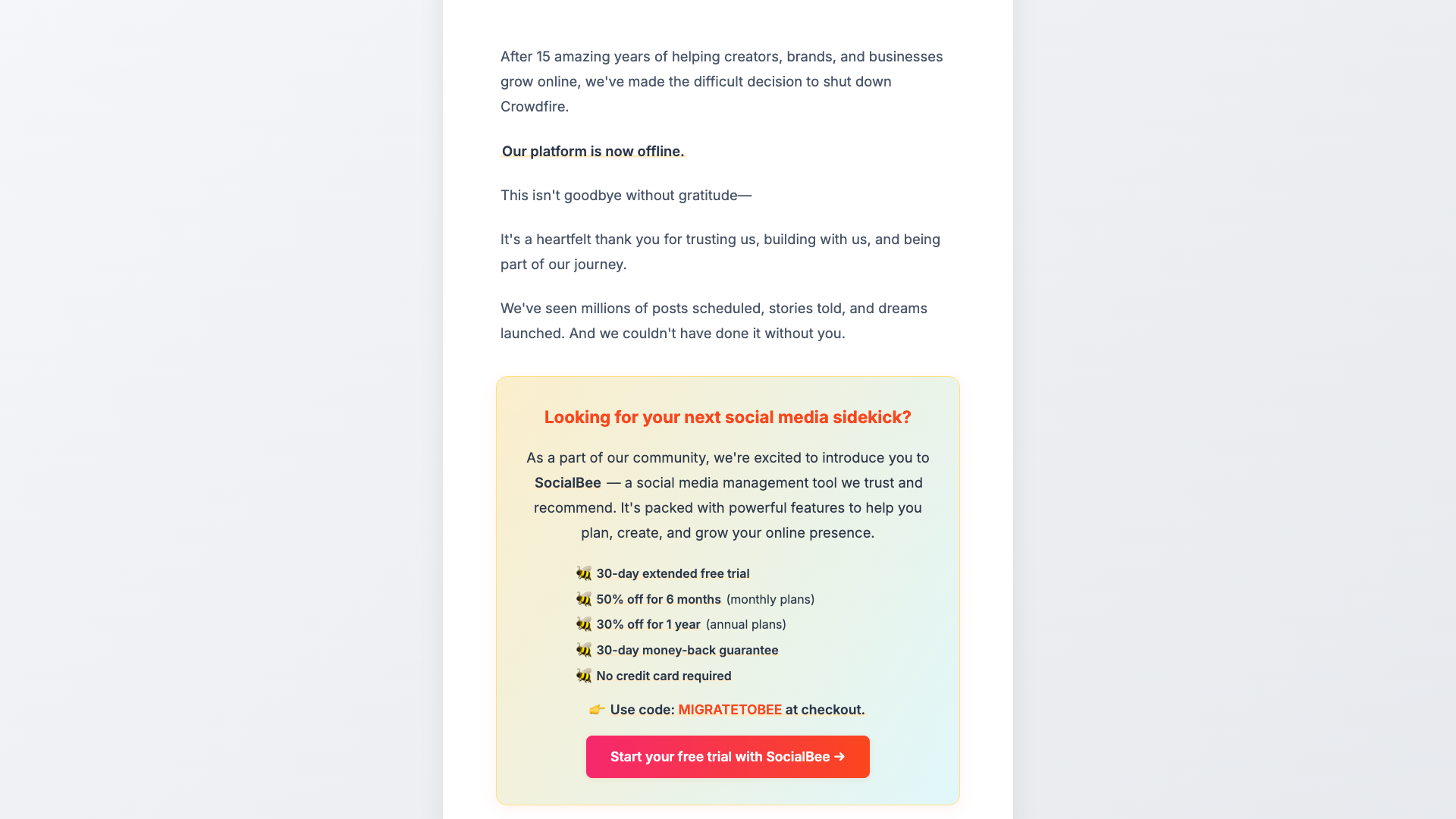
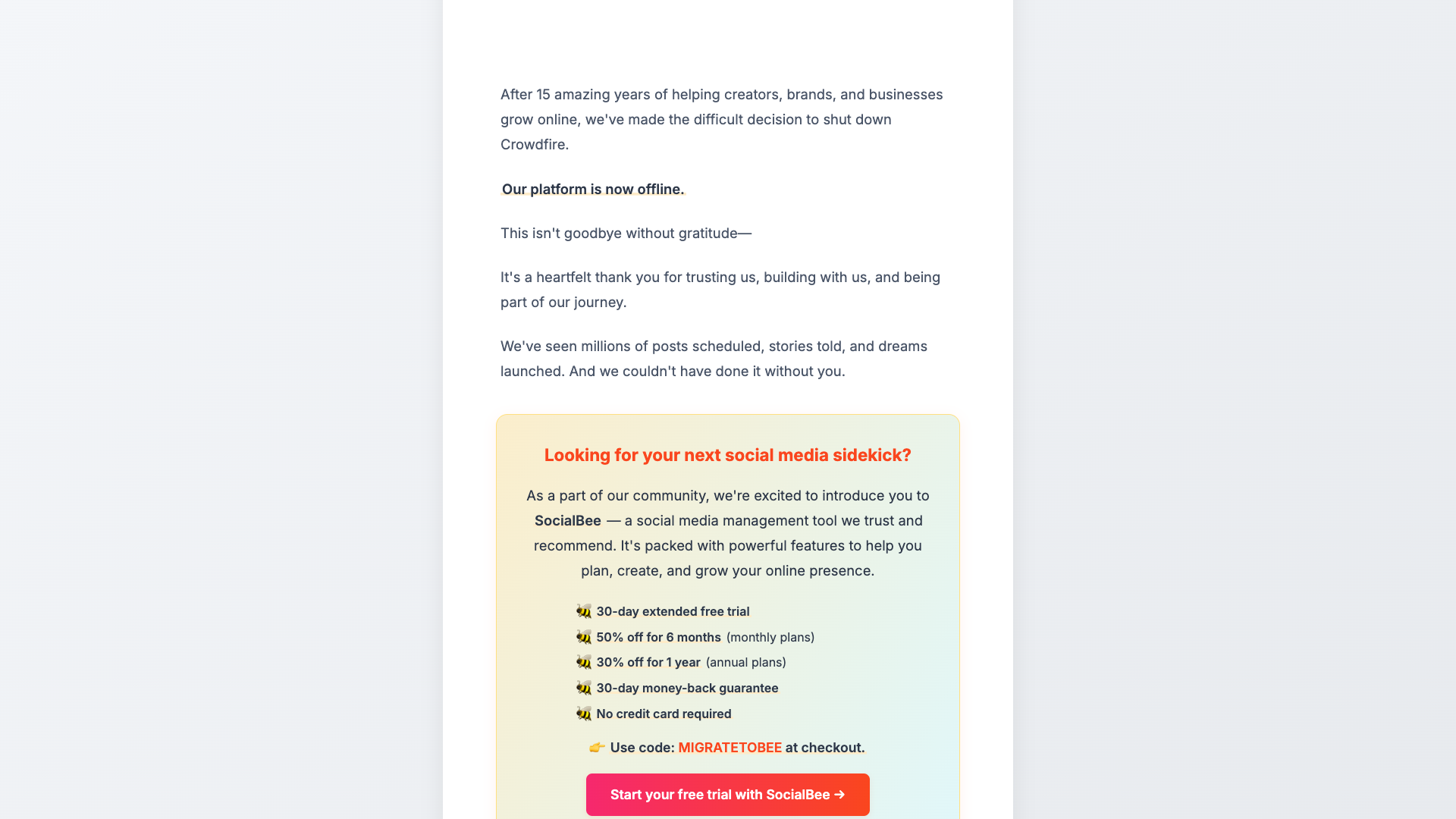
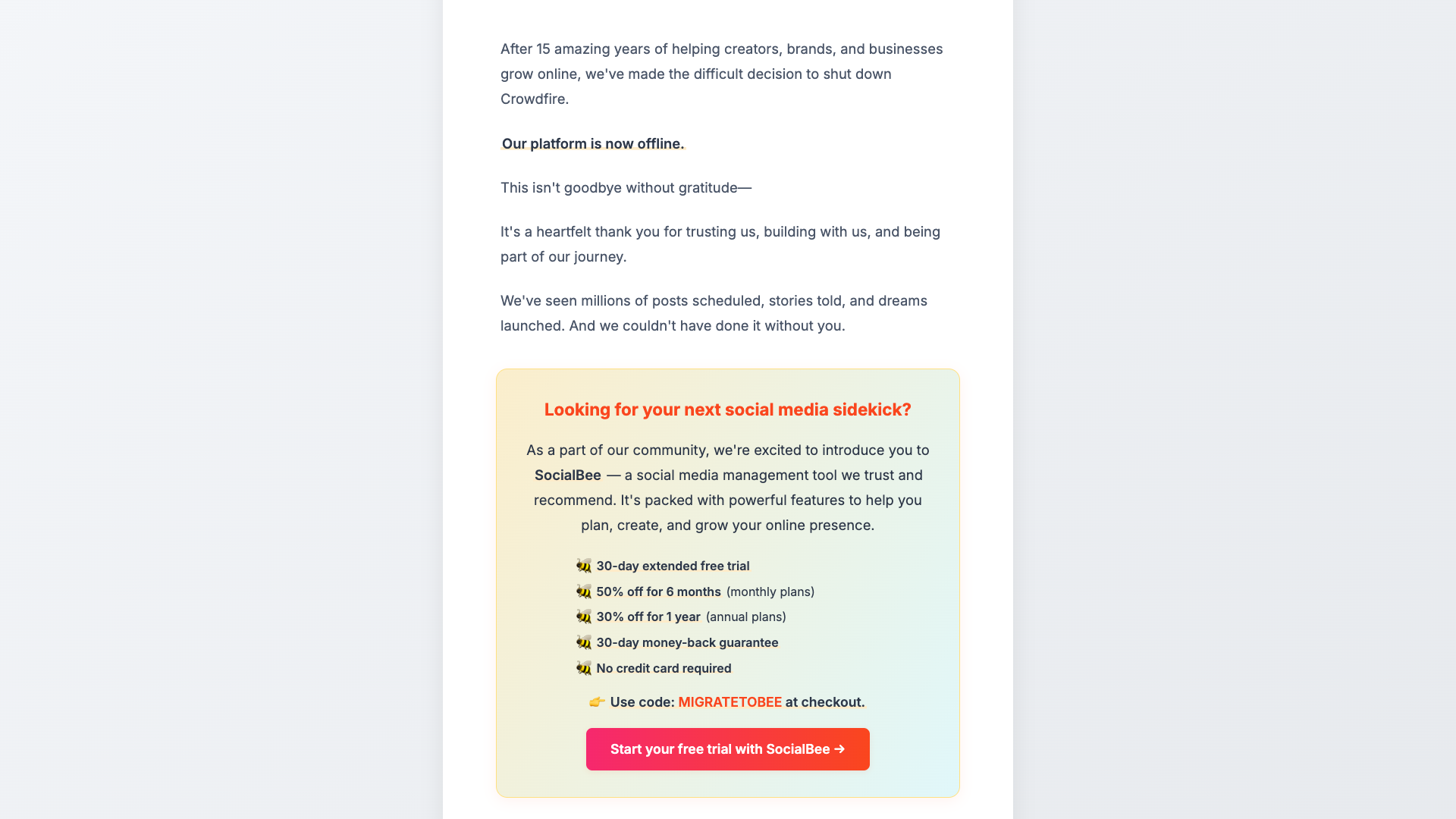
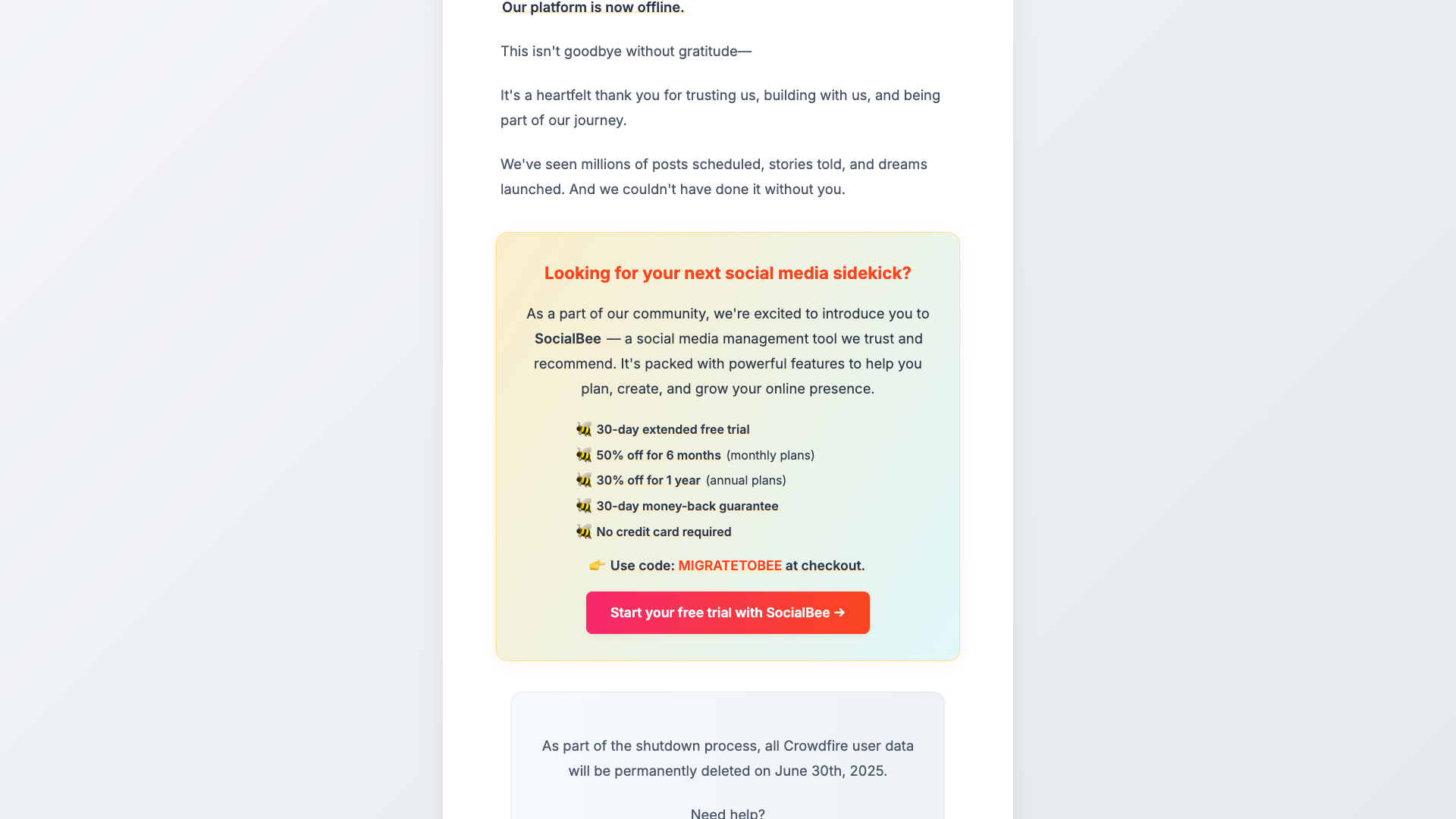
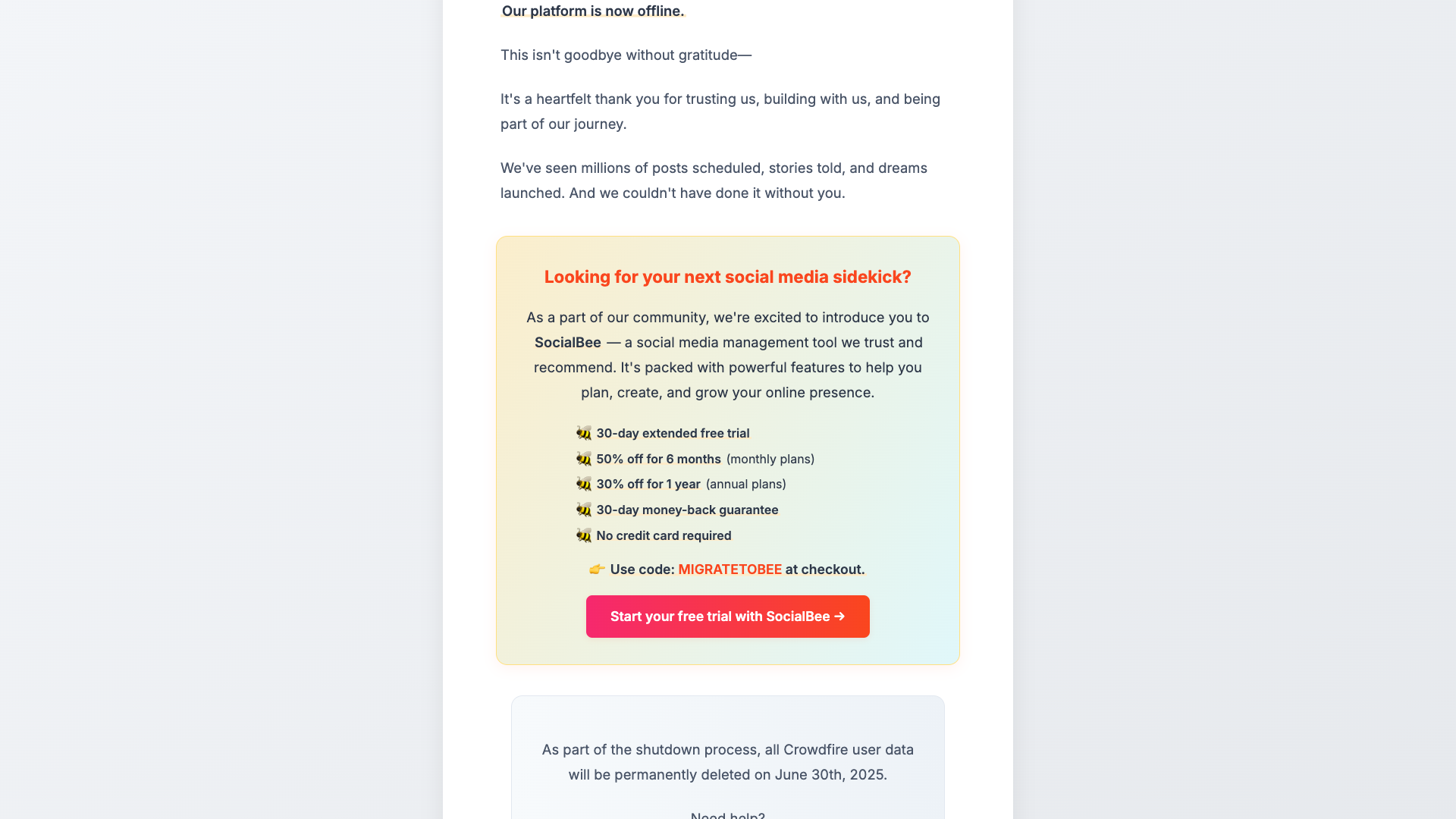
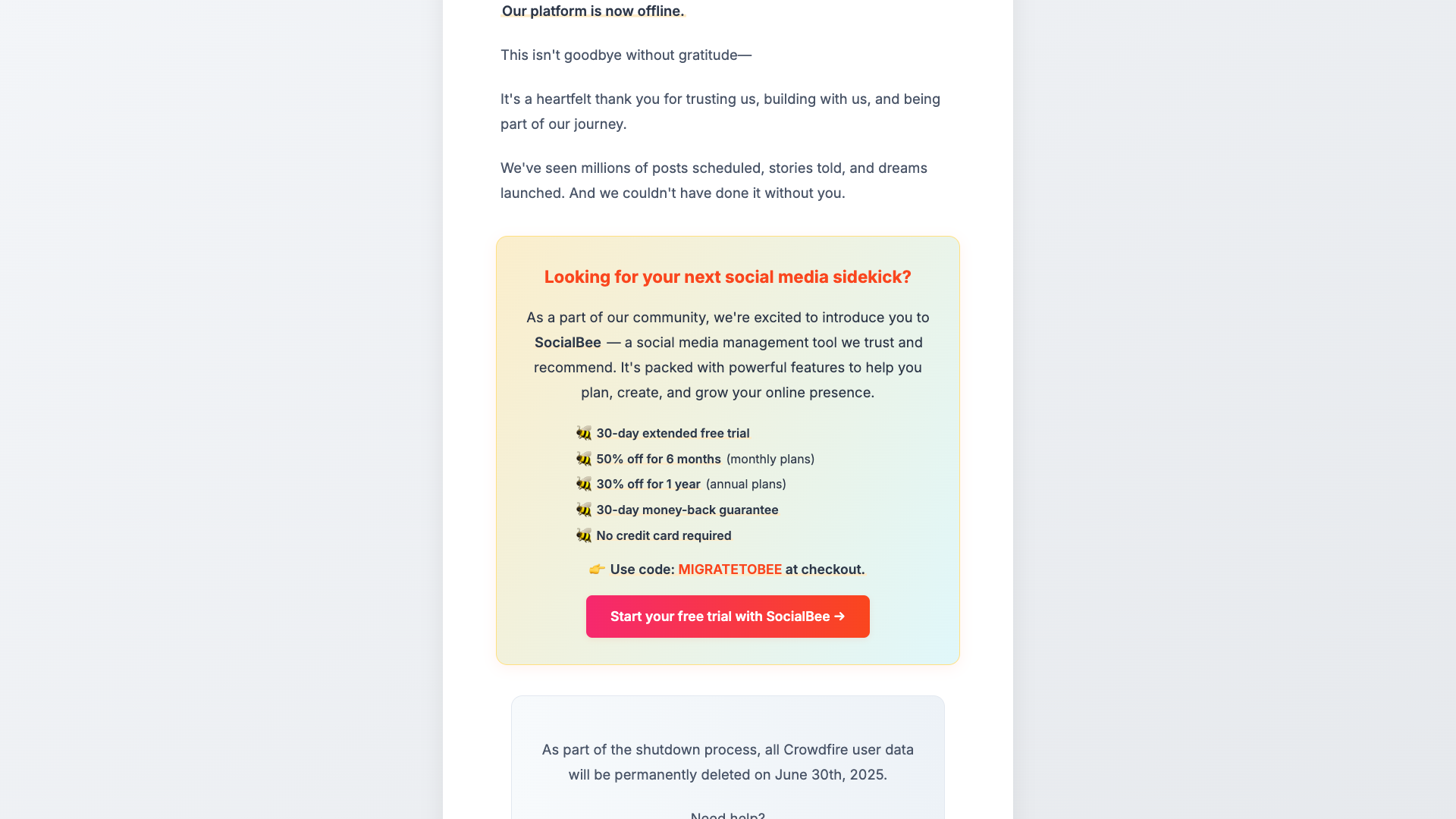
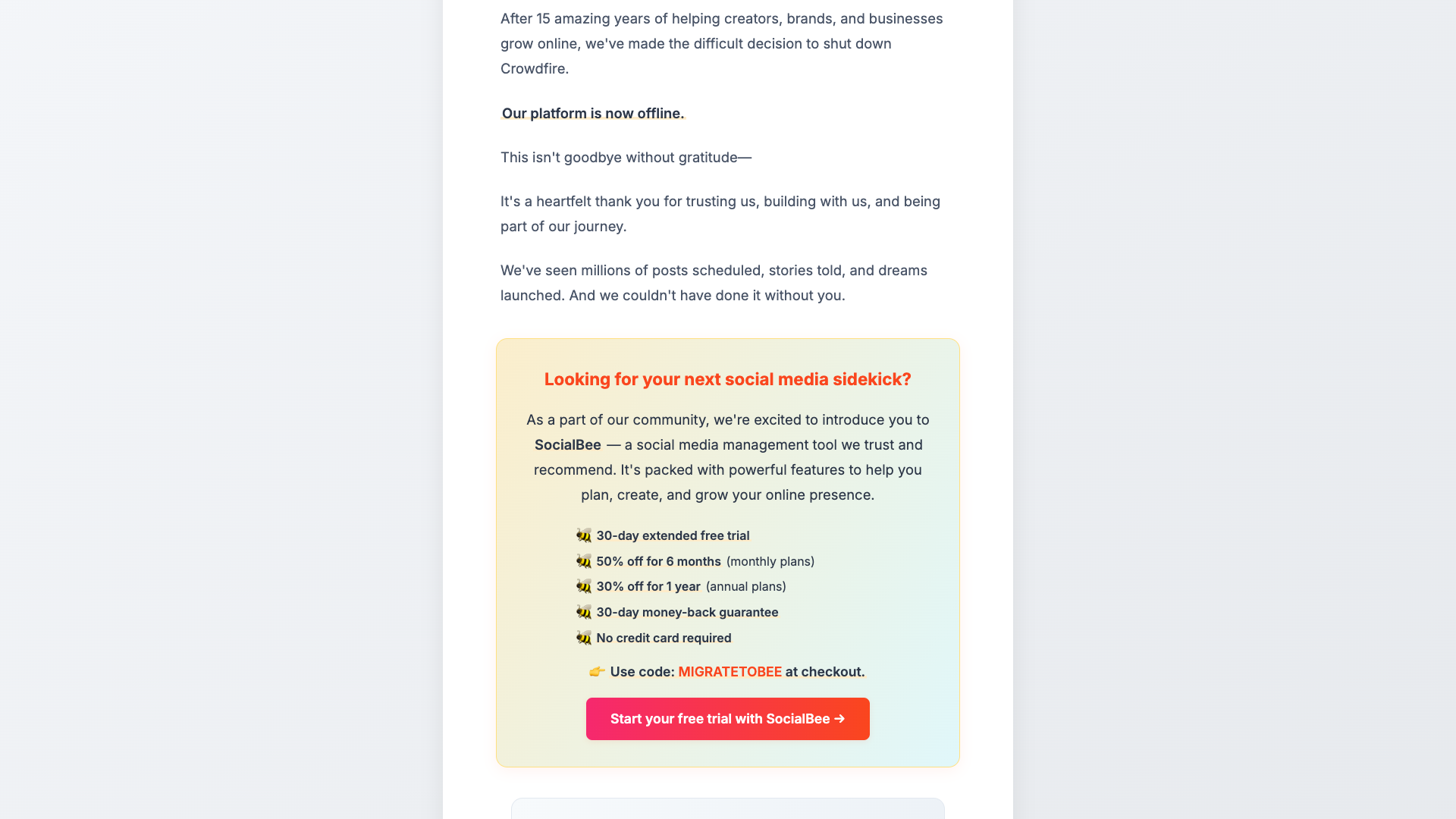
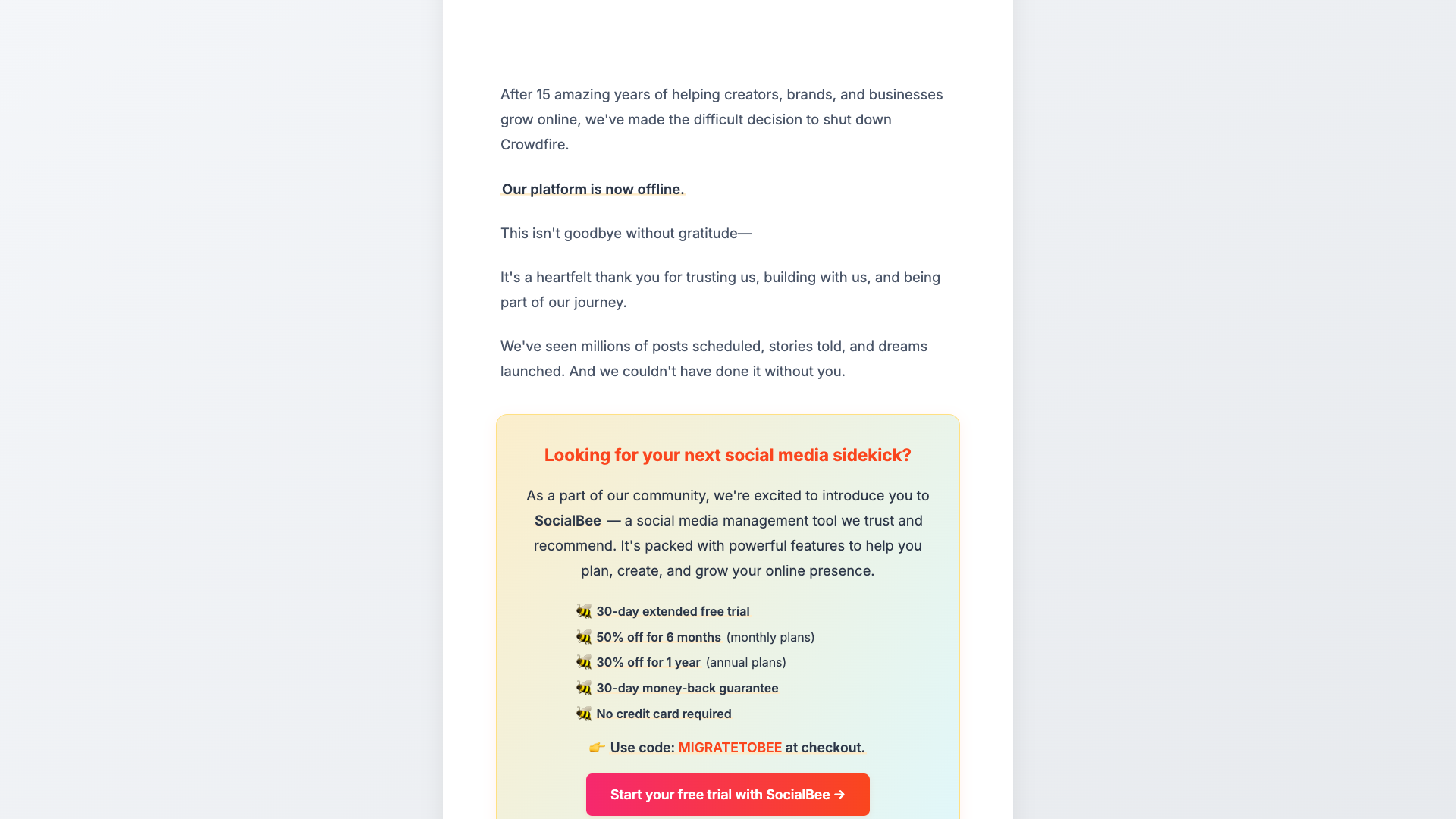
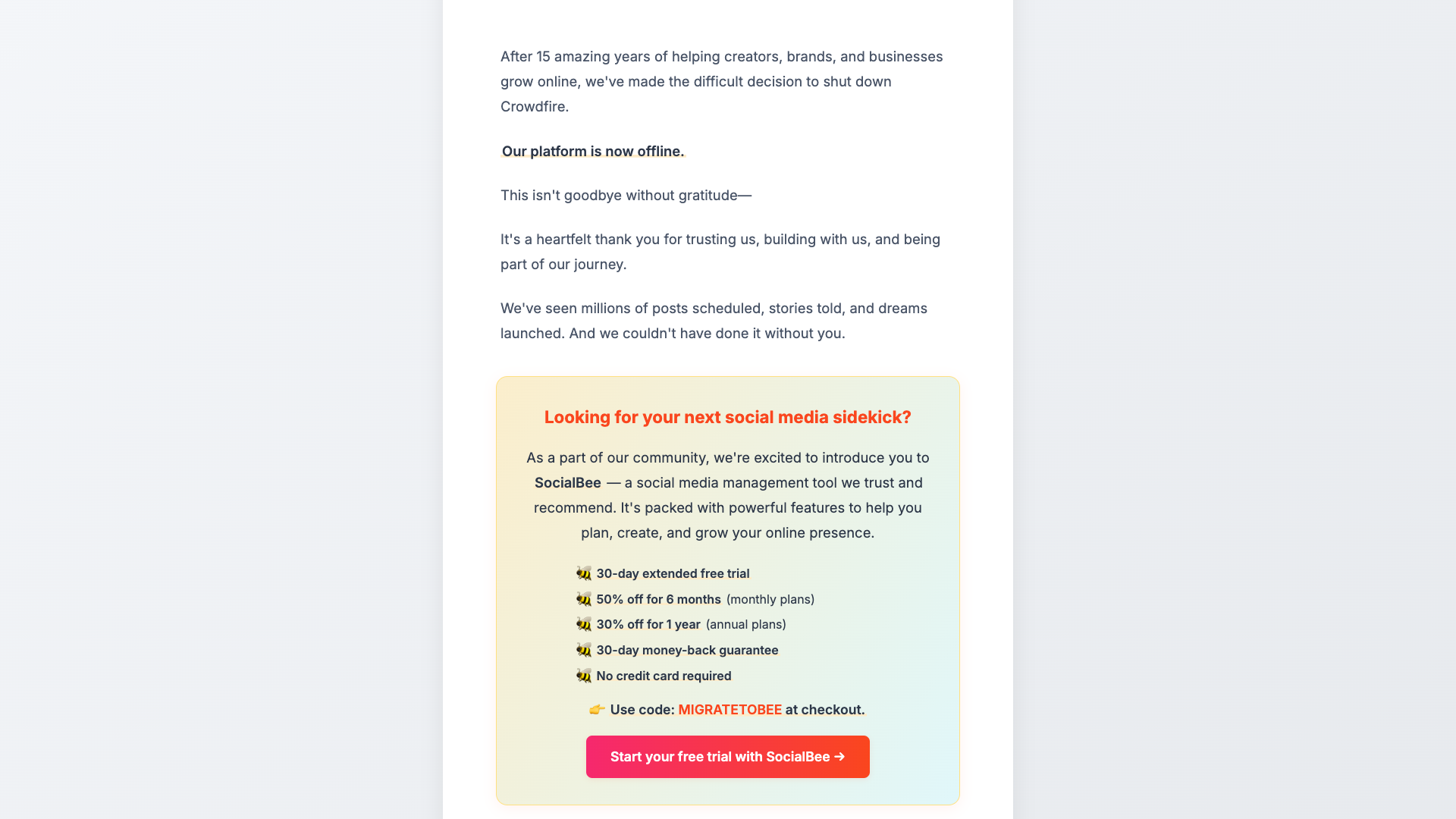
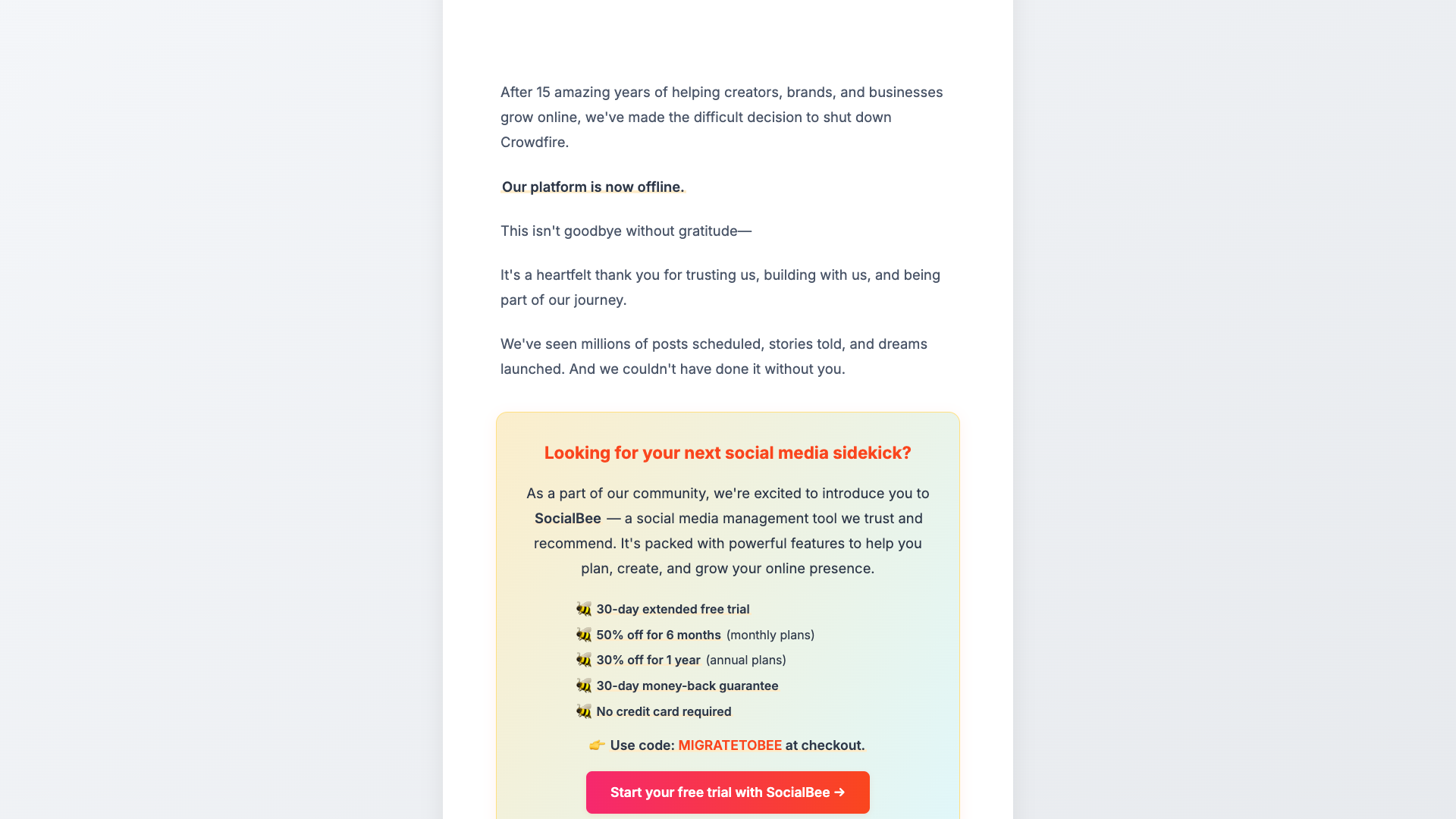
When you visit the official website today, you are greeted with a prominent message: “Thank You for 15 Incredible Years! After 15 amazing years… we’ve made the difficult decision to shut down Crowdfire. Our platform is now offline.” The page explains that millions of posts were scheduled through the service and that all Crowdfire user data will be permanently deleted on June 30th, 2025 as part of the shutdown process. The company also recommends SocialBee as a migration destination and offers a promotional code, which confirms that Crowdfire is not coming back as an active product.
Because of this, Crowdfire should now be viewed as a legacy tool rather than a current option for new users. Historical information about its features and pricing is still useful for understanding how social media tools evolved and for comparing older workflows to modern AI‑powered solutions. However, anyone looking for a practical tool today should focus on alternatives that are actively maintained, more automation‑driven, and better integrated with current social platforms.
Core Value Proposition: Simple Social Media Growth for Creators and Small Teams
Crowdfire’s core value proposition was to be a simple, affordable hub for managing multiple social media accounts from one place. It aimed to help users grow their audience by combining follower management, content scheduling, and content discovery into a single workflow. For many early‑stage creators and small businesses, this meant they could move away from manual posting and basic spreadsheets into a more structured system.
A major part of Crowdfire’s appeal was its focus on growth‑oriented workflows rather than just posting. Historically, it offered tools to identify inactive or non‑followers on Twitter, suggest relevant users to follow, and surface content that could drive engagement. Over time, it leaned more into content scheduling and curation, but the growth mindset remained central to its positioning.
Crowdfire also tried to differentiate itself through ease of use and low entry cost. The interface was relatively straightforward compared to enterprise‑grade tools, and the free and low‑cost plans made it accessible to freelancers, solo creators, and small agencies. This combination of simplicity, growth features, and affordability is what made Crowdfire a stepping stone for many users before they graduated to more advanced platforms.
Key Features and Capabilities Crowdfire Used to Offer
Historically, Crowdfire offered a multi‑platform publishing system that allowed users to connect several social networks and schedule posts from a unified dashboard. Users could compose posts, customize them per platform, and queue them for optimal times, which was particularly helpful for creators managing Twitter, Instagram, Facebook, and LinkedIn simultaneously. The tool also supported bulk scheduling and recurring posts in some plans, reducing the manual effort required to keep feeds active.
Another major capability was content curation and discovery, where Crowdfire suggested articles, images, and posts based on topics or connected RSS feeds. This helped users fill their content calendars with relevant third‑party content, which was especially useful for small teams that did not have the capacity to produce everything in‑house. The platform also provided basic recommendations for posts that performed well, encouraging users to reshare or repurpose high‑engagement content.
Crowdfire included analytics and reporting features that showed metrics like follower growth, engagement, and post performance across connected accounts. While not as deep as enterprise tools, these insights gave users a quick sense of what was working and where to adjust their strategy. Some plans also offered a simple social inbox and mention tracking, helping users respond to comments and messages from one place, though this functionality varied by network and plan.
Finally, Crowdfire originally gained traction through its Twitter follower management tools, which allowed users to identify inactive accounts, non‑followers, and potential new followers. Over time, platform policy changes forced Crowdfire to scale back some of these growth‑hacking features, but they remained part of its legacy reputation. Together, these capabilities made Crowdfire a well‑rounded, if not cutting‑edge, solution for early‑stage social media management.
- Multi‑platform social media scheduling and publishing from a unified dashboard
- Content curation and discovery based on topics and RSS feeds
- Basic analytics and reporting for follower growth and engagement
- Simple social inbox and mention tracking on supported networks
- Historical Twitter follower management and cleanup tools
- Bulk scheduling and queue management for recurring content
- Support for multiple social profiles across major networks
Crowdfire Pricing: Historical Plans and Tiers (Now Discontinued)
The current Crowdfire website no longer lists any active pricing, because the platform has been shut down and is officially offline. Historically, Crowdfire followed a freemium model with a Free plan and several paid tiers that scaled based on the number of social accounts, scheduled posts, and advanced features. While exact prices changed over the years, the structure typically included tiers similar to Plus, Premium, and VIP or Agency.
Based on archived information and historical references, the Plus tier was positioned for individual creators who needed more accounts and scheduled posts than the free plan allowed. The Premium tier targeted small businesses and growing teams that required additional profiles, better analytics, and more robust scheduling options. At the top end, a VIP or Agency tier was designed for agencies and power users managing many profiles and needing higher limits and priority support.
It is important to emphasize that these plans are no longer available for purchase, and any pricing listed here is purely historical context. New users cannot sign up for Crowdfire, and existing user data is scheduled for deletion by June 30th, 2025. Anyone evaluating tools today should instead compare current platforms like PostFlow, SocialBee, Buffer, or Hootsuite, which actively maintain their pricing and feature sets.
Free (Historical)
- Connect a limited number of social accounts
- Basic post scheduling with low queue limits
- Access to simple content curation suggestions
- Limited analytics and reporting
- Mobile and web access
Historical free tier; no longer available because Crowdfire is offline.
Plus (Historical)
- Higher limits on scheduled posts per account
- Support for additional social profiles
- Enhanced content curation and RSS support
- Improved analytics compared to the free plan
Previously targeted at individual creators; exact historical price varied and is no longer active.
Premium (Historical)
- Support for more social accounts and team use
- Deeper analytics and performance reports
- More generous scheduling and queue limits
- Priority support compared to lower tiers
Previously aimed at small businesses; discontinued with the platform shutdown.
VIP / Agency (Historical)
- Highest limits on profiles and scheduled posts
- Features tailored for agencies and power users
- Priority or dedicated support options
- Advanced reporting for multiple clients
Top‑tier legacy plan; no longer sold or supported.
All Crowdfire plans have been discontinued. The platform is offline and user data will be deleted by June 30th, 2025, according to the official shutdown notice.
Customer Feedback and Reviews on Crowdfire
Customer feedback on Crowdfire over the years was mixed but generally positive among budget‑conscious users. Many creators appreciated how easy it was to connect multiple accounts, schedule posts, and keep a basic content pipeline running without a steep learning curve. Others highlighted that the tool offered good value for money compared to more expensive enterprise platforms, especially when they were just starting out.
However, reviews also mentioned limitations and frustrations, particularly as social networks tightened their APIs and growth‑hacking tactics became harder to sustain. Some users felt that certain features, such as follower management on Twitter or Instagram automations, became less effective or were removed over time. There were also occasional complaints about bugs, posting errors, or delays in adapting to platform changes.
Overall, Crowdfire was often described as a solid entry‑level solution rather than a long‑term enterprise platform. It served its purpose for many users during a specific phase of their growth journey, but some eventually migrated to tools with deeper analytics, better collaboration features, or AI‑assisted content creation. The shutdown announcement on the official site has been received with nostalgia, as many long‑time users remember it as one of their first social media management tools.
- Crowdfire was often described as a helpful starter tool for scheduling posts across platforms, according to Sarah M., Social Media Manager.
- The platform was frequently praised for offering strong value for money compared to larger suites, noted James R., Freelance Marketer.
- Its interface was repeatedly mentioned as easy to learn for non‑technical users, observed Priya K., Content Strategist.
- Some users reported that certain automation features became less effective over time as networks changed, stated Daniel L., Digital Consultant.


Our Take: Crowdfire’s Legacy Strengths and Weaknesses
From a modern perspective, Crowdfire’s biggest strength was its accessibility. It lowered the barrier to entry for social media management by combining scheduling, basic analytics, and content curation in a single, affordable package. For many solo creators and small businesses, it was a practical first step away from manual posting and into a more systematic approach.
At the same time, Crowdfire’s feature set increasingly lagged behind newer tools that embraced AI‑assisted content creation, deeper analytics, and advanced collaboration. As social networks changed their rules and APIs, some of Crowdfire’s original growth‑hacking features became less reliable or had to be removed. This left the platform competing more directly on scheduling and curation, where differentiation is harder without strong automation or AI.
Given that Crowdfire is now officially shut down, it cannot be recommended as a solution for current use cases. Instead, its legacy is best understood as a stepping stone in the evolution of social media tools, showing how early platforms helped users scale basic workflows. For anyone seeking a replacement, it makes more sense to adopt a tool that builds on this foundation with modern capabilities like AI‑generated content, smart scheduling, and integrated analytics.
Pros
- Historically offered an easy‑to‑use interface for managing multiple social accounts.
- Provided affordable entry‑level plans suitable for solo creators and small teams.
- Included content curation features that helped fill social calendars quickly.
- Offered basic analytics and reporting to guide content strategy decisions.
- Supported multi‑platform scheduling from a single dashboard, reducing manual posting.
Cons
- The platform is now shut down and completely offline, making it unusable today.
- Legacy growth‑hacking features became less effective as social networks changed policies.
- Analytics and reporting were relatively shallow compared to modern competitors.
- Limited collaboration and workflow features for larger teams or agencies.
- Did not fully embrace AI‑assisted content creation before shutting down.
Final Verdict: Crowdfire’s Place in Social Media Tool History
Crowdfire deserves recognition for its 15‑year contribution to helping creators and small businesses manage their social media presence. At its peak, it offered a compelling mix of multi‑platform scheduling, content curation, and basic analytics at a price point that many early‑stage users could afford. For that era, it was a strong 4‑star solution that made social media workflows more manageable.
Today, however, the fact that the platform is offline and user data is scheduled for deletion by June 30th, 2025 means it is no longer a viable option. Any evaluation must therefore be historical rather than practical, and new users should not attempt to sign up or rely on Crowdfire for future campaigns. Instead, the focus should shift to active tools that have learned from Crowdfire’s strengths while addressing its limitations.
Taking both its historical impact and current shutdown into account, Crowdfire earns a final score of 2.0 out of 5 in this review. The score reflects the reality that, despite its past usefulness, a tool that is no longer available cannot be recommended for present‑day use. Creators and teams looking for a modern workflow should explore alternatives that combine scheduling with AI‑driven content creation and robust analytics.
Alternatives
If Crowdfire isn't the right fit, consider these similar tools:
Last updated: 17.11.2025