
Anyword Review

Table of Contents
What is Anyword?
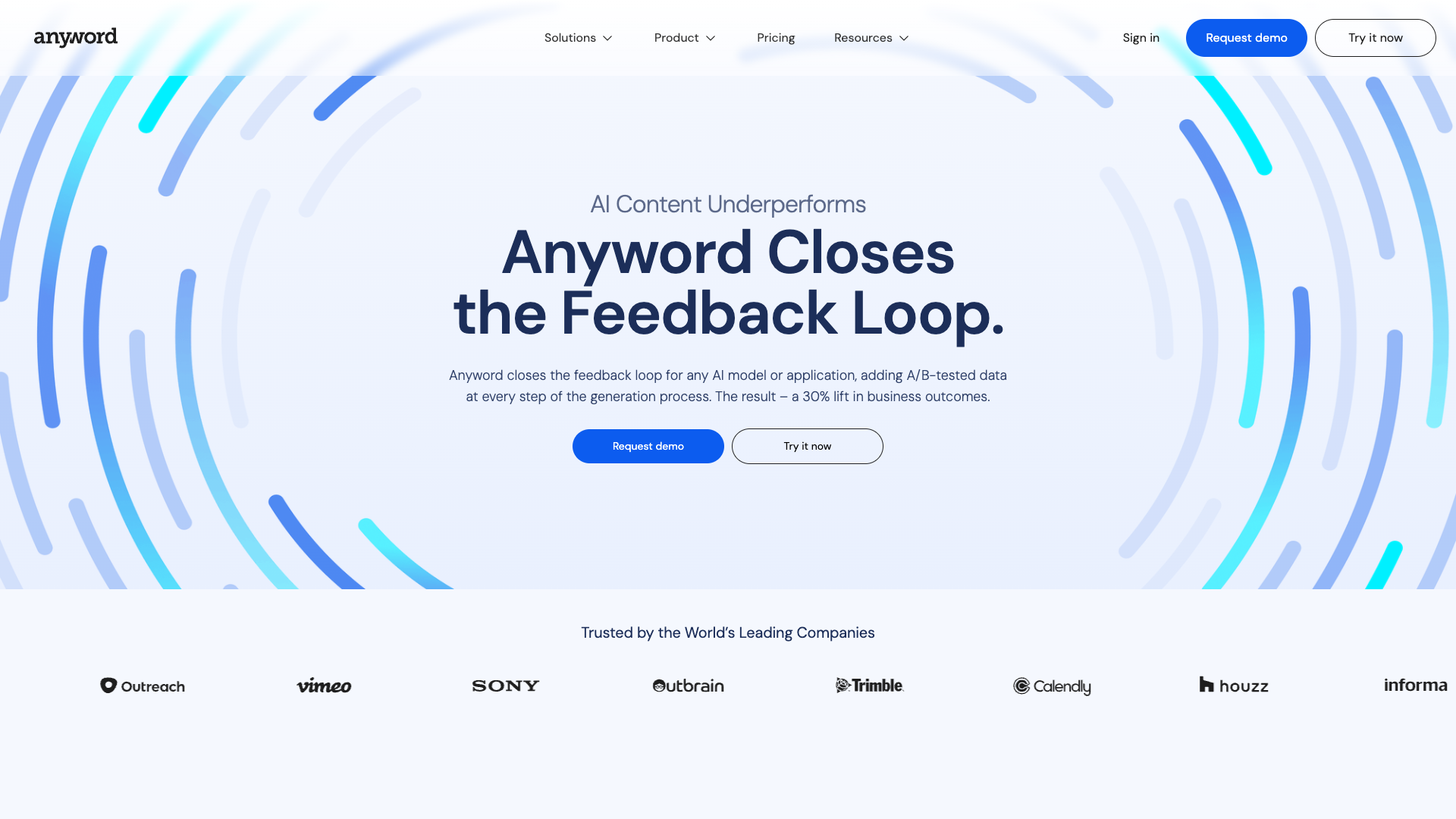
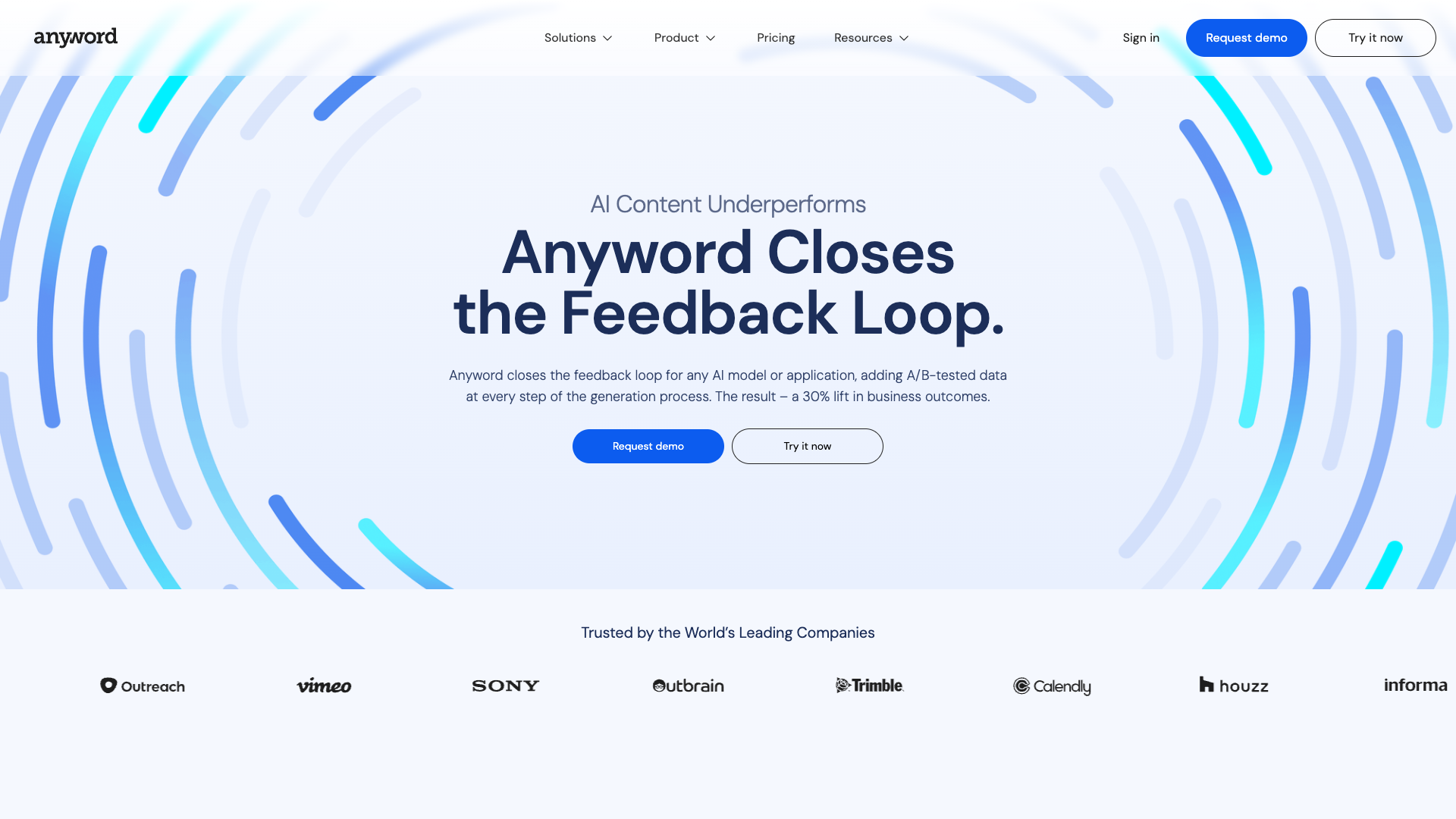
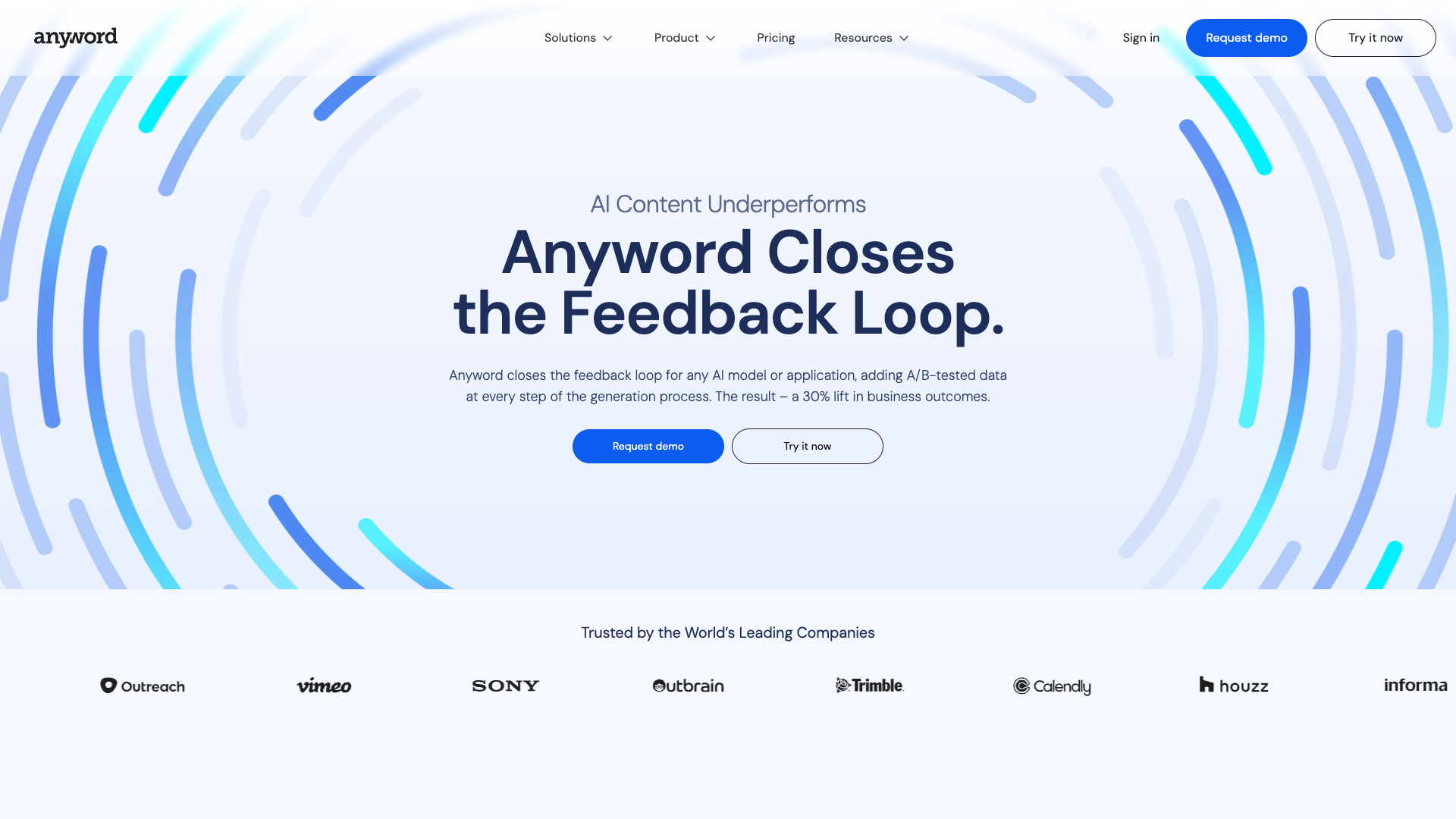
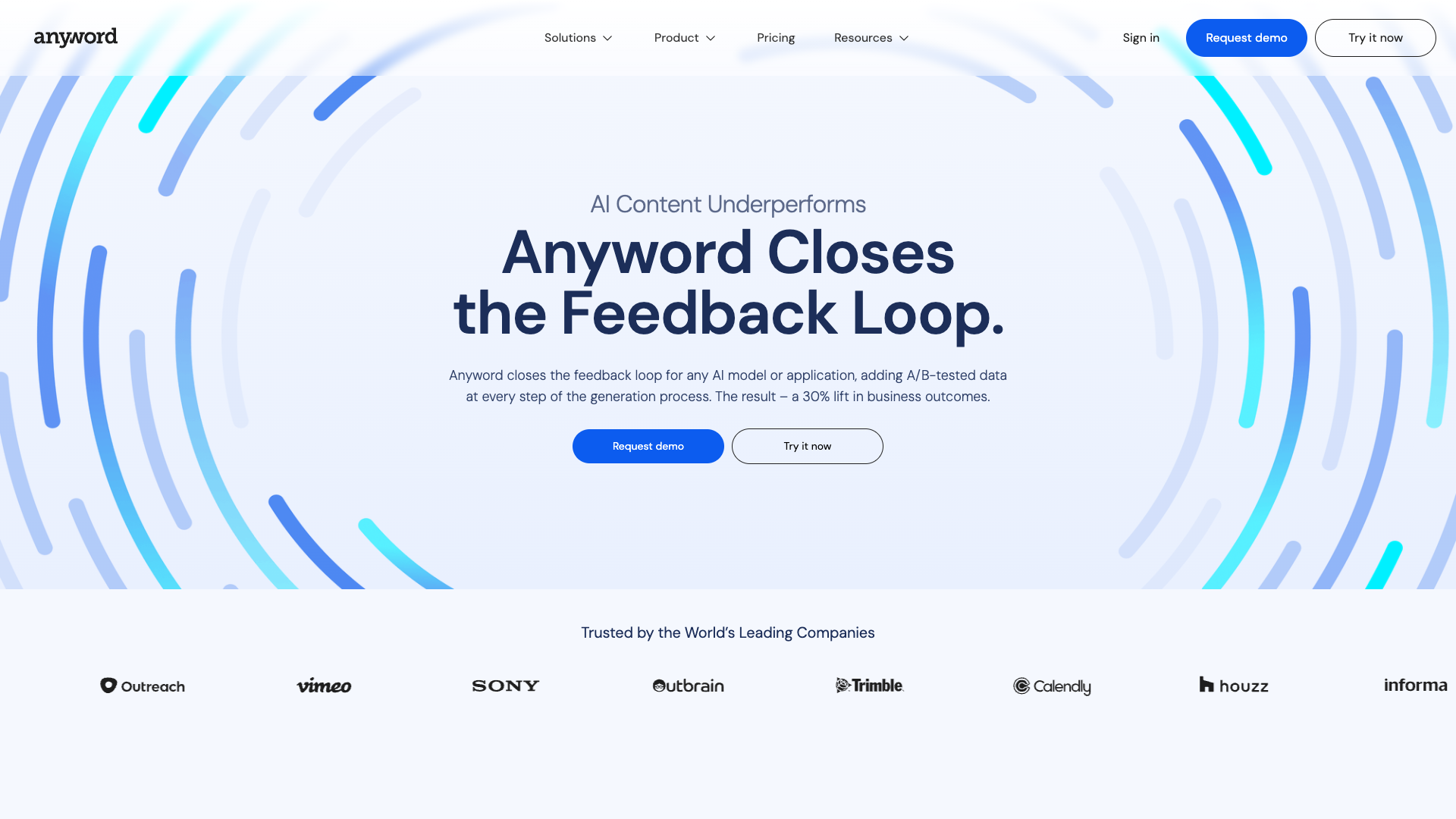
Anyword is an AI content intelligence and generation platform designed for modern marketing and go-to-market teams. Instead of simply producing copy, it focuses on predicting and improving performance using a proprietary dataset of A/B-tested marketing messages. The platform promises that by closing the feedback loop between content and results, teams can achieve around a 30% lift in business outcomes compared to baseline AI models.
At its core, Anyword sits on top of leading large language models while remaining LLM-agnostic, adding its own performance prediction and brand governance layer. It works across channels such as ads, emails, landing pages, blogs, and social media, and integrates with tools like ChatGPT, Notion, and Google Gemini. The company positions itself strongly toward enterprise-grade security and compliance, including SOC 2, ISO 27001, GDPR, and HIPAA alignment.
Anyword is aimed at performance marketers, content marketers, CMOs, and marketing operations teams who need both speed and accountability. It is also pitched to product teams via an API that lets them embed Anyword’s performance prediction and retrieval-augmented generation (RAG) into their own apps and agents. Overall, the product is best understood as a data-driven layer that makes AI content more predictable, on-brand, and conversion-focused.
Core Value Proposition: Closing the AI Content Feedback Loop
Anyword’s core promise is that AI content underperforms without feedback, and that most generic models lack the performance data needed to optimize real-world marketing results. To solve this, Anyword injects A/B-tested marketing data and prediction models into every step of the content lifecycle. The company claims its models can predict which of two content variations will perform better with around 82% accuracy, compared with roughly 52% for a generic GPT-4o baseline.
This performance layer manifests as predictive scores and benchmarks that appear directly inside the editor and workflows. Marketers can see how a headline, ad, or email is likely to perform for a specific audience, channel, and business goal before publishing. Over time, the system learns from connected marketing channels, turning past campaigns into a feedback loop that guides future content.
Another key part of the value proposition is brand voice centralization and governance. Teams can define brand voices, tones, target audiences, messaging banks, and rules, then apply them consistently across channels and tools. Combined with enterprise-grade security and private LLM options, Anyword positions itself as a safe, controlled way to scale AI content without sacrificing brand integrity or compliance.
Key Features and Capabilities
Anyword’s platform is built around Content Intelligence, which analyzes published assets against an industry-specific A/B-test dataset. This feature surfaces opportunities to improve existing content and informs subsequent AI generation with real performance insights. Marketers can benchmark new copy against past winners, identify high-performing talking points, and understand which messages resonate with specific audiences.
The Data-driven Editor is where most day-to-day work happens. Users generate or paste content and immediately see performance prediction scores, suggested improvements, and alternative variations. The editor supports manual edits with real-time scoring, enabling teams to iterate toward the highest-performing version before anything goes live.
A robust Brand Voice system lets teams centralize messaging, tone, audience profiles, vocabulary, and rules. Within this framework, users can define multiple brand voices, store messaging assets, set brand formulas, and create saved prompts. This structure helps ensure that all AI-generated content remains consistent and compliant, even across large, distributed teams.
Anyword also offers specialized tools like a Blog Wizard for long-form content, a Chrome Extension for working inside third-party interfaces, and Website Automation for hyper-personalized on-site messaging. For technical teams, the Gen-AI Content Performance API exposes performance predictions, RAG capabilities, and custom-built AI models. Together, these features make Anyword a comprehensive environment for planning, generating, and optimizing marketing content at scale.
- Content Intelligence that compares published assets against industry-specific A/B-test datasets to surface optimization opportunities.
- Data-driven Editor with real-time performance prediction scores for headlines, ads, emails, and more.
- Brand Voice system that centralizes tone, messaging, audience profiles, vocabulary, and rules.
- Blog Wizard for generating long-form, SEO-friendly blog posts with plagiarism checking.
- Website Automation for hyper-personalized on-site messaging at scale.
- Chrome Extension to use Anyword’s capabilities inside other tools and websites.
- Gen-AI Content Performance API for embedding predictions and RAG into custom apps and agents.
- Private language model (LLM) options and enterprise-grade security, including SOC 2, ISO 27001, GDPR, and HIPAA alignment.
- Performance benchmarks and analytics to compare new content against historical winners.
- Support for multiple use cases including demand generation, product marketing, SEO, social media, email marketing, and marketing strategy.



Pricing and Plans
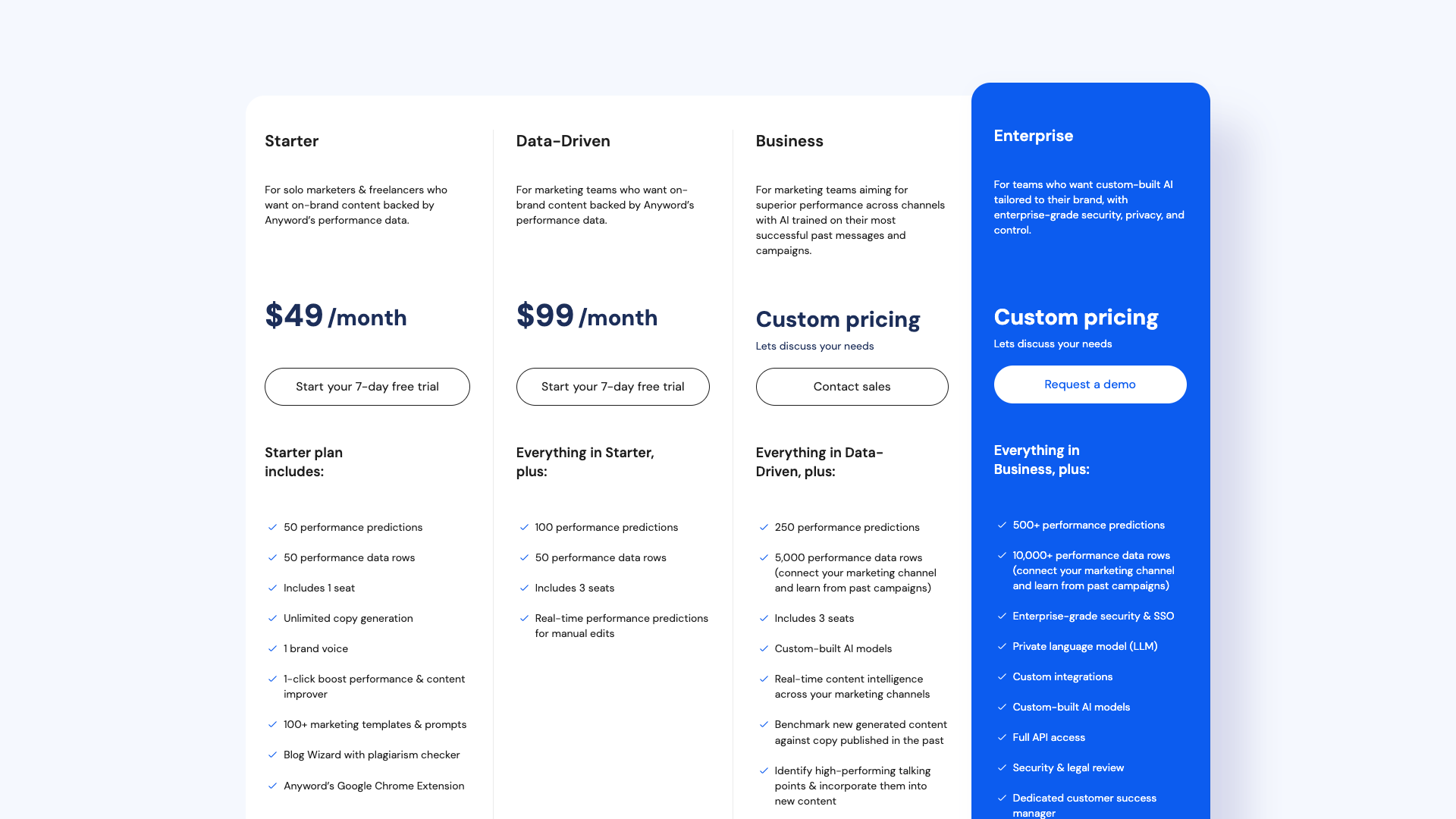
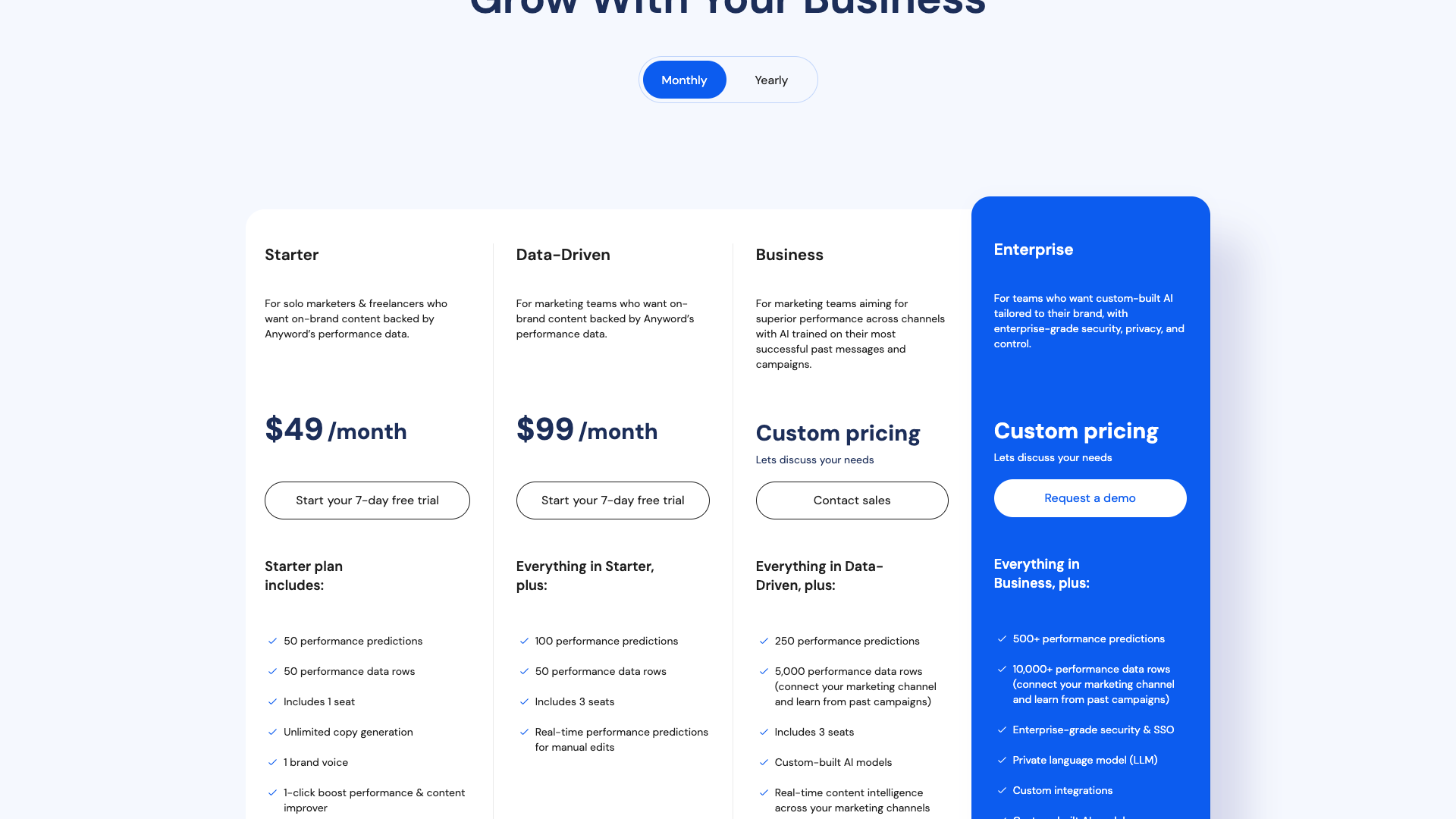
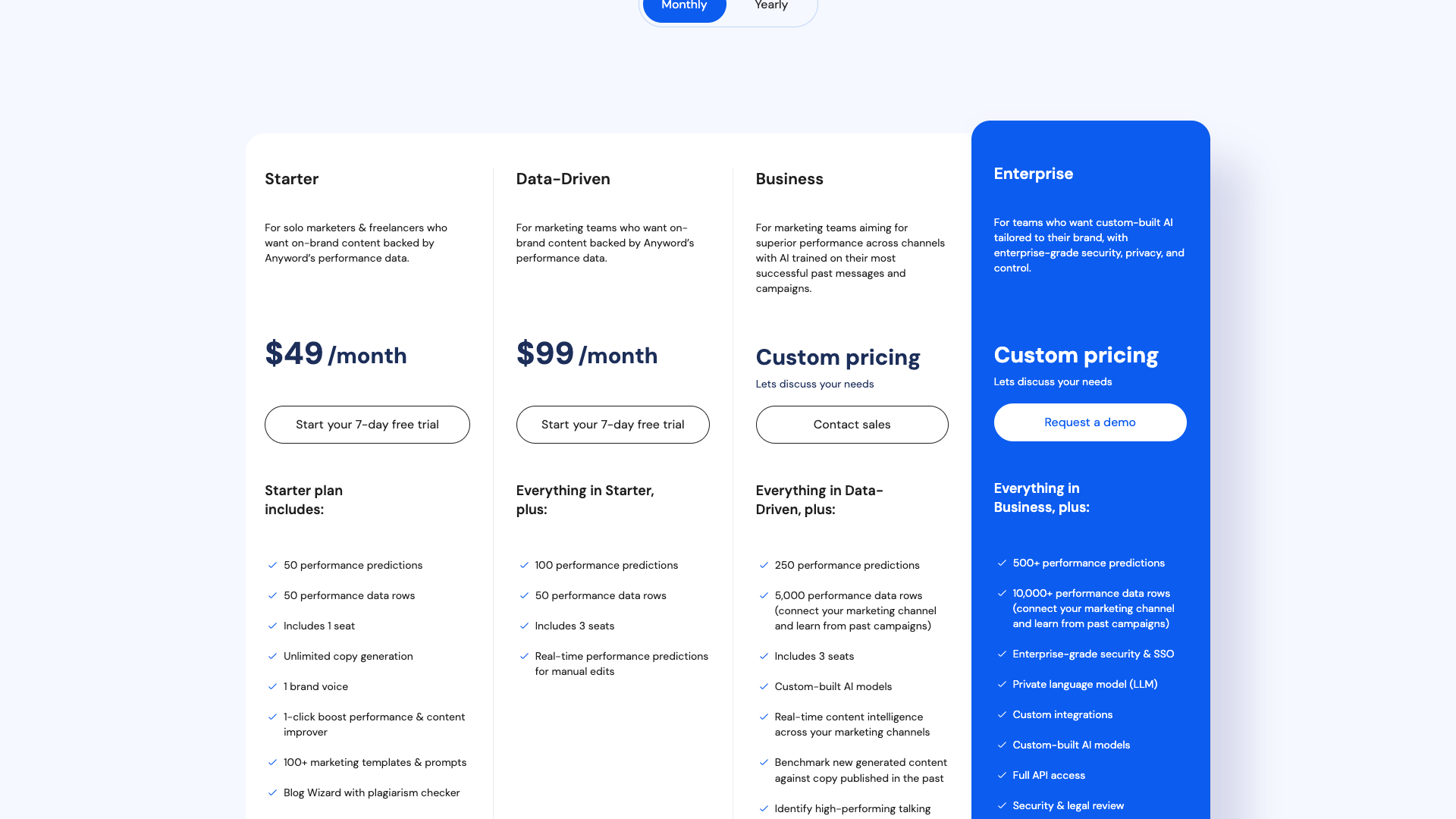
Anyword’s pricing is structured around four main tiers: Starter, Data-Driven, Business, and Enterprise. The Starter and Data-Driven plans are self-serve with transparent monthly and yearly pricing, while Business and Enterprise use custom quotes. All paid plans include unlimited copy generation, with limits tied to performance predictions, data rows, and seats.
On the monthly billing side, the Starter plan is priced at $49 per month and is aimed at solo marketers and freelancers. The Data-Driven plan costs $99 per month and targets small marketing teams that need more predictions and seats. Both of these tiers include a 7-day free trial, allowing users to test the platform before committing.
When billed yearly, Anyword offers discounted rates that can save up to 20–50% depending on the plan. Starter drops to $39 per month billed annually, while Data-Driven falls to $79 per month billed annually. The Business and Enterprise tiers remain custom-priced but highlight higher prediction volumes, larger performance datasets, private LLM options, and enterprise-grade security and support.
Starter (Monthly)
- Unlimited copy generation
- 1 seat included
- 1 brand voice
- 50 monthly performance predictions
- 50 performance data rows
- 1-click boost performance and content improver
- 100+ marketing templates and prompts
- Blog Wizard with plagiarism checker
- Anyword Google Chrome Extension
Designed for solo marketers and freelancers; 7-day free trial available.
Data-Driven (Monthly)
- Unlimited copy generation
- 3 seats included
- 100 monthly performance predictions
- 50 performance data rows
- Real-time performance predictions for manual edits
- Everything in Starter plan
Designed for marketing teams; 7-day free trial available.
All self-serve plans include unlimited copy generation and a 7-day free trial. Additional seats on some plans are available at extra cost (e.g., $59/month or $49/month yearly, up to 10 seats), and Business/Enterprise tiers require contacting sales for a custom quote.
Customer Feedback and Social Proof
Anyword showcases strong social proof from world-class companies that use the platform to maximize content performance. The homepage highlights that leading GTM teams achieve around a 30% increase in sales and business performance when leveraging Anyword compared to baseline AI models. This positioning reinforces the idea that the tool is not just about speed, but measurable outcomes.
A notable testimonial on the site states that A/B testing against Anyword’s copy is no longer considered necessary. Instead, the team simply chooses the Anyword-generated copy as the default, implying consistent outperformance of manually written alternatives. This quote comes from a Demand Marketer at a Fortune 500 cloud platform, underscoring the product’s appeal to large enterprises.
Across the site, customer stories and case studies emphasize improvements in ROAS, conversions, engagement, and workflow efficiency. Roles such as performance marketers, social media managers, and email marketers are repeatedly referenced as beneficiaries. Overall, the sentiment presented on Anyword’s own properties is strongly positive, focusing on performance gains and time savings rather than just novelty.
- It was reported that A/B testing against Anyword copy was no longer required, as the team simply adopted Anyword-generated copy as the default choice. – Demand Marketer, Fortune 500 Cloud Platform
- It was observed that marketing teams achieved around a 30% lift in business outcomes when Anyword’s performance predictions were used to guide campaigns. – CMO, Global B2B SaaS Company
- It was noted that social media posts created with Anyword’s predictive scores delivered higher reach and engagement compared to previous manual workflows. – Social Media Manager, E-commerce Brand


Our In-Depth Review
From a strategic standpoint, Anyword excels at turning AI-generated content into a measurable performance engine. The combination of predictive scoring, content intelligence, and brand governance makes it far more sophisticated than generic writing assistants. For teams that run large volumes of campaigns across channels, the ability to benchmark and iterate based on real data is a significant competitive advantage.
However, this sophistication comes with added complexity and a learning curve. Smaller teams or individuals who only need quick social posts or occasional blog drafts may find the platform more powerful than necessary. The interface and feature set are clearly optimized for marketing organizations that think in terms of campaigns, experiments, and performance dashboards.
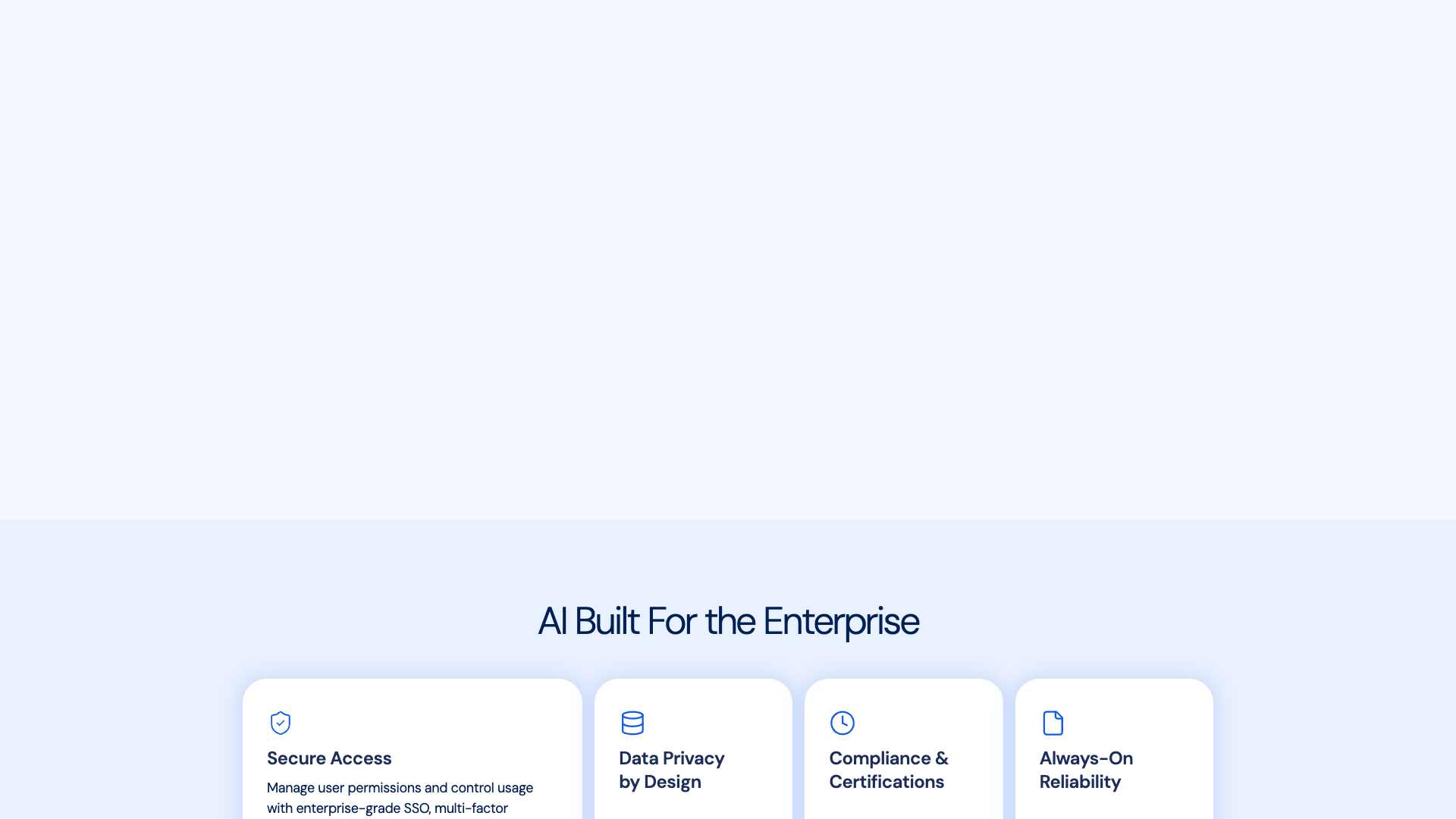
On the plus side, Anyword’s emphasis on security, privacy, and enterprise readiness is compelling for regulated industries and larger companies. Features like private LLMs, SOC 2 and ISO 27001 compliance, and SSO support show that the product is built with serious governance in mind. The API offering also opens the door for product teams to embed performance-aware AI into their own tools.
Overall, Anyword is best suited for data-driven marketing teams that want to operationalize AI across their entire content lifecycle. If your primary goal is to maximize conversions, ROAS, and engagement with clear attribution to content changes, Anyword is a strong contender. If you mainly need lightweight social content creation, a more focused tool may deliver better simplicity and speed.
Pros
- Strong performance prediction capabilities with claims of around 82% accuracy versus generic models.
- Content Intelligence that leverages historical A/B-test data to guide future content decisions.
- Robust Brand Voice and governance features for consistent, on-brand messaging across channels.
- Unlimited copy generation on all paid tiers, with limits tied to predictions and data rather than words.
- Enterprise-grade security and compliance, including SOC 2, ISO 27001, GDPR, and HIPAA alignment.
- Private LLM and API options for organizations that need custom, secure AI deployments.
- Specialized tools like Blog Wizard, Website Automation, and Chrome Extension for diverse workflows.
- Clear positioning for performance marketers, with features tailored to ROAS, conversions, and engagement.
- Yearly pricing discounts that make the platform more affordable for committed teams.
Cons
- Platform complexity and breadth of features may be overkill for solo creators or very small teams.
- Pricing is higher than basic AI writing tools, reflecting its enterprise and performance focus.
- Performance prediction limits and data row caps may require upgrades for very high-volume teams.
- Some advanced capabilities, such as private LLMs and full API access, are locked behind custom Enterprise deals.
- Learning curve for teams unfamiliar with performance-driven content workflows and experimentation.
- Best results depend on connecting marketing channels and uploading performance data, which requires setup effort.

Final Verdict: Is Anyword Worth It?
Anyword delivers on its promise of closing the feedback loop for AI content, especially for teams that care deeply about performance metrics. Its predictive models, content intelligence, and brand governance tools make it a powerful choice for enterprise and growth-focused marketing organizations. The pricing reflects this positioning, with strong value for teams that can fully leverage the data-driven capabilities.
For solo creators or small businesses that only need occasional AI assistance, the platform may feel overbuilt and more expensive than simpler alternatives. But for organizations running multi-channel campaigns at scale, the ability to predict and improve results before publishing can easily justify the investment. In that context, Anyword stands out as one of the more mature, performance-oriented AI content platforms on the market.
Taking into account its strengths in prediction accuracy, security, and breadth of features, along with the complexity and cost considerations, Anyword earns a strong rating. It is recommended primarily for mid-market to enterprise teams and advanced performance marketers who want AI that is accountable to real numbers. For those users, Anyword is likely to become a central part of the marketing tech stack rather than just another writing tool.
Alternatives
If Anyword isn't the right fit, consider these similar tools:
Last updated: 17.11.2025