
Before you even think about crafting that first viral tweet, let's talk about your digital storefront: your Twitter profile. Growing a following starts right here. Your bio, header, and that all-important pinned tweet need to work in concert to tell a new visitor exactly who you are and why they should care.
A strong first impression is everything. Get it right, and you’ll turn casual visitors into followers on autopilot.
Build a Profile That Attracts Your Ideal Followers

Think of your Twitter profile as a dynamic growth engine, not a static business card. When someone lands on your page, you have maybe three seconds to hook them. Every single element needs a purpose. If it's messy, unclear, or boring, they're gone.
It all starts with your profile picture. For founders, consultants, and creators, a logo is a missed opportunity. People connect with people. Use a high-quality, professional headshot where you look approachable. Your face is your brand—own it.
Craft a Bio That Converts Visitors to Followers
You have 160 characters. That's it. Your bio needs to be a knockout punch, instantly answering two questions for a visitor: "What's in it for me?" and "Why should I listen to you?"
Forget vague fluff like "Marketing enthusiast." That tells me nothing. A killer bio needs structure and clarity. Here’s a formula that just works:
- Who you help: Get specific. Not "businesses," but "SaaS founders," "freelance writers," or "e-commerce brands."
- How you help them: What’s the outcome? Do you help them "land 3 new clients a month" or "double their email subscribers"?
- Your credibility: Give them a reason to trust you. This could be your role ("Founder of @PostFlow"), a key achievement ("Helped 100+ founders scale"), or a major win.
A bio like "Helping businesses with marketing" is dead on arrival. Compare that to: "I help B2B consultants land 3 new clients a month using simple content systems. Founder of a 7-figure agency." See the difference? One attracts your ideal follower and actively repels everyone else—which is exactly what you want.
Use Your Header and Pinned Tweet Strategically
Your header image and pinned tweet are the most valuable real estate on your profile. Do not waste them. Your header shouldn't just be a nice background; it should amplify your bio's message. Use it to showcase a powerful tagline, logos of clients you’ve worked with, or a shot of you speaking on stage.
Your pinned tweet is your 24/7 salesperson. It should be the single best piece of content that proves your value.
Pin something that already has solid engagement and screams expertise. Good options include:
- Your most popular, value-packed thread.
- A glowing testimonial from a dream client.
- A link to your newsletter with a compelling freebie.
- A tweet outlining your core belief or mission.
When you dial in these elements, your profile transforms. It stops being a passive placeholder and becomes an active system, consistently converting curious onlookers into engaged followers and setting you up for real growth.
Develop a Content System That Builds Authority

Randomly tweeting your thoughts into the void is a slow, painful path to obscurity. If you want to grow a Twitter following that actually matters, you need to stop treating the platform like a personal diary and start treating it like a media channel. This means building a deliberate content system designed to consistently attract your ideal audience and build real authority.
The goal isn't just to be "active"—it's to become the go-to person in your niche. When people think of your topic, your name should be the first one that pops into their head. That shift happens when your content delivers undeniable value, tweet after tweet.
Define Your Core Content Pillars
You can't be everything to everyone, especially on a noisy platform like Twitter. The fastest way to build authority is to get known for a few specific things. These are your content pillars—the 2-3 core topics you’ll talk about over and over again.
For a freelance web designer, these might be "Webflow development," "client acquisition," and "freelance productivity." Choosing your pillars gives your content focus and tells your audience exactly what to expect. That clarity is what makes someone click "Follow." They aren't just following a person; they're subscribing to a specific stream of expertise.
Think of it this way: what are the biggest problems your ideal followers are facing? Your content pillars should directly map to those pain points.
- Pillar 1: Your main area of expertise (e.g., "AI for solopreneurs").
- Pillar 2: A related skill that supports the first (e.g., "Content repurposing systems").
- Pillar 3: Personal stories or mindset shifts connected to your work (e.g., "Building a one-person business").
This mix keeps your feed interesting and shows you’re not just a robot spitting out facts; you're a multi-dimensional expert with real experience.
Master the High-Impact Content Formats
Let’s be honest, not all tweets are created equal. While mixing things up is good, certain formats are proven workhorses for driving engagement and follower growth. Your content system should lean heavily on these winners.
Value-Packed Threads are your long-form authority builders. They let you go deep on a topic, solve a complex problem, or tell a compelling story from start to finish. A great thread is basically a mini-blog post, delivering so much value that people follow you just so they don't miss the next one.
The secret to a viral thread is a killer hook. Your first tweet has to grab attention and promise a clear, valuable outcome for the reader.
For instance, a bad hook is, "Here are some marketing tips." A great hook is, "I grew my client's traffic by 300% in 90 days with zero ad spend. Here's the exact 7-step framework we used." See the difference?
Insightful Single Tweets are your short, sharp jabs of authority. These are the concise, memorable takes that make people stop scrolling and think. They're perfect for sharing a contrarian opinion, a quick pro-tip, or a hard-won lesson from your own experience.
These tweets are incredibly shareable and often perform well because they’re so easy to digest. For more on this, our post on how to create engaging social media content offers a deeper dive into crafting posts that really connect.
Build a Simple Idea Generation Machine
The biggest hurdle for most people is the dreaded, "What should I tweet about today?" Your system needs to have an answer ready. The key is to stop waiting for inspiration to strike and start actively collecting ideas.
Set up a simple "idea bank" in a tool you already use, like Notion, Trello, or even a basic notes app on your phone. The moment an idea pops into your head, capture it.
Here’s how to keep that bank overflowing with high-quality ideas:
- Solve Your Past Problems: What did you struggle with two years ago that feels easy now? Document that solution. Your personal journey is a goldmine of relatable content.
- Answer Common Questions: What questions do clients, customers, or peers ask you all the time? Each one of those is a potential tweet or an entire thread.
- Document Your Process: Don't just show the polished final result; show the messy middle. Break down your workflows, explain your decision-making process, or share how you use a specific tool.
This systematic approach to content is what separates the pros from the amateurs. It removes the daily pressure of staring at a blank screen, freeing you up to focus on what matters: crafting high-quality content that establishes you as an authority people want to follow.
Nail Down a Posting Rhythm You Can Actually Stick With
A killer content strategy means nothing if you burn out after two weeks. The real engine of Twitter growth isn't a single viral hit; it's the steady, day-in, day-out drumbeat of your presence. The goal is to build a posting schedule that keeps you visible and top-of-mind without completely taking over your life.
When people see you showing up with valuable insights every single day, they’re far more likely to follow and engage. Consistency signals reliability, both to the algorithm and to your audience. This isn't about tweeting every hour—it's about finding a cadence you can maintain for the long haul.
Find Your "Minimum Effective Dose"
So, how often do you really need to tweet to grow? It’s probably less than you think, but more consistent than you’re currently doing. Forget the pressure to post ten times a day.
For most founders, freelancers, and creators, the sweet spot is 3-5 high-quality posts per day. This isn't just noise; it’s a strategic mix of original tweets, threads, and valuable replies that keep the conversation going.
This frequency keeps your profile active and popping up on timelines without annoying anyone. We’ve seen accounts hit 15-25% monthly follower growth by sticking to this kind of strategic plan. On the flip side, data shows that when brands suddenly cut their posting frequency, their engagement can crash by nearly 50%.
A simple daily mix could look like this:
- 1 Value Tweet: A standalone tip, a sharp observation, or a quick insight.
- 1 Engagement Tweet: A question, poll, or prompt to get people talking.
- 1-2 Replies: Thoughtful comments on posts from bigger accounts in your niche.
- 1 Quote Tweet: Adding your unique take to someone else's content.
This structure delivers value, builds community, and expands your reach—all within a totally manageable daily workload.
Batch and Schedule Your Content
The secret to consistency isn't magically finding more hours in the day. It's using your time smarter. This is where content batching becomes a total game-changer. Instead of scrambling to think of clever tweets on the fly every day, you carve out one block of time each week to write everything at once.
Just set aside 90 minutes on a Sunday evening or Monday morning. During that time, your only job is to write your core tweets for the week and load them into a scheduling tool. By doing this, you separate the creative work (writing) from the logistical task (posting).
Batching your content frees up your daily mental energy for what truly moves the needle on Twitter: authentic, real-time engagement in the replies.
Once your main content is scheduled, your daily Twitter time can be spent just interacting with people. That's where the real relationships are built and where follower growth really happens. To make sure you're consistently sharing great stuff without being glued to your screen, it's worth learning how you can automate social media posting.
Post When Your Audience Is Actually Listening
Scheduling your posts is smart. But scheduling them for the right time is brilliant. Dropping your best content when your audience is offline is like shouting into an empty room. You need to figure out when they're most active.
Luckily, Twitter gives you this data for free.
- Head over to your Twitter Analytics.
- Click on the "Tweets" tab.
- Check out the graphs showing your impressions and engagement by day and time.
You'll spot patterns pretty quickly. Maybe your audience of SaaS founders is most active around 9 AM ET on weekdays, while your creator followers are scrolling on weekend afternoons. By lining up your schedule with these peak hours, you give your content the best possible shot at getting seen, shared, and attracting new followers.
For a deeper dive, you can also check out our guide for building a solid social media posting schedule.
Turn Conversations into Followers with Authentic Engagement
Putting out great content is only half the job. If you’re serious about growing on Twitter, you need to understand one of the platform's fundamental truths: real growth happens in the replies.
Just pushing out your own tweets is like shouting into a void. But when you jump into existing conversations, you start shaking hands, making connections, and actually building relationships. This is how you shift from being just another content creator to a real community member.
Thoughtfully engaging in other people's discussions gets your ideas in front of new, highly relevant audiences. Honestly, it's the single best way I’ve seen to get noticed by bigger accounts and attract people who are already interested in what you have to say.
Stop Commenting, Start Conversing
There’s a world of difference between dropping a generic comment and actually adding value to a conversation.
Leaving a "Great point!" or "Totally agree!" is a complete waste of your time. It’s invisible, adds nothing new, and quietly signals you don't have an original thought to contribute. Don't be that person.
Your goal should be to leave a reply so insightful it could almost be a tweet on its own. You want to write something that makes people stop scrolling, think for a second, and maybe even click on your profile to see who this smart person is.
Here are a few ways to craft replies that actually get noticed:
- Add a new angle: Respectfully challenge the original point or offer a perspective no one else has mentioned.
- Share a personal story: Connect the tweet's idea to a real-world experience or a lesson you learned the hard way.
- Ask a smart question: Show you’re genuinely curious and want to go deeper on the topic.
- Give a specific example: If a tweet is making a high-level point, ground it in reality with a concrete case study.
This isn’t about just being present; it's about being a valuable participant. When you focus on adding real substance to every interaction, you start building a reputation as a trusted voice—making you a must-follow in your niche.
Use Quote Tweets to Showcase Your Expertise
Quote Tweets (QTs) are your chance to ride the wave of a popular conversation while putting your own stamp on it. Think of it like being a guest commentator—you’re using someone else's content as a launchpad to share your own authority and perspective.
Never just retweet. When you see a great tweet, ask yourself, "What can I add to this?" Use the QT to frame the original post with your own take.
A powerful Quote Tweet doesn't just share information; it interprets it. It tells your audience not just what happened, but why it matters to them.
For example, an industry leader shares a new statistic. Don't just echo it. QT it with a comment like, "This data is a huge deal for SaaS founders. It means your old customer acquisition strategy is now 50% less effective. Here’s what to do instead..." See the difference? You’ve just positioned yourself as an expert who translates noise into actionable advice.
This flowchart breaks down a sustainable approach to Twitter, where you're balancing smart content creation with the active engagement that fuels real growth.
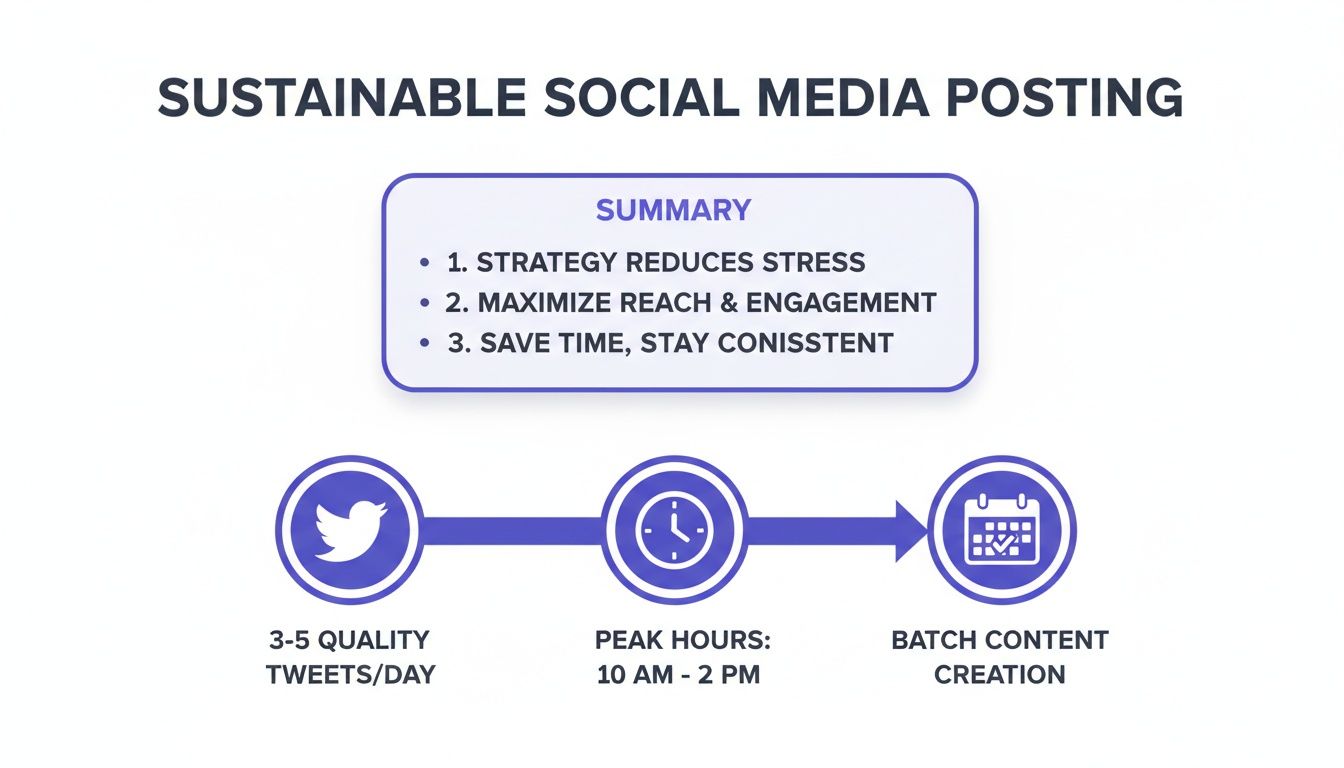
The system works because posting quality tweets, timing them right, and batching your work for consistency all support each other. It's a flywheel.
Don’t Just Participate—Be a Community Builder
Ready to take it to the next level? Start creating your own center of gravity. Instead of only joining other people's conversations, create your own. This is how you go from being a voice in the crowd to a leader in your corner of the internet.
Hosting a weekly Twitter Space on a hyper-specific topic is a fantastic way to do this. Invite other experts to co-host, run live Q&As, and solve real problems for your audience in real-time. It builds incredibly deep connections and establishes you as a go-to person in your community. We dive deeper into this in our guide on using Twitter for community marketing.
Each engagement tactic serves a different purpose, from quick visibility boosts to long-term authority building. Knowing when to use each one is key.
Engagement Tactics and Their Growth Impact
| Tactic | Primary Goal | Typical Impact on Follower Growth |
|---|---|---|
| High-Value Replies | Profile Views, Niche Authority | Steady, high-quality follower gain |
| Quote Tweets | Showcasing Expertise, Reach | Spiky growth from viral content |
| Hosting Twitter Spaces | Community Building, Trust | Slower, but highly loyal followers |
| Participating in Chats | Networking, Visibility | Moderate, targeted follower gain |
| Running Polls | Audience Interaction | Low direct growth, high engagement |
As you can see, a balanced strategy is your best bet. Relying on just one method will limit your potential.
Mastering community interaction is a proven path to growth. We've seen case studies showing 15-25% monthly follower increases for accounts that consistently engage with trending topics and niche communities. It’s this dedication to authentic conversation that turns passive lurkers into the loyal, engaged followers you're looking for.
Analyze Your Performance to Accelerate Growth

You can't improve what you don't measure. Seriously. Flying blind is the slowest, most frustrating way to grow on Twitter. It’s time to stop guessing what works and start using data to build a real feedback loop. This is the secret that separates stagnant accounts from those that see predictable, month-over-month growth.
Forget obsessing over your total follower count for a second. Sure, it feels good to watch that number tick up, but on its own, it’s a vanity metric. It tells you very little about the health of your account or if your strategy is actually working. We need to dig deeper.
Focus on Metrics That Actually Matter
To really get a grip on your growth, you need to track the numbers that show momentum and quality. These metrics tell the real story of what’s hitting home with your audience and what’s falling completely flat.
Here are the key performance indicators (KPIs) I recommend watching every single week:
- Follower Growth Rate: This is so much more insightful than your total follower count. You can calculate it with a simple formula:
(New Followers in a Period / Total Followers at Start of Period) * 100. A steady 5-10% monthly growth rate is a fantastic target when you're starting out. - Engagement Rate: This shows you how many people are actually interacting with your content. Just take the total engagements on a tweet (likes, replies, retweets) and divide it by the total impressions. This speaks to the quality of your content, not just its reach.
- Profile Visits: This one is pure gold. It tells you how many people liked your tweet enough to click through and see who you are. A high number of profile visits is a powerful sign that your content is attracting the right kind of followers.
Keeping an eye on these numbers is like building a command center for your growth. Those who consistently track their performance grow way faster than those who don't. The data shows that monitoring your follower velocity—your net daily changes—is what allows for the data-driven tweaks that can lead to 15-25% monthly gains. To go deeper, you can learn more about using a Twitter follower tracker to understand your growth and see how the top accounts use this data.
Use Twitter Analytics to Find Your Winners
Twitter's built-in analytics tool is surprisingly powerful, and best of all, it's free. Get into the habit of spending 15 minutes in here every week. Just go to "Analytics" in your account, click the "Tweets" tab, and sort your tweets by "Top Tweets."
This simple move reveals your best-performing content from the last month. Don't just glance at it—really study it.
Your top tweets are a roadmap. They are a direct communication from your audience telling you, "We want more of this." Your job is to listen and give it to them.
Look for the patterns. Are your winners mostly threads? Sharp, single-line insights? Do they include personal stories or hard data? Whatever the common thread is, your next move is simple: do more of what's working. Research backs this up, showing that 65% of fast-growing accounts actively find and replicate their winning content formats.
Run Simple Experiments to Learn Faster
Once you’ve got a handle on what works, you can start running small, simple experiments to learn even faster. You don't need to overcomplicate this. An experiment can be as basic as trying two different hooks for the same thread idea.
Here’s a dead-simple framework for running your own growth experiments:
- Form a Hypothesis: "I believe that adding a personal story to my data-driven tweets will increase my engagement rate."
- Run the Test: For one week, intentionally add a short, relevant anecdote to half of your tweets.
- Measure the Results: At the end of the week, compare the engagement rate of the story-based tweets to your regular tweets.
- Iterate: If you were right, integrate that learning into your content system. If not, ditch it and try something new.
This cycle of analyzing, identifying winners, and experimenting creates a powerful flywheel. It turns your content strategy from a guessing game into a methodical process, ensuring your hard work leads to real, sustainable growth.
Answering Your Burning Twitter Growth Questions
Even with the best playbook, you're going to have questions. Growing on Twitter can feel like a moving target, but the core principles are simpler than you think. Let's cut through the noise and tackle the questions I hear most often from founders and creators.
These aren't just hypotheticals; they're the practical hurdles and mindset shifts that often separate the accounts that take off from the ones that stay stuck.
How Long Does It Really Take to See Follower Growth?
This is the big one, and I'll be blunt: it's not a 30-day game. There's no switch you can flip. But, from what I've seen with hundreds of accounts, if you're consistently posting valuable content and engaging every single day, you'll start to feel real momentum in about 3 to 6 months.
The first 1,000 followers are always the toughest. It's a grind. You're building a reputation from absolute zero and proving you're worth listening to. But once you cross that threshold, something magic happens—network effects kick in. Your stuff gets seen by more people, bigger accounts start noticing you, and growth starts to feel less like pushing a boulder uphill. Don't give up in those first few months. Consistency is your only superpower.
Your initial goal isn't to go viral; it's to be reliable. Show up every day with something smart to say, and the right people will find you. The growth curve isn't a straight line—it’s an S-curve that starts painfully slow.
Should I Use Automation Tools to Grow My Following?
Let's be very clear about this: there's good automation and there's bad automation.
Using tools to schedule your content is smart. In fact, it's pretty much essential if you want to stay consistent without completely burning out. That's strategic.
But using bots to auto-follow, auto-like, or spam generic DMs? That's a one-way ticket to a dead audience full of ghosts. It's against Twitter's rules, and more importantly, it screams "I'm looking for shortcuts, not connections." Real growth is built on human interaction, period. Stick to tools that help with scheduling and analyzing your performance, not faking engagement.
Is a Super-Narrow Niche Better Than a Broad Topic?
When you're starting out, going narrow is almost always the right move. It’s far easier to become the go-to person for "AI tools for writers" than it is to be just another person yelling about "marketing."
Picking a tight niche does two things brilliantly:
- It makes your value crystal clear. People know exactly what they're getting when they follow you.
- It attracts a hyper-relevant audience. You get followers who are genuinely obsessed with your specific flavor of expertise.
This doesn't mean you're stuck there forever. Once you've built authority and a loyal base, you can absolutely start to broaden your topics. For a deeper dive into what really moves the needle in organic growth, check out this expert guide to building your Twitter following. The strategy is simple: start as a specialist, earn trust, then expand your turf.
How Important Are Hashtags for Growth Anymore?
Hashtags aren't the magic growth hack they were five years ago, but they aren't totally useless either. Think of them as a secondary tool for discovery, not your primary engine for growth.
My advice is to use maybe one or two highly relevant hashtags in a tweet, especially if they tie into a specific community or event (like #SaaS, #FinTwit, or #Web3). This can help people who are actively searching for those topics find your content.
But let's be real: your growth will come from the quality of your ideas and the conversations you start, not from cramming your tweets with a dozen hashtags. Write something compelling first, then maybe sprinkle a hashtag on top.
Ready to stop guessing and start growing your professional presence with a consistent, AI-powered content system? PostFlow turns your expertise into engaging LinkedIn content without the struggle. Let Emilia, your AI content strategist, help you build your authority today.