
We've all been there. Staring at a blank LinkedIn post, the cursor blinking, with absolutely no idea what to say. It's a frustratingly common spot for founders, freelancers, and consultants. A content planning template is your way out, transforming those scattered ideas into a reliable pipeline of content that actually builds your authority.
Why a Content Plan Is Your Greatest Advantage
Relying on last-minute inspiration is a recipe for burnout and missed opportunities. A structured approach, however, completely flips the script. It kills the daily stress of "what do I post today?" and ensures your voice stays consistent, methodically building your reputation as an expert.
Think of it less like a rigid set of rules and more like a framework that gives you freedom. Instead of waking up and scrambling, you just look at your plan and know exactly what topic to hit, what format to use, and how it ladders up to your bigger business goals. This is the crucial shift from being just another content creator to becoming a content strategist.
From Chaos to Consistency
Let's be blunt: the biggest win from a content planning template is turning random acts of content into a predictable system. Consistency is king on platforms like LinkedIn. The algorithm rewards people who show up regularly, and more importantly, your audience learns to expect and look forward to your insights.
A structured plan is one of the best predictors of consistent posting. This is a huge deal when you realize LinkedIn now has over 1 billion members, yet only about 1% of users post weekly. That tiny group racks up an estimated 9 billion impressions every week. It shows just how much visibility is up for grabs for the small minority who simply show up consistently.
A System for Better Ideas
A great content plan does more than just schedule posts—it actually helps you come up with better ideas. Once you've defined your content pillars and your posting cadence, your brain starts filtering everything through that lens. A casual client conversation turns into a potential case study. An industry article sparks a strong point-of-view post. A personal reflection fits perfectly into your "storytelling" slot for Friday.
This is a quick look at how the core pieces of a modern content plan fit together, creating a system that’s both strategic and manageable.
Key Components of a Modern LinkedIn Content Plan
| Component | Purpose | PostFlow Integration |
|---|---|---|
| Content Pillars | Core themes that define your expertise and brand. | Categorize ideas under specific pillars in your content library. |
| Posting Cadence | The frequency and timing of your posts (e.g., 3x a week). | Use the scheduler to set and automate your posting rhythm. |
| Content Formats | The mix of post types (text, image, poll, etc.) you use. | Plan and draft different formats directly in the editor. |
| Idea Repository | A central place to capture raw ideas and inspiration. | The "Record" feature acts as your on-the-go idea bank. |
| Analytics Review | A scheduled check-in to see what's working and what's not. | Track post-performance to refine future content themes. |
Each element supports the others, creating a feedback loop that continually improves your content's impact and reach. You can dig deeper into building a dedicated social media content calendar to really flesh this out.

The image above gets to the heart of it. An organized system, like the one we've built into PostFlow, is what turns those rough notes scribbled in a notebook into polished, ready-to-schedule content. The whole point is to remove friction, making it ridiculously easy to get from a fleeting thought to a published post that actually drives results for your business.
Defining Your Core Content Pillars
Before you ever touch that content planning template, you need a solid foundation. Think of it this way: you wouldn't build a house on shaky ground, right? Your content pillars are that foundation—the 3 to 5 core topics you’re going to absolutely own.
They sit at the sweet spot where your expertise, your audience’s pain points, and your business goals all meet. Nail this, and I promise you, creating content becomes infinitely easier.
Instead of chasing every fleeting trend, pillars keep your content grounded and valuable. They're your guideposts, making sure every single thing you post reinforces your authority and talks directly to the people you actually want to reach. It’s the difference between shouting into a crowded room and having an engaging one-on-one conversation.
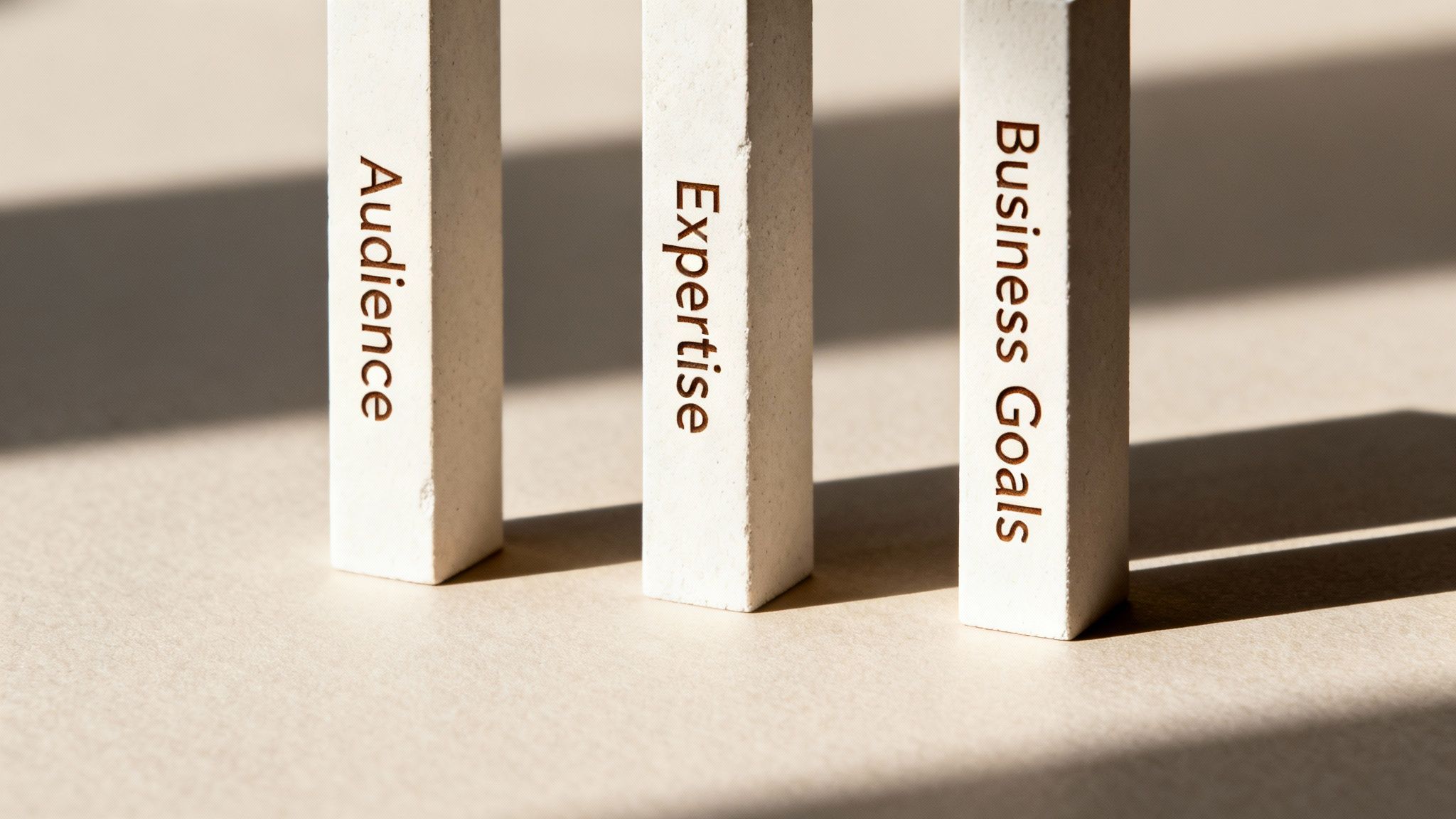
Honestly, just think of them as the main categories of your professional brain. Every post, every video, every comment should ladder back up to one of them. It’s a simple constraint that kills decision fatigue and makes brainstorming feel less like a chore.
Finding Your Pillar Sweet Spot
So, how do you find these magical pillars? Start by asking yourself three straightforward questions. The answers will point you directly to the most powerful themes for your brand.
- What am I a true expert in? Jot down the skills and knowledge you possess that set you apart. Don't be shy.
- What keeps my audience up at night? What are their biggest headaches and challenges that you are uniquely equipped to solve?
- What do I want to be known for? Think about how your content ties back to the services or products you're selling.
That overlap? That's where you'll find your strongest content pillars. If you want to go even deeper on this, our guide on building a LinkedIn content strategy framework is a fantastic resource.
Key Takeaway: Your pillars can't just be topics you find interesting. They need to be commercially viable and solve a real, pressing problem for your target audience.
Let's get practical for a second. A pillar like "Marketing" is useless. It’s way too broad and tells me nothing about your specific expertise. You’ve got to get specific to stand out.
Real-World Pillar Examples
Seeing how this works in the wild always helps. Here’s how a couple of different professionals could define their pillars for LinkedIn.
Example 1: A B2B SaaS Founder
This founder needs to attract investors, top talent, and their first wave of customers. Their content has to scream vision, leadership, and industry disruption.
- Pillar 1: Bootstrapped Growth Tactics - This immediately shows their resourcefulness and gives other founders something they can actually use. It’s a direct signal of business savvy.
- Pillar 2: Building a Remote-First Culture - Perfect for attracting top talent. It positions them as a modern leader who gets it.
- Pillar 3: The Future of [Their Industry] - This is pure thought leadership. It’s what grabs the attention of investors and establishes them as someone with a clear vision.
Example 2: A B2B Sales Consultant
This consultant’s goal is to land high-ticket clients. Their content needs to radiate expertise and prove they can deliver results, period.
- Pillar 1: Outbound Prospecting Systems - Super specific and targets a massive pain point for sales teams. It shows they have a process.
- Pillar 2: Closing Complex Enterprise Deals - This signals experience with the big fish, which builds immediate trust and authority with other large companies.
- Pillar 3: Sales Team Leadership and Coaching - This widens their appeal. It shows they don’t just understand the process; they understand the people behind it.
Once you have these pillars locked in, they become the absolute backbone of your content planning template. Every idea you come up with from here on out will have a home.
Nail Down Your Weekly Posting Cadence
You've got your content pillars sorted. Awesome. Now, let's turn those pillars into a weekly rhythm. Building real authority on LinkedIn isn't about random flashes of brilliance—it’s about showing up consistently, so your audience knows when to expect value from you. This is where your content plan really starts to take shape.
Think of a weekly cadence as a framework, not a cage. It's there to kill decision fatigue. No more staring at a blank screen on a Tuesday morning, wondering what to post. You’ll already know it's an "educational day," which makes creating content a whole lot easier.
Design a Balanced Weekly Flow
Your goal is to mix things up strategically throughout the week. A good mix keeps your feed interesting and hits different parts of your audience. Some people follow you for personal stories; others are hunting for tactical advice. A solid cadence serves them all.
I've seen this three-post-per-week model work wonders for founders, freelancers, and consultants. It’s simple but powerful:
- Monday: The Personal Story Post. Kick off the week by building a connection. Share a lesson you learned the hard way, a personal win, or a look behind the curtain of your business. This is how you build trust and show the human behind the brand.
- Tuesday: The Educational Post. Time to switch gears and deliver pure value. This is the perfect spot for a multi-image carousel that breaks down a tricky concept, a practical "how-to" text post, or even a quick video tutorial. This is where you flex your expertise.
- Thursday: The Point-of-View (POV) Post. End the work week with a strong, confident take. Share your opinion on an industry trend, push back on a common belief, or make a bold prediction. This is what sparks conversation and cements you as a thought leader.
This structure ensures you’re consistently hitting the trifecta of connection, education, and authority. To get even more mileage out of it, look into smart content repurposing strategies to turn one idea into multiple pieces of content.
Prioritize High-Engagement Formats
Let's be real—not all post formats are created equal. The average LinkedIn engagement rate hovers around 2.8%, but certain formats can blow that number out of the water.
Multi-image carousels, for example, can see engagement rates closer to 6.6%. Document posts and videos also perform really well. A modern content plan has to account for this, making sure you’re intentionally slotting in these high-impact formats.
This is where PostFlow’s calendar view becomes your best friend. It lets you see your content mix visually, so you're not just defaulting to text posts every single day.
A quick glance at your calendar can tell you if you're leaning too heavily on one format. A balanced calendar almost always leads to a more engaging feed for your followers.
Pro Tip: Don't treat your schedule like it's set in stone. The Monday-Tuesday-Thursday plan is a fantastic starting point, but your audience is unique. Dive into your analytics. See which days and times get the most traction, and don't be afraid to adjust your cadence based on that data.
Ultimately, the best cadence is the one you can actually stick to. We dive deeper into finding your perfect frequency in our guide to creating a social media posting schedule. The whole point is to build a system that makes showing up regularly feel less like a chore and more like second nature.
Turning Your Template into an Actionable Workflow
A well-structured content plan is a great start, but let's be honest—it’s just a static document until you breathe some life into it. The real magic happens when you turn that plan into a dynamic, repeatable workflow that consistently gets ideas from your head onto your LinkedIn feed.
This isn’t about adding more work to your already-packed schedule. It's about creating a smooth pipeline that starts with capturing those fleeting thoughts and ends with a polished, scheduled post that actually moves your business forward. It's how you make consistency feel less like a chore and more like a habit.
From Raw Ideas to Refined Posts
Your best content ideas rarely show up when you're staring at a blank screen. They pop up during a client call, while you're listening to a podcast, or in the middle of a workout. The very first step in a killer workflow is having a dead-simple way to capture these moments before they vanish.
This is why I'm a huge advocate for voice notes. Recording a quick, unfiltered thought is so much faster than stopping everything to type it out. You can capture the genuine energy and nuance of an idea in seconds.
- Capture a Client Story: Just wrapped up a great call? Record a 30-second summary of the problem they had and the solution you gave them.
- Record an Opinion: Just read an interesting industry article? Hit record and talk through your immediate reaction or counterpoint.
- Document a Personal Insight: Had a "lightbulb moment" about your business? Capture that feeling and the lesson you just learned.
Seriously, a single two-minute voice note can hold enough raw material for 3-5 distinct post ideas. This simple habit ensures your content template never runs dry. As you build this workflow, it's also smart to stay updated on the latest strategies for LinkedIn to keep your content sharp.
The Goal: Make idea capture so easy that it becomes second nature. Your daily experiences are your greatest source of content—your workflow should be designed to mine them effectively.
Here’s a simple weekly rhythm I've seen work wonders. It helps you visualize what's coming up and mentally prep for the type of content you need to create.
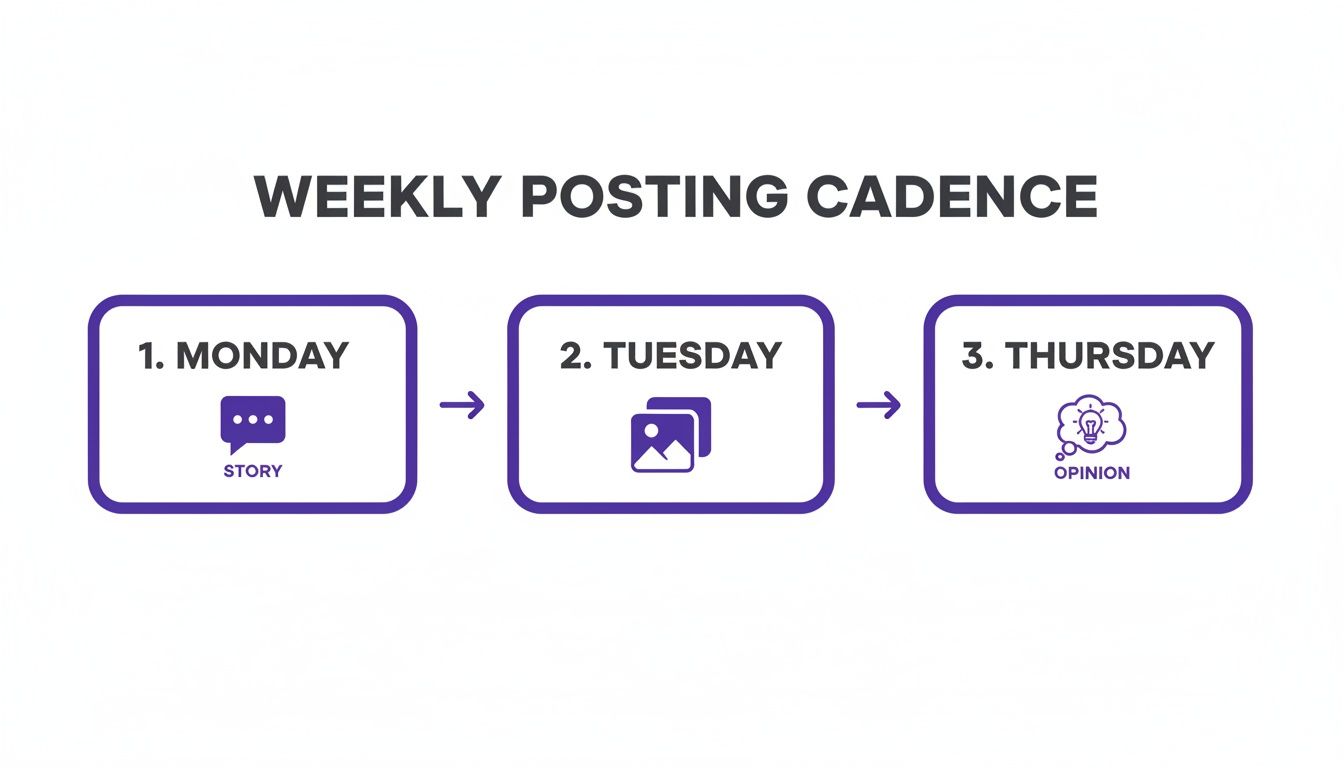
Mapping out your week like this takes the guesswork out of creation and helps you build a more balanced, engaging feed over time.
Bringing it All Together in Your Workspace
Okay, so you've got a growing bank of recorded ideas. Great. But you can't let those gold nuggets languish in a folder full of audio files. The next phase is all about refinement and scheduling, and this is where having a central hub is a game-changer.
The process should feel intuitive. Imagine this: your raw, transcribed notes from a recording sit on one side of your screen, your post editor is right in the middle, and a live preview of the final post is on the other. This setup lets you pull key phrases and concepts directly from your notes straight into a structured post.
This is exactly how a tool like PostFlow streamlines the whole process. It’s all about creating a visual system that connects the initial spark of an idea to the final, polished output. By integrating these steps, your content planning template evolves from a mere guide into the engine of your entire content machine.
Download Your Ready-To-Use Template
All the theory in the world is great, but it's putting it into practice that actually gets you somewhere. To help you skip the dreaded blank-page phase and jump right into action, we've put together a content planning template built specifically for LinkedIn.
But we didn't stop at just one generic version. We've designed three distinct templates, each one geared toward the unique goals of different professionals. You can grab the one that fits your world and start plugging in your own ideas today.
Which Template Is Right for You?
Each downloadable template comes pre-loaded with example content pillars, a suggested weekly cadence, and a bunch of post ideas that align with common professional goals. It takes the guesswork out of the equation and gives you a proven structure to build on.
Just pick the version that matches what you do:
- For the Startup Founder: This template is all about telling a powerful story. The pillars are built around sharing your vision, showing off your team culture, talking about industry disruption, and crafting fundraising narratives. The whole point is to build a brand that pulls in top talent, early customers, and maybe even a few investors.
- For the B2B Consultant: This one is laser-focused on demonstrating expertise and building rock-solid trust. It prioritizes pillars like client case studies, deep-dive tactical guides, and sharing your strong point-of-view on industry trends. Every single piece of content is designed to prove you can deliver real, tangible results.
- For the Freelancer: This template is your engine for showcasing skills and attracting a steady stream of high-quality clients. The pillars here are all about your specific craft, giving behind-the-scenes glimpses into your process, and highlighting glowing client testimonials. It's built to turn your LinkedIn profile into a lead-gen machine.
My Pro Tip: Don't treat these templates like a strict set of rules. Think of them as a launchpad. The best content plans I've ever seen are the ones that evolve as you learn what your audience actually wants to see from you.
Download the template that feels right for your brand, and start making it your own. At the end of the day, the best content plan is one that feels like a natural extension of who you are and what you're trying to achieve. Use these as a solid foundation to make your content creation process both strategic and sustainable.
Even with the perfect template, questions are going to pop up. It happens to everyone.
Here are the most common ones I hear from founders, consultants, and freelancers who are getting serious about their LinkedIn content plan. Think of this as your back-pocket guide for when you feel stuck.
How Far in Advance Should I Plan My LinkedIn Content?
You're looking for the sweet spot between strategy and spontaneity. Here’s how I break it down.
Plan your big-picture themes and content pillars quarterly. This gives you a solid strategic roadmap for the next three months without boxing you in.
When it comes to the actual posts, aim to work two to four weeks ahead. This is the perfect runway. You'll stay consistent without losing the flexibility to jump on a timely piece of industry news or share a sudden insight from a client call. A tool like PostFlow is a game-changer here, letting you build up a bank of approved posts you can slot into your calendar a week or two out. No more last-minute scrambling.
What Is the Ideal Number of Times to Post on LinkedIn Per Week?
Let me be crystal clear on this: consistency always trumps frequency. Don't burn yourself out trying to post multiple times a day.
For most busy professionals I work with, posting three to five times per week is the magic number.
It’s enough to keep you on the LinkedIn algorithm's good side and stay top-of-mind with your audience. Crucially, it's also a manageable pace that prevents burnout and stops your content quality from taking a nosedive. This is exactly why a content plan is so vital—it makes this rhythm achievable by giving you a pipeline of ideas ready for your key posting days.
A plan isn't a straitjacket; it's a starting point. It's designed to give you direction, not take away your ability to be spontaneous. The goal is to make smart, strategic choices, even when new opportunities arise.
How Do I Generate Enough Ideas to Fill My Content Template?
This is the hurdle where almost everyone stumbles. The key isn't having more ideas; it's having a better system to capture and develop them.
First, lean on your content pillars. They’re your best friend for instantly narrowing your focus and killing the "what should I post about?" paralysis. Second, get into the habit of capturing ideas the second they hit you.
This is where a feature like PostFlow's voice recording is so powerful. Just had a great client call? Walked away from a meeting with a strong opinion? Grab your phone and just talk it out. Our AI strategist, Emilia, can then spin that single recording into several distinct post ideas, making it ridiculously easy to fill your template.
How Do I Measure the Success of My Content Plan?
Likes and impressions are vanity. Success is about tracking metrics that actually tie back to your business goals.
When you dive into your analytics, zone in on these three things:
- Engagement Rate: Forget likes. Are people leaving thoughtful comments and sharing your posts? That’s what matters.
- Profile Views: Is your content compelling enough to make people click through to learn more about you?
- Inbound Connections & DMs: This is the big one. Are people reaching out and actually mentioning your content?
A plan that’s truly working will deliver a slow but undeniable increase in meaningful conversations and real leads. That’s the only ROI that counts.
Ready to stop staring at a blank screen and start posting with purpose? PostFlow gives you the tools and the AI-powered strategy to turn your expertise into consistent, high-impact content. Get started with PostFlow today and build the LinkedIn presence your business deserves.