
Thinking about starting a blog about social media? It can feel like you're just adding to the noise, but trust me, it’s still one of the best ways to carve out your space and build real authority in this fast-moving industry. This guide is all about cutting through the fluff. We’ll get you from a rough idea to a blog that actually pulls in a loyal audience and positions you as the go-to expert you are.
Let's dig in.
Laying the Foundation for Your Social Media Blog

Before you even think about writing that first post, you need to get crystal clear on what your blog is all about and who you're talking to. This isn't the boring part; it's the most critical. Getting this foundation right makes everything else—from writing content to promoting it—so much easier and more effective.
Treat your blog like a brand from day one. What's its personality? Are you all about hard data and analytics, or are you the creative, inspirational type? Getting a handle on creating effective social media branding guidelines early on is a game-changer. It keeps your visuals, tone, and message tight and consistent everywhere.
Defining Your Core Purpose
Look, the world doesn't need another generic "social media tips" blog. The ones that truly succeed are built on a sharp, clear purpose. You have to find your unique angle.
Ask yourself these questions to nail it down:
- What specific problem am I solving? Are you helping freelance creators finally figure out TikTok, or are you showing B2B consultants how to win on LinkedIn? Get granular with the pain point.
- Who is my exact reader? "Small business owners" is way too broad. Think more like, "Etsy sellers who want to use Pinterest to drive actual sales." Now we're talking.
- What’s my unique perspective? This is where you lean into your own story. Did you grow an Instagram account from 0 to 100k followers? That's your goldmine. Share that journey.
Your unique voice and niche expertise are your greatest assets. In a sea of content, specificity is what makes readers choose your blog over others. Don't be afraid to go narrow; a dedicated audience is far more valuable than a broad, disengaged one.
Nailing this down sets the stage for everything that comes next. If you want to dive even deeper into the nuts and bolts of getting set up, our guide on how to start blogging covers these initial steps in more detail.
Finding Your Niche in the Social Media Universe
Let's be brutally honest: starting a blog "about social media" is like opening a restaurant that just serves "food." It’s a recipe for getting lost in the noise. To stand a chance, you can't be everything to everyone. You have to be the one indispensable resource for a very specific group of people.
Your real competitive advantage isn't being broader; it's being deeper. Who, exactly, are you trying to help? What's the one nagging problem you can solve better than anyone else? That's where you'll find your footing.
Moving Beyond Broad Topics
So many social media blogs get stuck in the shallow end, writing about generic topics like "how to get more followers." The real question is, who needs those followers and why? Specificity is your superpower.
Think about the difference here:
- Broad: "Tips for Instagram Marketing"
- Niche: "Instagram growth strategies for freelance photographers and visual artists."
Or this one:
- Broad: "How to use LinkedIn for business."
- Niche: "LinkedIn content systems for B2B consultants who hate selling."
See the difference? The niche version instantly signals to a very specific person, "Hey, this is for you." You’re not just handing out random tips; you're solving a real-world business challenge for a clearly defined audience.
Identify Underserved Audiences
Your biggest opportunity is almost always in a corner of the market that the big-name blogs are ignoring. Start thinking about professional groups who rely on social media but probably aren't experts at it.
Maybe it's real estate agents fumbling with TikTok video tours, or non-profit managers trying to figure out Facebook fundraising campaigns. The more dialed-in you get, the easier it becomes to create content that feels like it was written just for them.
Take B2B consultants, for example. They are masters of their craft but often struggle to turn that expertise into compelling online content. This is a massive, underserved pain point. Consider that over 59% of LinkedIn's user base are millennials, and a staggering 11 million of them are in decision-making positions. According to data from Statista.com on LinkedIn's demographics, this group dominates the platform, making them a golden audience for any B2B-focused blog.
A powerful niche is born at the intersection of your expertise, your audience's passion, and a problem they are willing to invest time or money to solve. Find that sweet spot, and you've found your content goldmine.
Create a Detailed Reader Persona
Once you’ve zeroed in on an audience, give them a face and a name. A reader persona is basically a character sketch of your ideal reader. It's not just a demographic profile; it's about understanding their goals and, more importantly, their frustrations.
Let's stick with our B2B consultant and build a quick persona:
- Name: Alex Chen
- Role: Independent Management Consultant
- Goals: Attract high-ticket clients without cold calling; build a reputation as a thought leader.
- Pain Points: Feels awkward "bragging" on LinkedIn; doesn't have time to create content consistently; isn't sure what to post beyond sharing industry news.
Now, every single time you sit down to write, you have a simple filter: "Would this actually help Alex?" This keeps your content laser-focused and genuinely useful.
Analyze What Your Competitors Are Missing
No niche is an island. Once you have your focus, find 3-5 other blogs or creators talking to a similar crowd. Your goal isn't to copy them—it's to find the gaps they've left wide open.
A simple framework can help you map out the landscape and spot your opening.
Social Media Niche Selection Framework
Use this table to brainstorm and validate potential niches for your social media blog by evaluating audience size, competition, and monetization potential.
| Niche Idea | Target Audience Example | Competition Level (Low/Med/High) | Monetization Potential |
|---|---|---|---|
| Social Media for Authors | Self-published fiction writers | Medium | Ebooks, Courses, Coaching |
| Pinterest for Etsy Sellers | Handmade craft sellers | High | Affiliate Links, Templates |
| LinkedIn for Financial Advisors | Independent financial planners | Low | Consulting, Services |
| TikTok for Local Restaurants | Small, family-owned eateries | Low | Local Workshops, Services |
Look for patterns. Are they all just writing beginner-level posts? You can go intermediate or advanced. Do they only publish articles? Maybe there's a huge opportunity for video tutorials, checklists, or templates.
Your unique angle comes from filling a need that everyone else is overlooking. This kind of methodical approach is what separates a blog that just adds to the noise from one that builds a real, loyal audience.
Building Your Content Strategy and Editorial Calendar
A great blog about social media doesn't just happen. It isn't built on random late-night strokes of genius. It's powered by a smart, consistent content strategy—the actual engine that keeps your blog moving with purpose.
Without a plan, you'll constantly be scrambling for ideas and publishing whenever you feel like it. That's the fastest way I've seen blogs lose steam and fade away.
So, let's build that engine. First up, you need to lock in your core content pillars. These are the 3-5 big-picture topics that your blog will be known for. Think of them as the main categories you'd see in your site's navigation. Every single article you publish should slide neatly into one of these buckets.
Defining Your Core Content Pillars
Let’s say you’ve decided to niche down to "LinkedIn for B2B consultants." Your content pillars might look something like this:
- Content Creation: Real, tactical guides on writing killer posts, designing scroll-stopping carousels, and even scripting short videos.
- Audience Growth: Proven strategies for connecting with the right clients and building a network that actually matters.
- Lead Generation: Smart tactics for turning your LinkedIn hustle into real sales calls and paying clients.
- Personal Branding: Actionable tips for optimizing your profile, becoming a recognized thought leader, and building a reputation people trust.
These pillars give your blog a solid structure. They clearly signal to both readers and Google what you’re an expert in. Plus, they make brainstorming new article ideas a whole lot easier.
Your content pillars are basically a promise you make to your readers. They set the expectation that you have deep, focused expertise in the exact areas they care about, which is how you build real trust.
Brainstorming and Organizing Ideas
Once you have your pillars locked down, you can start mapping out specific article ideas. A simple but powerful way to do this is with topic clustering. For each pillar, plan out one massive "pillar page" (a super comprehensive, ultimate guide) and then several "cluster posts" (shorter articles that dive deep into one specific subtopic).
Using our "Content Creation" pillar, here’s how that might look:
- Pillar Page: The Ultimate Guide to Creating High-Engagement LinkedIn Content
- Cluster Posts:
- 5 Proven Hooks for Your Next LinkedIn Post
- How to Design LinkedIn Carousels That Stop the Scroll
- A Simple Framework for Turning One Idea into a Week of Content
This little infographic breaks down a simple workflow for turning audience knowledge into a concrete content plan.
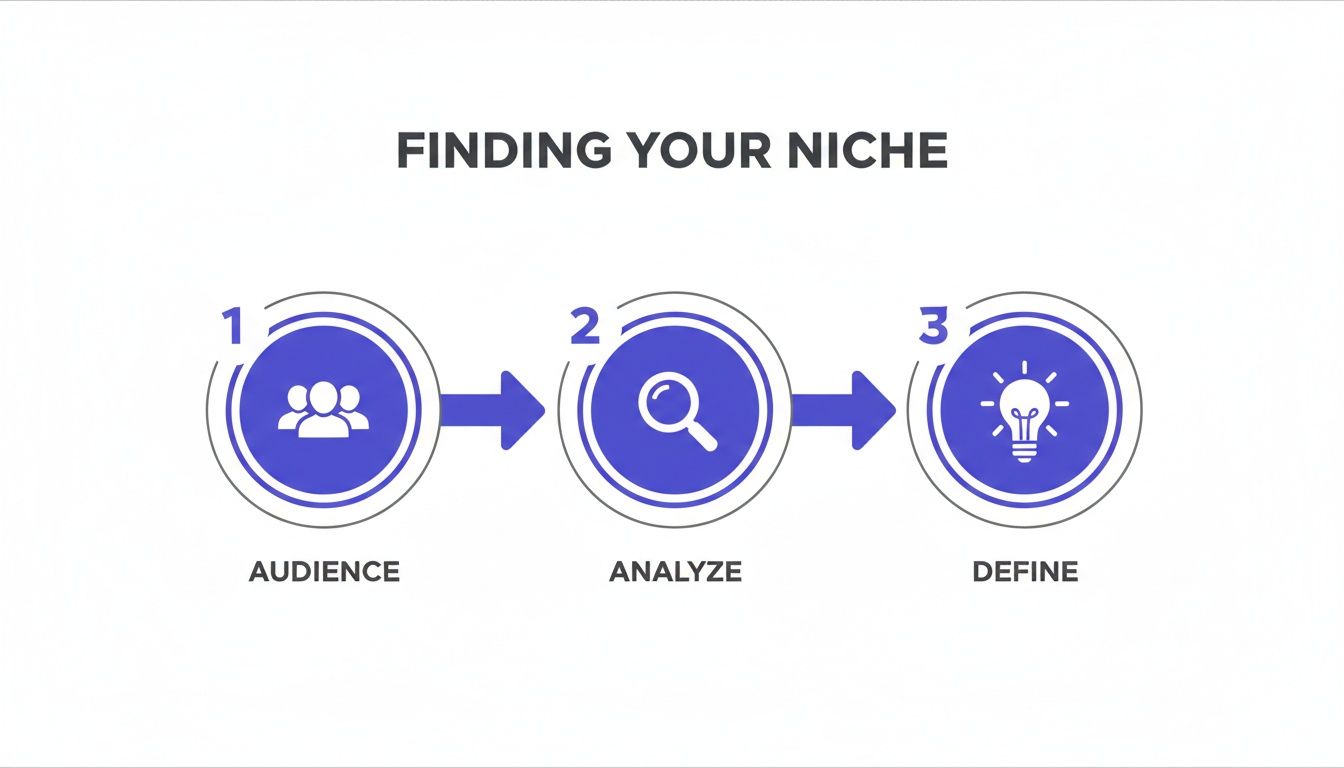 This whole process makes sure you're always writing stuff that hits on a real need for your target reader. It keeps your strategy sharp and effective.
Creating a Functional Editorial Calendar
Okay, now you need a system to organize all this brilliance. An editorial calendar is so much more than a to-do list with dates; it’s your command center. It’s what turns your strategy into a real, actionable plan and ensures you’re publishing consistently—something your audience will come to expect and rely on.
Your calendar doesn't have to be some fancy, expensive software. Honestly, a simple spreadsheet is often the best tool for the job. We've got some great templates and ideas you can steal from our guide on building a social media content calendar, which you can easily tweak for your blog.
At a minimum, your calendar should track a few key things for every post you plan:
| Column Header | Description | Example |
|---|---|---|
| Publish Date | The day the article will go live. | October 28, 2025 |
| Working Title | A draft headline for the article. | How to Write a LinkedIn Hook |
| Content Pillar | The main category it falls under. | Content Creation |
| Target Keyword | The primary SEO phrase you're aiming for. | "LinkedIn post hooks" |
| Content Format | The type of article. | How-to Guide, Listicle, Case Study |
| Status | The current stage of production. | Idea, Drafting, Editing, Scheduled |
This kind of structured approach takes all the guesswork out of creating content. You’ll never have to wake up and ask, "Ugh, what should I write today?" Instead, you just pull up your calendar and get to work on the next strategic piece. Consistency is what builds authority, and a solid editorial calendar is the tool that makes it happen.
Mastering SEO for Your Social Media Blog
You can write the most brilliant, insightful content on the planet, but if nobody can find it, does it even matter? This is where Search Engine Optimization (SEO) comes into play. It’s all about making your blog pop up when people are actively searching on Google for the exact expertise you offer.
Don't let the acronym scare you off. For a blog about social media, SEO isn’t some dark art of complex code. It’s about understanding what your audience is desperately trying to figure out and then serving up the answer in a way search engines can easily understand.
Think of it as paving a brightly lit path from someone's question straight to your blog post.
Start with Smart Keyword Research
Before you type a single word, you have to get inside your audience's head. What are they actually typing into that search bar? This is the entire game of keyword research. The sweet spot is finding topics people are searching for, but that aren't already dominated by the huge players.
Forgetting a super broad term like "social media marketing" is a good start—it's just too competitive. Instead, you want to hunt for more specific, long-tail keywords. These are the longer, more conversational phrases that show someone knows exactly what they're looking for.
- Too Broad: "LinkedIn tips" (Massive competition, vague intent)
- Just Right: "how to write engaging LinkedIn hooks for consultants" (Way less competition, super clear intent)
- Too Broad: "Instagram growth" (Good luck with that one)
- Just Right: "Instagram Reels strategy for local restaurants" (Now you're talking!)
Tools like the free Google Keyword Planner or paid powerhouses like Ahrefs and Semrush are your best friends here. You're looking for keywords where you can create a better, more detailed answer than what's currently ranking. That specificity is your secret weapon.
SEO success isn't about trying to trick Google. It’s about genuinely helping your audience by creating the best, most relevant answer to their specific questions. Focus on user intent, and you’ll naturally align with what search engines want to promote.
Nail Your On-Page SEO Fundamentals
On-page SEO just means optimizing the stuff directly on your blog posts. These are simple but incredibly powerful signals that tell Google what your article is all about, making it way easier to rank for your target keywords.
Here’s the bare-minimum checklist for every single article you hit ‘publish’ on:
- Compelling Title Tag: This is your big headline in the search results. It has to include your main keyword and be juicy enough to make someone click. "10 Actionable LinkedIn Post Ideas for B2B Coaches" will always beat a snoozer like "LinkedIn Ideas."
- Engaging Meta Description: This little summary under your title is your ad copy. It doesn't directly affect rankings, but a killer meta description convinces people to click on your link instead of the one above or below it.
- Clean URL Structure: Keep your URLs short, sweet, and descriptive. A URL like
yourblog.com/linkedin-post-ideasis infinitely better than a messy one likeyourblog.com/p=123. - Logical Header Structure: Use headings (H2s and H3s) to break up your content and create a logical flow. Your main title is always an H1. This makes it scannable for humans and helps search engines map out the structure of your post.
Build Authority and Earn Trust
Beyond the post itself, Google wants to see that your entire blog is a credible source on social media. This really comes down to two things: topical authority and backlinks.
Topical authority is what you build when you consistently publish deep, high-quality content around your main topics. If you create a whole cluster of amazing articles all about "LinkedIn content strategy," you start sending strong signals to Google that you're an expert on that subject.
Backlinks are simply links from other websites pointing to your blog. Think of each one as a "vote of confidence." When another reputable site links to you, they're telling search engines that your content is trustworthy. You can earn these naturally by creating incredible stuff people want to share, or by being a guest on other blogs in your niche.
Getting SEO right is a marathon, not a sprint, but the payoff is huge. It's the engine that drives a steady, reliable stream of organic traffic—people who are actively looking for the solutions you provide.
Promoting Your Content and Building an Audience

Hitting "publish" on a post you’ve poured hours into feels great, but let's be real—that’s just the starting line. The real work begins now. Your content's journey is all about smart, strategic promotion. Great writing deserves an audience, and your job is to build the bridges that connect your insights with the people who actually need them.
I see so many new bloggers make the same mistake: they just drop links to their articles on social media and hope for the best. This "spray and pray" approach is a waste of time. If you want to build a real audience for your blog about social media, you have to treat each platform like its own unique channel.
Repurpose Your Content Natively for Each Platform
Stop just sharing links. Your goal is to repurpose the core ideas from your blog posts into content that feels natural on each social network. This means breaking down your big article into smaller, bite-sized pieces of value.
Think about it this way. For a single blog post, you could create:
- A LinkedIn carousel post: Turn the main sections of your article into a slick slide deck that summarizes the key takeaways.
- An X (formerly Twitter) thread: Break down your main points or steps into a series of short, punchy tweets that tell a story.
- An Instagram Reel or Story: Grab a killer statistic or a powerful quote from your article and use it as the hook for a short video.
- A YouTube Short: Create a quick vertical video explaining one core concept from your post, then point viewers back to the blog for the full breakdown.
If you're serious about using video, this guide to video social media marketing is a goldmine. This approach easily turns one blog post into a full week's worth of promotional content, massively extending its reach.
Make LinkedIn Your Thought Leadership Hub
For anyone writing about social media, LinkedIn isn't just another platform—it's your main stage. People on LinkedIn are actively looking for insights to help their careers and businesses. This is where you build your reputation and prove you know your stuff.
And the audience is massive. As of early 2025, LinkedIn now has a staggering 1.2 billion members worldwide, a number that’s almost doubled in just six years. This isn't just a huge crowd; it’s a concentrated network of founders, consultants, and decision-makers hungry for quality content. To cut through the noise, you have to be consistent. For more on this, check out the latest LinkedIn statistics.
Don't just share links to your blog on LinkedIn. Share the ideas from your blog. Post a key framework, a surprising stat, or a personal story related to your article. Then, engage in the comments, ask questions, and build a real conversation.
Expand Beyond Your Own Channels
Repurposing content for your own profiles is step one. Step two is venturing out to find your audience where they already hang out.
- Guest Posting: Find other respected blogs in your niche and offer to write for them. This gets your name in front of an established, relevant audience and scores you a valuable backlink.
- Engage in Online Communities: Find relevant groups on LinkedIn, Facebook, or even Reddit. Don't just drop links and run. Actually participate. Answer questions, share your knowledge, and when it makes sense, mention a relevant article you've written.
- Build Your Email List: Start this from day one. Your email list is the only audience you truly own, safe from any algorithm changes. Offer a valuable freebie—like a checklist or a template—to get people to sign up.
Building an audience is a long game. It’s all about consistently showing up and providing real value. For more actionable strategies, check out our guide on how to increase blog traffic and start expanding your reach today.
From Passion Project to Paycheck: Monetizing Your Expertise
So, you've put in the work. You're consistently dropping value, your audience is growing, and people are starting to see you as a go-to expert. This is the moment your blog about social media starts to shift from a passion project into a real business asset.
Now, let's talk about making money. But forget plastering your site with a million blinking ads. The best way to monetize is to double down on the trust you’ve already built. The goal is to get paid for serving your audience, not for distracting them.
Start with Authentic Affiliate Marketing
Affiliate marketing is the most natural place to start. It’s simple: you recommend products or services you actually use and believe in, and you get a small commission when someone buys through your link. For a social media blog, this could be your favorite scheduling tool, the mic you use for videos, or an analytics platform you can't live without.
The whole game here is authenticity. If you wouldn't recommend it to a friend over coffee, don't recommend it to your audience.
- Go beyond the link. Write an in-depth review showing exactly how you use a tool in your own workflow. Share before-and-after screenshots.
- Create comparison posts. Help your readers choose by breaking down a few popular tools. Who is each one for? What are the real pros and cons?
This turns a simple affiliate link into another piece of high-value content that genuinely helps people, which is what got them to trust you in the first place.
Your readers trust you for your honest, expert advice. Affiliate marketing should feel like an extension of that trust, not a betrayal of it. You're not just pushing products; you're recommending solutions.
Level Up by Selling Your Own Digital Products
The next logical step is to package your knowledge into something you can sell directly. This is where you really cement your authority and gain full control over your income. You already know your audience's biggest frustrations because they tell you in the comments and DMs every day.
What questions pop up over and over again? What are they struggling with? Turn those pain points into products.
A few ideas to get you started:
- Ebooks: Think super-focused guides like "The Ultimate Guide to LinkedIn for B2B Startups."
- Templates: Save your audience time with things they can use immediately, like a social media content calendar, a pack of Canva templates for Instagram, or a set of outreach scripts.
- Online Courses: Build a structured, step-by-step program that walks people through a bigger transformation, like "From Zero to 10k Followers on TikTok."
Sure, creating your own product is more work upfront, but the profit margins are way higher, and it establishes you as a true expert.
The Ultimate Goal: Offer High-Value Services
Finally, your blog is the single best lead-generation machine you could ever build for high-ticket services. Every article you publish acts as a mini-portfolio, showcasing your expertise and attracting clients who are already sold on your value before they even contact you.
Instead of you chasing them, your content brings qualified leads right to your inbox.
Think about offering services like:
| Service Type | Who It's For | How Your Blog Sells It For You |
|---|---|---|
| Consulting | A SaaS company that can't figure out its LinkedIn strategy. | Your in-depth posts on B2B social media prove you know your stuff. |
| Coaching | A solo creator trying to build a personal brand on Instagram. | The case studies on your blog show you get real results for clients. |
| Management | A local business that needs someone to handle their socials. | Your content proves you’re on top of all the latest trends and best practices. |
When you build your blog the right way, you create a powerful system that doesn't just educate an audience—it fuels a profitable business built entirely on what you know.
Got Questions About Your New Social Media Blog?
Starting a new blog is exciting, but it's natural to have a few nagging questions that can stall your momentum. I've been there. Let's clear up some of the most common hurdles I see new bloggers face so you can get back to creating with confidence.
How Often Should I Be Publishing New Posts?
Let's get one thing straight: consistency is king, not frequency.
Seriously. Publishing one incredibly detailed, well-researched article every single week is infinitely more powerful than churning out three shallow, rushed posts just to hit a number. When you're just starting out, find a rhythm you can actually stick with for the long haul. Maybe that’s once a week. Maybe it's twice a month. It doesn't matter, as long as it's sustainable for you.
Your audience will start to look forward to your content, and search engines absolutely reward that kind of reliability. You can always ramp things up later once you've got your systems down.
Is the Market Too Saturated? Am I Too Late to Start?
Absolutely not. But you can't be generic. The internet doesn't need another blog full of vague "social media tips."
What it does need is your unique take on a specific corner of the social media world. Maybe you're the go-to expert on using TikTok for local brick-and-mortar shops. Or perhaps you have a killer system for financial advisors to build authority on LinkedIn. That’s where the gold is.
The key isn’t to go broader; it’s to go deeper. Zero in on a specific audience with a very specific problem, and you’ll carve out a space that’s all your own.
How Long Until I Actually See Any Results?
Blogging is a marathon, not a sprint. I know that's a cliché, but it's true. It typically takes a solid 6-12 months of consistent work before you start seeing real, meaningful organic traffic and building an audience that sticks around.
It's easy to get discouraged in those first few months when the numbers feel small. Instead of obsessing over traffic, look for these early signs that you're on the right path:
- Keyword Rankings: Are you starting to pop up on Google for some of your long-tail keywords? Even on page 5? That's a start!
- Email Subscribers: Is your email list growing? Even one or two new subscribers a week is a win.
- Engagement: Are people leaving comments? Sharing your posts on social? Those are your first true fans.
These small wins are proof that your strategy is working. Be patient, keep creating great stuff, and trust the process.
Ready to stop wrestling with what to post on LinkedIn and start building your authority? PostFlow uses your own voice and expertise to generate consistent, high-quality content. Let our AI content strategist, Emilia, turn your ideas into posts that attract clients and grow your business. Start your journey with PostFlow today at https://gopostflow.com.