Is there a single best time to post on social media? The short answer is no.
The real answer? Yes—but it’s a time that’s completely unique to your audience. The secret to success isn’t finding some universal magic hour; it’s about syncing your content with the daily rhythm of your specific followers. That’s when timing becomes your competitive edge.
Why Social Media Timing Is Your Secret Weapon
Think of it like a stand-up comedian. They could have the funniest joke in the world, but if the delivery and timing are off, it falls flat. Your content works the same way. If you share it when no one’s around to see it, it’s just whispering into an empty room.
When you post at the moment your audience is most active, you give your content a huge initial boost. That early engagement is a powerful signal to the platform’s algorithm, telling it, "Hey, people like this!" In turn, the algorithm shows it to more people, extending your reach far beyond your immediate followers.
Start with General Benchmarks
Okay, so if your perfect time is unique, where do you even begin? This is where general industry benchmarks come in handy. They’re not the final answer, but they give you a fantastic, data-backed starting point for your own experiments.
Think of them as a well-educated guess. For example, it’s no surprise that professional networks like LinkedIn buzz during the workday, while entertainment-focused platforms like TikTok and Instagram light up in the evenings.
Here's a quick look at some of those widely accepted peak windows.
General Peak Posting Times by Platform
| Platform | Best Days | Peak Time Windows (Local Time) |
|---|---|---|
| Tuesdays, Wednesdays, Thursdays | 8 AM – 2 PM | |
| Weekdays | 11 AM – 6 PM | |
| Weekdays | 11 AM – 6 PM | |
| TikTok | Weekdays | 5 PM – 9 PM |
Treat these times not as strict rules, but as your first hypothesis in an ongoing experiment. They get you out of the guessing game and into making informed decisions based on a solid foundation.
The key is to use these benchmarks as a launchpad, not a destination. They’re the starting line for your own testing and optimization journey.
Of course, timing is just one piece of the puzzle. The best schedule in the world won't save weak content. When you pair smart timing with genuinely valuable posts, that's when the magic happens. For a deep dive, check out our guide on how to create engaging social media content.
Moving Beyond Generic Posting Advice
Relying on generic posting benchmarks is like trying to use a key for the wrong lock. I've seen it time and time again. While those general time slots give you a decent starting point, they completely ignore the one thing that actually matters: your unique audience.
Let's be real, a one-size-fits-all approach is doomed from the start because no two audiences are the same.
Think about it like trying to schedule a global conference call that works perfectly for everyone. A 9 AM start in New York is midday for your colleague in London, but it’s late evening for the team in Tokyo. It's a mess. Your audience is just as diverse—they're spread across different time zones, industries, and daily routines. The best time to post on social media for a SaaS company chasing startup founders is worlds apart from a B2C brand trying to catch college students.
Key Factors That Shape Your Perfect Schedule
To find what really works, you have to look past the broad advice and get into the nitty-gritty of what makes your audience tick. These are the core elements that create your brand's unique "prime time."
- Audience Demographics and Roles: A founder’s day probably starts early with quick check-ins on LinkedIn. A marketing manager? They might be diving into industry news during their lunch break. Their job dictates when they're most likely to be scrolling.
- Industry-Specific Habits: Professionals in tech are often active during standard business hours. But if you're targeting people in hospitality or retail, their peak times are usually evenings and weekends. Their work life is their social media life.
- Time Zones: This one’s a biggie. If your audience is international, posting only during your 9-to-5 means a huge chunk of your followers will never even see your content.
- Platform Algorithms: Social media platforms are designed to push fresh, timely content that gets people talking right away. Posting when your followers are online gives your content that critical initial boost it needs to get noticed.
The goal isn't to find a single magic hour, but to understand the rhythm of your specific audience. This means you stop copying what everyone else is doing and start digging into your own data.
From General to Granular
Making this shift requires a much more focused approach. For instance, instead of just accepting that "mid-week" is good for Instagram, you need to dig deeper. To really get ahead, you could look for insights tailored to your specific field, like understanding the most effective niche-specific Instagram post times for the beauty industry.
This is where the real results are found.
By breaking down who your audience is and how they spend their day, you stop guessing and start building a strategy based on actual data. It’s about ditching the generic advice and starting to think like a strategist who knows what works for your brand.
Decoding LinkedIn's Professional Prime Time
While those broad, all-platform benchmarks are a decent starting point, things get much clearer when you zoom in. For B2B folks, startup founders, and consultants, LinkedIn isn't just another app to scroll through—it's the digital water cooler, the virtual conference hall, the place where business happens.
Because of that, its usage patterns are deeply tied to the rhythm of the professional workweek. Unlike platforms that hit their stride on evenings and weekends, LinkedIn's prime time is squarely within business hours. People are scrolling when they're already in a work mindset, looking for a nugget of industry insight or a new connection before their next meeting.
The Mid-Week Morning Advantage
I've seen it time and time again: the mid-week morning is the sweet spot. Think about your own schedule. Monday is all about triage—clearing the inbox and planning the week. Friday? Everyone’s already mentally checked out, dreaming of the weekend.
That leaves Tuesday, Wednesday, and Thursday as the core days for real, heads-down work and strategic thinking. It’s when decision-makers are most tuned in and receptive to quality content. A sharp, well-timed post can land right in their feed as they’re sipping that first coffee, and that's when you have the best shot at getting seen, shared, and discussed.
Picture this: It's Tuesday at 9:00 AM, and your post is popping up on the feeds of your ideal clients. It’s not just a hunch—data backs this up. Comprehensive analysis often points to 9:00 AM on Tuesdays and Wednesdays as a peak window for engagement because professionals are active before their calendars get slammed. Other studies point to the same trend, naming Tuesdays, Wednesdays, and Thursdays as the best days overall.
Key Takeaway: It really comes down to simple psychology. People use LinkedIn when they're focused on their careers and solving business problems. If you can align your posts with those moments, you’ve already won half the battle.
Pinpointing Your LinkedIn Time Slots
"Mid-week mornings" is a great rule of thumb, but we can get even more granular. Research consistently highlights a few key windows where engagement tends to spike:
- Early Morning (8 AM - 10 AM): You’ll catch people as they’re settling in for the day, scanning for updates before diving into their task list.
- Lunchtime (12 PM - 1 PM): This window captures professionals taking a midday break. It’s often the first time they have a moment to catch up on their LinkedIn feed.
Using a scheduler with smart suggestions helps you hit these windows without having to live on your phone. If you want to go deeper on this, you can check out some great analysis on the best time to post on LinkedIn.
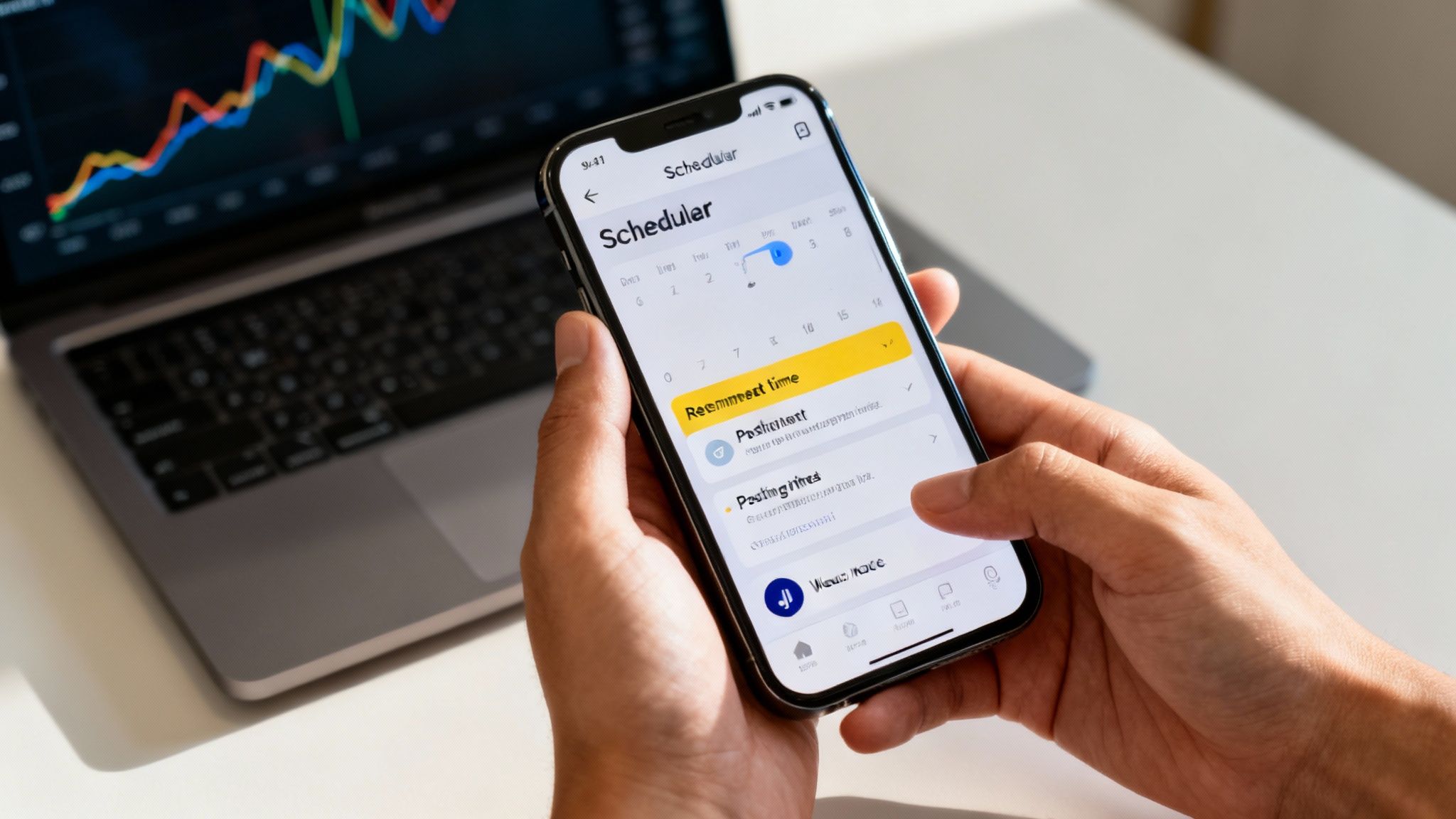
Tools like PostFlow’s scheduler make it dead simple to visualize your content calendar and consistently target these prime windows. This is what it looks like in action—you can literally map out your posts for the week and stop worrying about missing those key moments.
This is how you move from just randomly posting to building a deliberate, data-backed strategy. It's the first step toward creating a predictable engine for engagement on the world's biggest professional network, and it sets the stage for even smarter optimization down the road.
How to Find Your Audience's Peak Engagement Window
Alright, let's move past the generic advice. This is where the real wins happen—when you swap guesswork for a strategy built on your own audience data. It’s time to stop just publishing content and start thinking like a strategist.
The process is a simple loop: analyze, hypothesize, test, and repeat. You’re just looking for your audience’s natural rhythm. For a professional platform like LinkedIn, this flow is surprisingly intuitive once you see it in action.
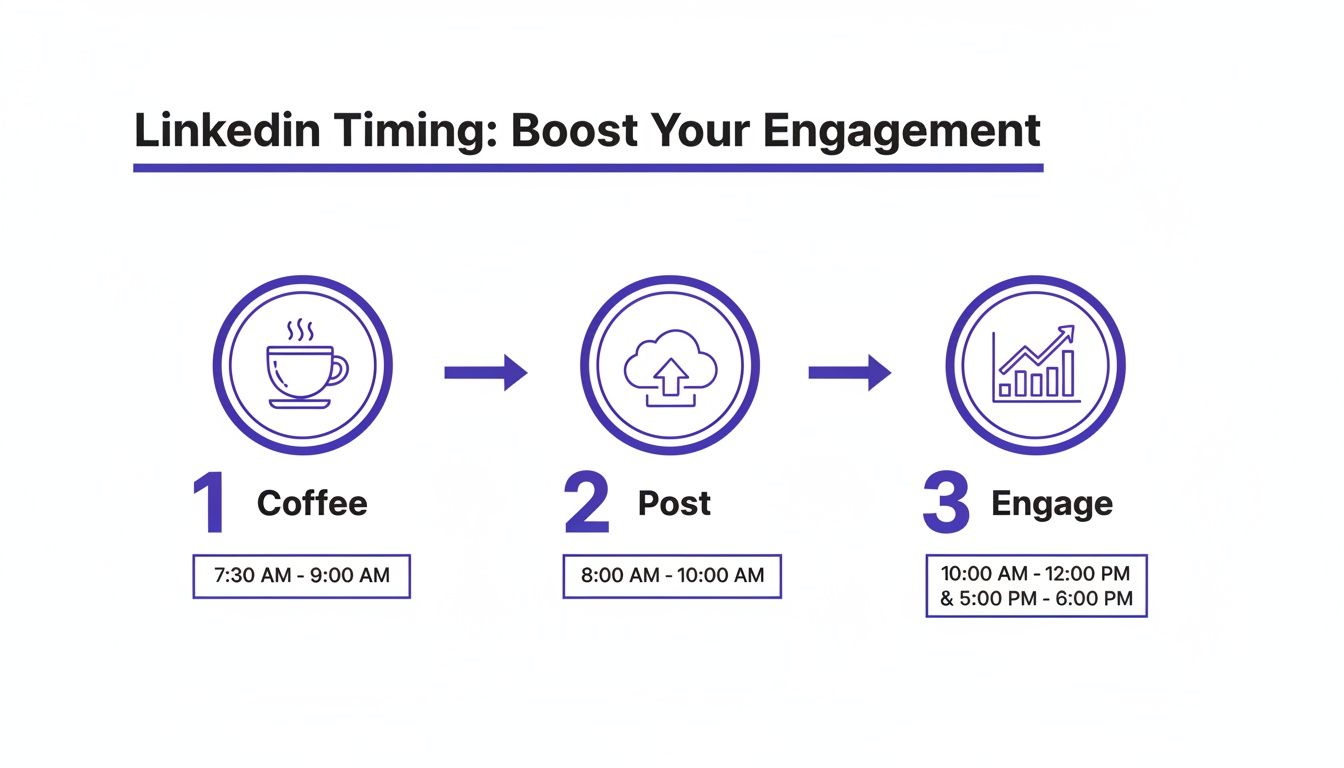
The big idea here is to sync up your posting schedule with the natural flow of your audience's workday, from their morning coffee check-in to those midday scrolling breaks.
Start with Your Platform Analytics
Your first job is to play detective. Every major social media platform has a built-in analytics dashboard, and it's an absolute goldmine of information about your followers. This is where you find the hard data to back up your decisions.
Jump into your LinkedIn, Instagram, or Facebook analytics and hunt for a few key clues:
- Follower Demographics: Where in the world are your followers? Knowing their main time zones is step one for any sensible schedule.
- Peak Activity Times: Most platforms give you a chart or heatmap showing the exact days and hours your audience is most active. Treat this as your starting line.
- Top-Performing Posts: Scan your best posts from the last few months. Make a note of the day and time you published them. See any patterns emerging?
This initial dig gives you a solid baseline—a snapshot of how your audience behaves right now. It's the raw material you'll use to build your first experiment.
Formulate a Smart Hypothesis
With your data in hand, it’s time to make an educated guess. I call this a scheduling hypothesis. This isn't a shot in the dark; it's a strategic assumption you're making based on both the general best practices and your own specific numbers.
For example, a ton of research points to Wednesdays being an engagement powerhouse on LinkedIn, with a broad window from 8:00 AM to 3:00 PM often delivering great results. This is backed up by multiple sources that highlight peaks around midday and in the early morning when professionals are most plugged in. If you want to dig deeper into these professional habits, Elementor's comprehensive guide is a great resource.
Your hypothesis might sound something like this: "My analytics show a spike in activity around noon, and industry data loves mid-week. So, I'm betting that posting on Wednesdays and Thursdays between 11 AM and 1 PM will get me the highest engagement."
That simple statement gives your testing a clear purpose. You've turned abstract data into a concrete plan, and now you have a specific timeframe you can actually validate. The next logical step? Setting up a simple test to see if you're right.
Automating Your Perfect Posting Schedule
So, you’ve figured out when your audience is most likely to be online and ready to engage. That's a huge win. But here's the reality check: knowing the perfect time to post and actually posting at that perfect time are two very different things.
For busy founders, consultants, and creators, life doesn't stop for a social media schedule. Being chained to your desk, waiting for the clock to strike 2:17 PM on a Tuesday to hit "publish," just isn't going to happen. This is where the manual grind ends and smart automation takes over.
Let Smart Tools Do the Heavy Lifting
This is exactly why we built PostFlow. It’s not just another scheduler that queues up your posts. Think of it as an intelligent partner that turns your content strategy from a reactive scramble into a proactive, data-backed workflow. The goal is simple: make sure your best content always gets its best shot.
One of the coolest parts is the smart time suggestions. This isn't some generic list of "best times to post" pulled from a blog post. Instead, PostFlow digs into your historical data—your likes, your comments, your reach—to pinpoint the exact time slots where your content has popped off in the past.
It’s like having a data analyst whispering in your ear, "Hey, based on your own audience, Wednesday at this specific time is your sweet spot." All the guesswork is just… gone.
From Scattered Ideas to a Cohesive Plan
We all know the best ideas rarely show up on command. They strike when you’re on a walk, stuck in traffic, or in the middle of a client call. PostFlow is built for this, with features like voice notes that let you capture a thought, have it transcribed, and turn it into a ready-to-go content idea before it vanishes.
Once your ideas are in, the scheduler makes it ridiculously easy to map out your content calendar for weeks or even months. If you want a deep dive on how to get that set up, check out our guide on how to schedule social media posts.
Track, Refine, and Optimize with Real Data
The final piece of the puzzle is closing the feedback loop. Your strategy can't be set in stone; it needs to breathe and adapt as your audience grows and the algorithms shift. An integrated analytics dashboard is non-negotiable for making this happen.
Here’s a peek at how PostFlow’s analytics helps you see what's working at a glance.
This dashboard instantly tells you which posts are hitting the mark and which ones are duds, so you can stop guessing and start doubling down on what your audience actually wants.
By keeping an eye on your metrics, you can start answering the really important questions:
- Performance Trends: Are my impressions and engagement actually climbing over time?
- Content Pillars: Which of my core topics are sparking the best conversations?
- Timing Validation: Are the times I’m posting still the right ones, or has something shifted?
This whole process—finding your best times, scheduling consistently, and analyzing the results—goes from being a complex, spreadsheet-fueled headache to an effortless, optimized system. You get all the perks of a data-driven strategy without the grunt work, freeing you up to do what you do best: create killer content.
Wrapping It All Up: Your Social Media Timing Playbook
Let's get one thing straight: finding the "best time to post" isn't about uncovering some universal, magic hour that works for everyone. It’s about building a smart, adaptable strategy that grows and changes right alongside your audience. Moving from pure guesswork to real growth is a clear, repeatable process, and you're now equipped to make it happen for your brand.
It all begins with a solid starting point. Think of industry benchmarks as your first hypothesis—a good guess, not a golden rule. From there, you have to get your hands dirty and dig into your own analytics. This is where you uncover the unique rhythms of your audience, from their time zones to their daily professional routines. This is how you leave generic advice in the dust.
Test, Tweak, and Let It Run
Once you have a hypothesis, it’s time to put it to the test. Start experimenting with different posting windows and content types, paying close attention to what actually gets a reaction. This feedback loop, driven by your own data, is the single biggest thing that separates successful creators from those just shouting into the void.
The real goal here is to turn timing into a reliable engine for engagement. That means shifting from constant manual effort to an intelligent, automated workflow that gives your best content its best shot at success, every single time.
With a clear process and the right tools, you can completely change your approach. For more ideas on how to structure your content calendar, check out our complete guide to creating a powerful social media posting schedule.
Tying Up Loose Ends
Even after you've mapped out a solid plan, a few questions always seem to pop up once you start putting it into practice. Let's tackle some of the most common ones I hear from professionals trying to dial in their posting times. Getting these sorted will help you move forward with a lot more confidence.
How Often Should I Be Posting on LinkedIn Anyway?
Here’s the deal with LinkedIn: consistency will always beat frequency. Seriously.
Don't burn yourself out trying to post multiple times a day. Start with a goal of two to three high-quality posts per week. The data is pretty clear on this—businesses that post at least once a week see double the engagement. Find a rhythm you can stick with, and once that's locked in, your analytics will tell you if it’s time to ramp things up.
Does the Type of Content Change When I Should Post?
You bet it does. The format of your post should absolutely play a role in your timing. Think about your audience's daily routine. A quick news update or a simple text post? That might crush it first thing in the morning when people are scrolling through their feeds, catching up before the day gets crazy.
On the other hand, a more involved piece of content—like a deep-dive analysis or a video tutorial—is going to need more of your audience's attention. That kind of post often gets way more traction during lunch breaks or even in the early evening when the workday is winding down.
The only way to know for sure is to test different formats at various times. Let the data be your guide.
What if My Audience Is All Over the World?
Having a global audience is a great problem to have, but it definitely requires a bit more thought. First things first: dive into your analytics. Find out where the bulk of your most engaged followers are and make their peak hours your top priority.
If your audience is spread out pretty evenly, you’ve got a couple of smart options:
- Post multiple times a day. This lets you hit the prime-time windows in key regions like North America, Europe, and APAC.
- Find the time overlap. For example, a morning post on the US East Coast can catch your European audience just as they're finishing their workday.
This is exactly where a scheduling tool becomes a lifesaver. It lets you show up at the perfect time in every time zone without actually having to be online 24/7.
Ready to stop guessing and start scheduling with data-backed precision? PostFlow uses your own performance data to suggest the perfect times to post, turning your expertise into consistent, engaging content. Start your journey with PostFlow today.