Want to really make an impact on LinkedIn? The first step is to stop thinking of your profile as a digital resume. It’s not a static document. It’s your 24/7 professional storefront, and it needs to pull people in.
Build a LinkedIn Profile That Pulls People In
Think about it. When a recruiter, a potential client, or a future business partner hears your name, the first thing they do is look you up on LinkedIn. A generic profile that just lists your job history is a massive missed opportunity.
What you want is a profile that tells a compelling story, showcases your expertise, and works for you even when you're offline. This isn't just about looking good—it's about being findable and memorable in a sea of professionals. Nailing this part is the foundation for everything else you'll do on the platform. It's a critical piece of the puzzle when you're building a personal brand online.
Optimize Your Headline and About Section
Let’s start with the most valuable real estate on your profile: your headline. Don't just settle for the default job title.
Instead of "Marketing Manager at Company X," try something with more punch: "B2B SaaS Marketing Leader | Driving Growth with Content & Demand Gen | Ex-HubSpot." See the difference? It instantly tells people who you are, what you do, and the value you bring, all while packed with keywords that help you get found in searches.
Your "About" section is where you get to expand on that story. Forget the stuffy, third-person bio. Write like a human. Use the first person ("I help...") to build an immediate connection.
A killer About section usually includes:
- A strong opening hook: What’s the main problem you solve for people? Start there.
- Your core value proposition: State clearly who you help and exactly how you do it.
- A few key wins: Use bullet points to highlight 2-3 big accomplishments. Use numbers to show your impact.
- A clear call to action: Tell people what to do next. "Feel free to connect," or "DM me to talk about marketing strategy."
This simple workflow breaks down the three pillars of a great first impression.
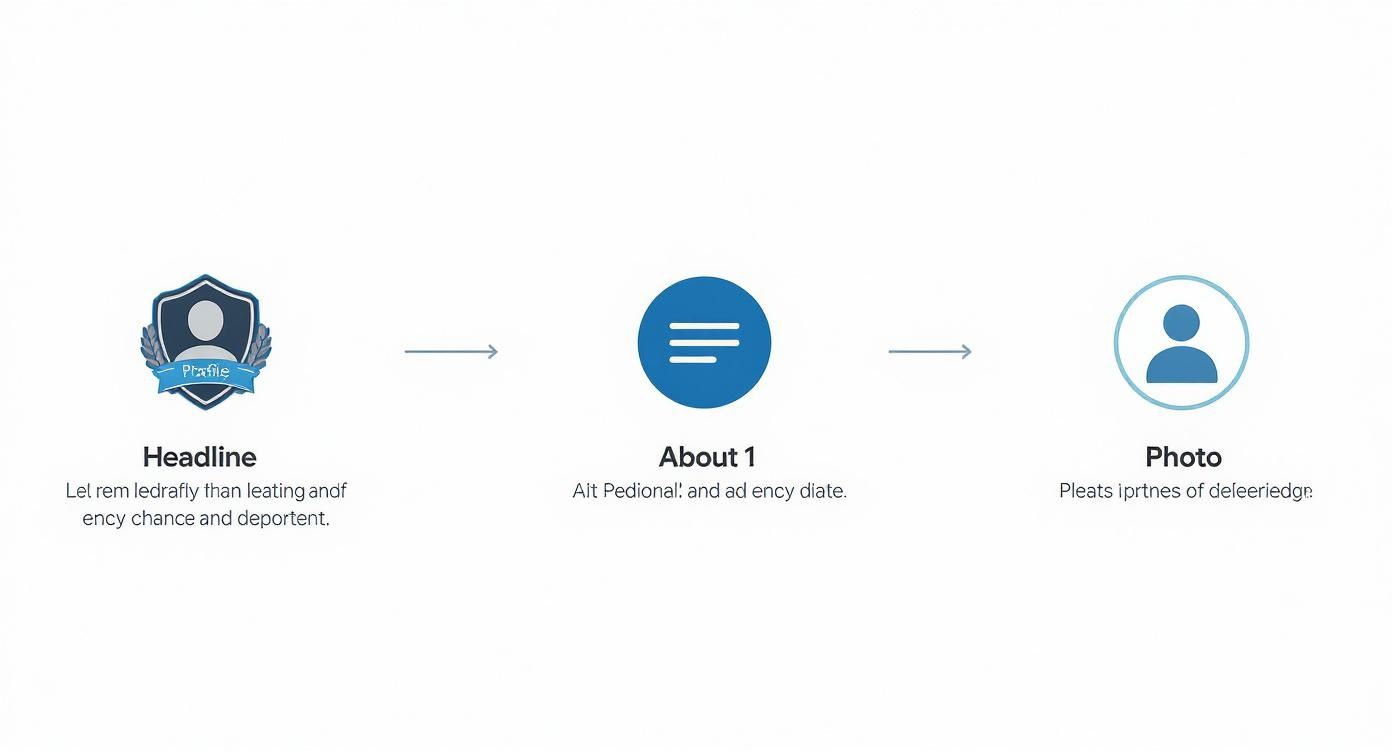
A killer headline, a story-driven About section, and a professional photo all work together. Get these right, and you're already ahead of the game.
Fine-Tune Your Visual and Technical Elements
Visuals and the small details matter more than you think. A high-quality, professional headshot is absolutely non-negotiable. We're talking a clear photo of your face where you look friendly and approachable. No vacation pics, no blurry crops.
Your background banner is another prime spot for branding. Use it to reinforce the message in your headline. If you're a speaker, use a shot of you on stage. If you're a designer, show off a piece of your work.
Pro Tip: Don't forget to customize your LinkedIn URL. Switching it from
linkedin.com/in/jane-doe-a1b2c3d4tolinkedin.com/in/janedoelooks way more professional on your resume and in your email signature.
Finally, always remember who you’re talking to. A staggering 80% of high-quality B2B leads from social media come from LinkedIn. The platform is full of decision-makers and high-income professionals.
Crafting a profile that speaks directly to this audience is the critical first step. For a deeper look, check out our complete guide on how to build a personal brand that attracts the right kind of opportunities.
Here's a quick cheat sheet for the most important parts of your profile to get right.
Key Profile Elements to Optimize
This table breaks down the most impactful sections and how to make them work for you.
| Profile Element | What to Do | Why It Matters |
|---|---|---|
| Profile Photo | Use a high-quality, professional headshot where you look approachable. | It’s your first impression. A good photo builds trust instantly. |
| Headline | Go beyond your job title. Use keywords to describe your value and expertise. | This is prime SEO real estate. It helps the right people find you. |
| Background Banner | Create a custom banner that visually reinforces your brand or mission. | It adds personality and professionalism, making your profile memorable. |
| About Section | Write a first-person story that hooks the reader and highlights your key achievements. | This is your chance to connect on a human level and state your value proposition. |
| Custom URL | Personalize your URL to linkedin.com/in/yourname. |
It’s clean, professional, and easy to share on resumes or business cards. |
Getting these core elements dialed in transforms your profile from a passive resume into an active asset that works for your career around the clock.
Create Content That Actually Starts Conversations
An optimized profile gets people to your digital doorstep, but your content is what invites them inside and convinces them to stay awhile. If you really want to stand out on LinkedIn, you have to shift from being a passive scroller to an active voice in your industry.
This means creating posts that do more than just broadcast your wins. The goal is to share real value, offer a unique point of view, and give people a genuine reason to stop and engage. When you get this right, you start building a reputation as the person to follow in your space.

Go Beyond Text-Only Posts
Look, a well-written text post can absolutely crush it. But if that's all you're doing, you're leaving engagement on the table. Both the LinkedIn algorithm and the people scrolling through it crave variety. Mixing up your content formats keeps your feed from feeling stale and lets you connect with your audience in more dynamic ways.
Try working some of these into your content plan:
- Carousels (PDFs): These are absolute gold for breaking down complex ideas into easy-to-digest, swipeable slides. Think step-by-step guides, lists of pro-tips, or key takeaways from a recent presentation.
- Polls: Need to get a quick pulse on an idea or spark a friendly debate? Polls are a low-effort, high-impact way to get immediate engagement and learn what your network is thinking.
- Short Videos: Putting a face to the name builds trust like nothing else. A quick, casual video (1-3 minutes) where you share a tip or a personal story creates a much stronger bond than text ever could.
- Images and Quotes: Pull a killer line from a blog post or a talk you gave and pop it onto a clean, branded graphic. It's a simple way to create shareable micro-content that's both visually appealing and valuable.
The trick is to match the format to the message. A detailed tutorial is perfect for a carousel, while a hot take on an industry trend could make for a fantastic poll.
Develop a Sustainable Content Plan
Let's be clear: consistency beats intensity every single time. Posting like a machine for one week and then going dark for a month will kill your momentum. What you need is a simple framework that makes creating content feel less like a chore and more like you're just sharing what you know.
The best content on LinkedIn comes from what you already know and do every day. You don’t need to invent groundbreaking ideas from scratch. Just document your expertise, your experiences, and your opinions.
A dead-simple way to structure this is with content pillars. These are 3-5 core themes you know inside and out and actually enjoy talking about.
For example, a B2B marketing consultant’s pillars might look like this:
- Lead Generation Strategies
- Marketing Automation Hacks
- Personal Branding for Founders
- Lessons from Business Failures
With these pillars in place, coming up with post ideas becomes so much easier. You can just aim to create one post for each pillar every week or two. This keeps your content focused and constantly reinforces what you want to be known for. If you need more guidance, check out our deep dive on how to write a LinkedIn post that grabs attention from the very first line.
Post Ideas That Spark Engagement
Staring at that blinking cursor is the worst part. I get it. To help you out, here are a few proven post types you can easily adapt to your own niche.
Share a Hard-Earned Lesson
- Example: "I completely bombed a major client presentation early in my career. It was humiliating, but it taught me one critical lesson about preparation that I still lean on today..."
Ask an Insightful Question
- Example: "If you could give just one piece of advice to someone starting out in [Your Industry] today, what would it be? Genuinely curious to hear the different takes."
Give a Contrarian Take
- Example: "Everyone preaches the 24/7 hustle culture to get ahead. I think that’s terrible advice. Here’s why strategic rest has been far more critical to my growth than just working more hours."
This approach works because people on LinkedIn are actively searching for valuable, insightful content. The platform's engagement metrics tell the story. As of January 2025, LinkedIn hit a median engagement rate of 8.01%, a massive jump from 6.00% just a year earlier. This signals that users are more eager than ever to interact with content that matters.
Engage and Network to Build Real Relationships
Alright, your LinkedIn profile is looking sharp and you've got a content plan in motion. That’s a massive win, but it's only half the story. Just broadcasting your ideas into the ether won't get you very far. LinkedIn is built on conversation, and the real magic happens when you step out from behind your own feed and actually talk to people.
This is where you shift from passive scrolling to an active networking strategy. It’s not about racking up connections like they're trading cards; it's about building genuine professional relationships, one thoughtful comment and personalized message at a time.

Master the Art of the Insightful Comment
Honestly, the comment section is the most underrated networking tool on the entire platform. It's your ticket to getting on the radar of industry leaders and potential clients in a way that’s helpful, not salesy. But dropping a "Great post!" or "Thanks for sharing!" is the digital equivalent of a limp handshake. It’s forgettable.
To actually make an impact, your comments need to add something to the conversation.
- Ask a smart question: "This is a fascinating take on lead scoring. How do you see this model adapting for businesses with longer, more complex sales cycles?"
- Share a quick, relevant story: "I ran into a similar challenge with a client last quarter. We found that [briefly describe your solution], which really reinforces your point about X."
- Offer a supporting resource: "Excellent breakdown. For anyone who wants to dive deeper into the data, the latest report from [Industry Source] has some compelling stats that back this up."
This approach does two things brilliantly. First, it proves to the original poster you actually read and understood their content. Second, it positions you as a thoughtful peer who contributes value. This is how you start building a reputation for expertise before anyone even clicks on your profile.
The goal of a great comment isn't just to agree—it's to extend the conversation. Add a new layer, a different perspective, or a deeper question. That's what gets you noticed.
Send Connection Requests That Actually Get Accepted
Once you've been engaging with someone's content for a bit, sending a connection request is the natural next step. But for the love of all that is good, never just hit the "Connect" button without adding a personal note. An empty request is lazy, impersonal, and has a much lower chance of being accepted, especially from busy, high-profile people.
Your note doesn't need to be an essay. It just needs to provide context and show you’ve put in 30 seconds of effort.
Here are a few simple templates you can steal and adapt:
The "Shared Content" Approach
- "Hi [Name], I really enjoyed your recent post on the future of AI in marketing. Your point about ethical data sourcing was spot on. Would love to connect and follow your work."
The "Mutual Connection" Angle
- "Hi [Name], I see we're both connected with [Mutual Connection's Name]. I work in a similar space, focusing on [Your Field], and I've been impressed with your contributions to the [Industry] community. Would be great to connect."
The "Event or Group" Follow-Up
- "Hi [Name], I was in the audience for your talk at the [Event Name] webinar yesterday and was really inspired by your insights on customer retention. Looking forward to connecting."
These short, specific messages show genuine interest and immediately pull you out of the flood of generic requests people get hit with every single day.
Nurture Your Network Without Being a Pest
The moment someone accepts your request, the real work begins. Your goal isn't to immediately slide into their DMs with a sales pitch. It's to build a warm professional relationship over time. Think of it as a long-term investment in your career.
Here’s a simple, non-aggressive playbook for nurturing new connections:
- Keep engaging: Continue to leave thoughtful comments on their posts. Stay visible.
- Look for ways to be helpful: Did they ask a question you can answer? Do you have an article or resource that could solve a problem they mentioned? Share it with a simple DM: "Hey, saw your post about [topic] and thought you might find this article useful." No strings attached.
- Remember the little things: If they mention a big project or an upcoming event, make a mental note. Following up a week later to ask how it went shows you're actually paying attention.
Building a powerful network on LinkedIn is a marathon, not a sprint. If you focus on giving value through smart engagement and personalized outreach, you won’t just stand out—you’ll build a network that actively wants to help you grow.
Mastering Outreach and Direct Messages
https://www.youtube.com/embed/mVAuwv_UHlg
If you want to find the real opportunities on LinkedIn, you have to get comfortable in the DMs. This is where a simple connection can snowball into a new client, a dream job, or a career-changing mentor.
But let's be honest, most people are doing it wrong. They treat outreach like a numbers game, blasting out cold, generic messages that everyone ignores.
To actually stand out in someone's inbox, your approach has to be human. It needs to feel personal and add value from the very first word. Forget the hard sell. The real goal is to start a conversation, not close a deal on message one.
Craft Your Opening Message
That first message you send to a new connection? It sets the tone for everything that follows. Your only goal here is to give some context and show you've done a tiny bit of homework. Nothing screams "I'm a spammer" louder than a message that’s obviously been copied and pasted to a hundred other people.
Start by referencing something specific. Did you love a recent post they shared? See them speak at a virtual event? Or maybe you have a mutual connection you both respect?
A simple, effective opener might look something like this:
- For a potential client: "Hi [Name], I've been following your work at [Company Name] for a while and was really impressed by your recent article on project management. Your point about agile workflows really resonated with me."
- For a recruiter: "Hi [Name], I saw your post about the open Product Manager role at [Company]. I've been a longtime admirer of your company's product and wanted to reach out directly. My background in B2B SaaS seems like a great fit."
Notice how neither of these asks for a thing. They lead with a genuine compliment or a specific point of connection, which makes it incredibly easy for the other person to hit "reply."
The golden rule of LinkedIn outreach is simple: give value before you ask for it. A solid connection is built on generosity and mutual respect, not a transactional request.
The Art of the Follow-Up
So, you sent a great first message and... crickets. It happens. People are busy, inboxes are a warzone. A thoughtful follow-up isn't being pushy; it's a helpful nudge that brings your message back to the top of their mind.
I recommend waiting at least 3-5 business days before sending a follow-up. When you do, keep it light and—you guessed it—add a piece of value.
For example, you could send a link to a relevant article with a simple note: "Hey [Name], just came across this report on [Industry Trend] and thought of our conversation. Seemed like something you might find interesting. No need to reply!"
This no-pressure approach shows you're thinking of them without demanding their time. With LinkedIn now having over 1.2 billion members globally, a thoughtful, personalized outreach strategy is your secret weapon to cut through the noise. That massive growth means your ability to connect authentically is a huge advantage. You can find more insights on LinkedIn's user growth at Kinsta.com.
Common DM Mistakes to Avoid
Knowing what not to do is just as important as knowing what to do. Whatever you do, steer clear of these common mistakes that can kill a conversation before it even starts.
- The Immediate Sales Pitch: Just don't. Never, ever lead with a sales pitch to a brand-new connection. It’s the digital version of walking up to a stranger at a party and asking for money.
- Vague and Generic Questions: Avoid asking "Can I pick your brain?" It's lazy and puts all the work on the other person. Instead, ask a specific, well-researched question that's easy to answer.
- Long, Rambling Messages: Keep your DMs short and scannable. Write in short paragraphs and remember most people are reading this on their phone.
Look, effective outreach on LinkedIn is a skill. But by focusing on personalization, providing value, and playing the long game, you can turn those cold connections into warm professional relationships that genuinely move the needle for you.
Measure Your Impact and Refine Your Strategy
If you're putting in the work on LinkedIn, you need to know what's actually moving the needle. Flying blind is a surefire way to burn out. The real key to sustainable growth isn't about guessing what your audience wants; it's about using LinkedIn's own data to make smarter decisions.
This isn't about chasing vanity metrics. It's about focusing on the numbers that tell you a story, helping you double down on what resonates and ditch what's falling flat. A data-driven approach turns your daily activity into a genuine plan for growth.

Key LinkedIn Metrics That Actually Matter
Diving into LinkedIn Analytics can feel like a lot, but honestly, only a few metrics really tell you if your strategy is working. Focus on these, and you'll get a clear picture without drowning in data.
Here’s what I track regularly:
- Post Impressions: This is simply how many times your content has been seen. A sudden spike here can be the first sign that a post is starting to go viral beyond your immediate network.
- Engagement Rate: This is the big one. It's the total likes, comments, and reposts divided by impressions. A high engagement rate means your content was compelling enough to stop the scroll.
- Profile Views: Are people curious about you? This metric tells you if your content and comments are actually driving people to check you out.
These three numbers tell a complete story. High impressions but crickets on engagement? Your content is getting seen but isn't hitting the mark. Great engagement but no new profile views? Your posts are solid, but they aren't making people curious enough to learn more about who you are.
Decode Your Profile View Sources
One of the most powerful—and most overlooked—features in your analytics is the "Profile viewers" dashboard. It doesn't just tell you who saw your profile, but how they found you. This is absolute gold.
You'll see sources like:
- Homepage Feed: They saw your content in their feed. Your content strategy is working.
- Search: They found you by typing in keywords. This is direct validation for the keywords in your headline and "About" section.
- People You May Know: LinkedIn's algorithm is putting you in front of the right people. Your networking is paying off.
If you see a ton of views from "Search," you know your profile optimization is on point. If most views come from the "Homepage Feed," your content is doing the heavy lifting. Use this info to lean into what’s already working for you.
To get the full picture of your performance, I've broken down the most important metrics and what to do with the information they give you.
LinkedIn Metrics That Matter
| Metric | What It Tells You | Actionable Insight |
|---|---|---|
| Impressions | How many times your post was displayed on a screen. | High impressions mean your content is reaching a wide audience. Look for patterns in high-impression posts to replicate that reach. |
| Engagement Rate | The percentage of people who interacted (liked, commented, reposted) with your post after seeing it. | This is your quality score. A high rate means your content is compelling. Analyze these posts to understand what topics and formats resonate most. |
| Profile Views | The number of people who clicked on your profile. | This shows your content and comments are making people curious. If this number is low, add a stronger call-to-action in your content or comments. |
| Search Appearances | How often your profile appeared in search results. | A direct measure of your profile's SEO. A low number here means you need to refine the keywords in your headline and "About" section. |
| Follower Growth | The rate at which you are gaining new followers. | Indicates your overall brand is growing. If this is flat, you might need to engage more outside of your own posts to increase visibility. |
By regularly checking these key metrics, you can stop guessing and start making informed adjustments that lead to real, measurable growth on the platform.
Another great tool for a quick health check is LinkedIn's Social Selling Index. It’s designed for sales folks, but it gives anyone a solid benchmark for their personal branding efforts. You can learn more about how to interpret your Social Selling Index score and what steps to take to improve it.
Test and Iterate for Continuous Improvement
Your LinkedIn strategy should never be set in stone. The most successful people on the platform are constantly running little experiments. The good news? You don't need a complex setup to do this.
Try running some simple tests every couple of weeks.
- Tweak Your Headline: Run a headline focused on your job title for two weeks. Then, switch to a more value-driven one ("I help B2B founders...") for the next two. Did one drive more profile views?
- Mix Up Content Formats: For one week, post only text and polls. The next week, go all-in on carousels and short videos. Which week had a better average engagement rate?
- Play with Posting Times: Try posting in the morning for a week, then switch to the afternoon. Your analytics might give you a hint, but real-world testing is the only way to know for sure.
Treat every post as a piece of data. When something performs way better than average, don't just feel good about it—figure out why. Was it the topic? The format? The question you asked? Finding these patterns is how you build a repeatable playbook for success.
Your Burning LinkedIn Questions, Answered
Look, even with the best strategy in hand, the day-to-day reality of building a presence on LinkedIn can throw you some curveballs. You're not the first person to wonder how to fit it all in or what to post when your brain feels empty.
Let's cut through the noise and tackle the most common questions I hear. Getting these sorted will help you stop overthinking and start making real progress.
How Much Time Do I Really Need to Spend on LinkedIn Every Day?
This is the big one, and the answer usually surprises people: it’s less than you think. You don't need to be glued to your screen for hours to see an impact.
Forget intensity; focus on consistency. I’m talking 15-30 minutes a day. The key is to make that time count with focused, smart activity—not mindless scrolling.
Here’s what a killer 20-minute daily session actually looks like:
- 5 minutes: Jump on your latest post and reply to every single comment. This is non-negotiable. It’s how you build a community, not just an audience.
- 10 minutes: Go leave 3-5 genuinely thoughtful comments on posts from people you want to connect with. Think industry leaders, ideal clients, or peers you respect.
- 5 minutes: Check your DMs and fire off one or two personalized connection requests.
That’s it. Seriously. This small, daily habit is the secret sauce. It’s the steady drip of engagement that builds momentum and carves out your space on the platform without burning you out.
What if I Run Out of Things to Say?
Creator's block is a real beast, but it’s rarely because you have nothing valuable to share. More often than not, it’s because you’re trying way too hard to invent something brilliant from scratch.
Your best content ideas are already hiding in plain sight—in your everyday work.
The most powerful content isn't about creating some revolutionary new theory. It's about documenting what you're already doing, thinking, and solving. Just share what you know.
Next time you feel stuck, raid these goldmines:
- Your "Sent" Folder: What questions are you answering over and over for clients or your team? Each of those detailed replies is a post just waiting to happen.
- Your Calendar: Look at your meetings from this week. What problem did you help solve? What insight did you share? Break it down.
- Your Industry Newsfeed: See a trend or a piece of news you have a strong take on? Don't just read it—share your perspective.
The goal isn't to be a groundbreaking visionary with every post. It's to be a consistently helpful, authentic voice. Show up, share what you see from your unique vantage point, and you will stand out.
How Do I Actually Make Money From This?
At the end of the day, all this effort has to lead somewhere, right? Standing out is great, but it’s even better when it leads to a new client, a dream job, or a valuable partnership.
The magic happens when you start guiding conversations from your public content into your private DMs. A simple, well-placed call-to-action in a post or a thoughtful message to a new connection can open that door.
If you’re curious about how to turn your growing influence into real income, you should explore these hidden ways to make money on LinkedIn. The core principle is always the same: build genuine relationships first. Trust is the currency that makes any transaction possible.
Ready to stop guessing and start posting with confidence? PostFlow gives you an AI content strategist, Emilia, who turns your spoken ideas into polished, engaging LinkedIn posts.