
Before you even think about sending that first cold email, let's talk about setting the stage. Getting a steady stream of freelance clients isn't about luck; it’s about having a clear strategy. You need to know exactly who you’re trying to reach, package your services in a way that solves their biggest headaches, and price your work based on the incredible value you deliver.
Nailing this foundation means every bit of outreach you do is targeted, powerful, and way more likely to land the clients you actually want to work with.
Building Your Foundation to Attract Ideal Clients
Look, before clients can find you, you need to be findable. And when they land on your profile or website, they need to get what you do in about three seconds flat.
Jumping straight into pitching without this groundwork is like setting sail without a map. You might drift somewhere eventually, but it's probably not where you intended to go. Being a successful freelancer isn't just about being good at your craft—it's about getting ridiculously good at communicating why you're the only logical choice for a very specific type of client.
This means shifting from a generalist "I can do it all" mindset to a specialist who solves a particular problem for a defined audience. That’s where the real money and fulfillment are.
Define Your Ideal Client Profile
You can't hit a target you can't see. Vague descriptions like "small businesses" are useless. It's time to get granular and build out a detailed Ideal Client Profile (ICP) that feels like you're describing a real person.
Get specific about:
- Industry and Niche: Are they B2B SaaS? D2C e-commerce? Health and wellness? The tighter your niche, the easier it is to stand out.
- Company Size: Are you helping solo founders, lean startups with 10-50 employees, or established mid-market companies? Their needs are wildly different.
- Key Challenges: What’s keeping their CEO up at night? Is it a leaky sales funnel, an invisible brand, or messy internal workflows?
- Goals: What are they trying to hit this quarter? Maybe it’s increasing revenue by 20%, launching in a new market, or slashing customer churn.
When you know your ICP inside and out, you can tailor every piece of content, every message, and every service offering to speak directly to them. It makes your value proposition impossible to ignore. A strong personal brand is the magnet that pulls these clients in. If you need a hand with that, check out our guide on how to build a personal brand.
To help you get organized, here’s a quick rundown of the essential pieces you need to put in place.
| Component | Why It Matters | Actionable Tip |
|---|---|---|
| Ideal Client Profile (ICP) | Stops you from wasting time on bad-fit leads. | Interview 3-5 of your best past clients to find common traits. |
| Packaged Services | Makes your value tangible and easier to sell. | Turn your skills into a solution, e.g., "LinkedIn Authority Package" instead of "writing services." |
| Value-Based Pricing | Lets you earn based on results, not hours worked. | Calculate the potential ROI your client gets from your work and price accordingly. |
| Strong Personal Brand | Attracts clients to you, so you do less chasing. | Consistently post helpful content on one platform where your ICP hangs out. |
Putting in this upfront work is non-negotiable. It’s what separates the freelancers who are constantly stressed from the ones who are booked out with high-paying, respectful clients.
Package Your Services for Results
Clients don't buy your time; they buy outcomes. Stop selling "freelance writing" or "web design" and start offering tangible solutions packaged up with a neat little bow. This simple shift changes the conversation from "How much do you cost?" to "What results can I expect?"
For instance, a content writer could ditch the per-word rate and offer:
- SEO Blog Post Package: Four keyword-optimized articles per month designed to climb Google rankings and drive organic traffic.
- LinkedIn Authority Builder: Eight thought-leadership posts and a full profile overhaul to turn a founder into a recognized industry voice.
- Website Content Refresh: A complete audit and rewrite of core website pages aimed squarely at boosting conversion rates.
This approach makes it dead simple for a potential client to see exactly what they're getting and the tangible result it will produce. It also streamlines your sales process and gives you the confidence to charge premium prices.
This simple graphic breaks it down perfectly. Define, package, and then price.
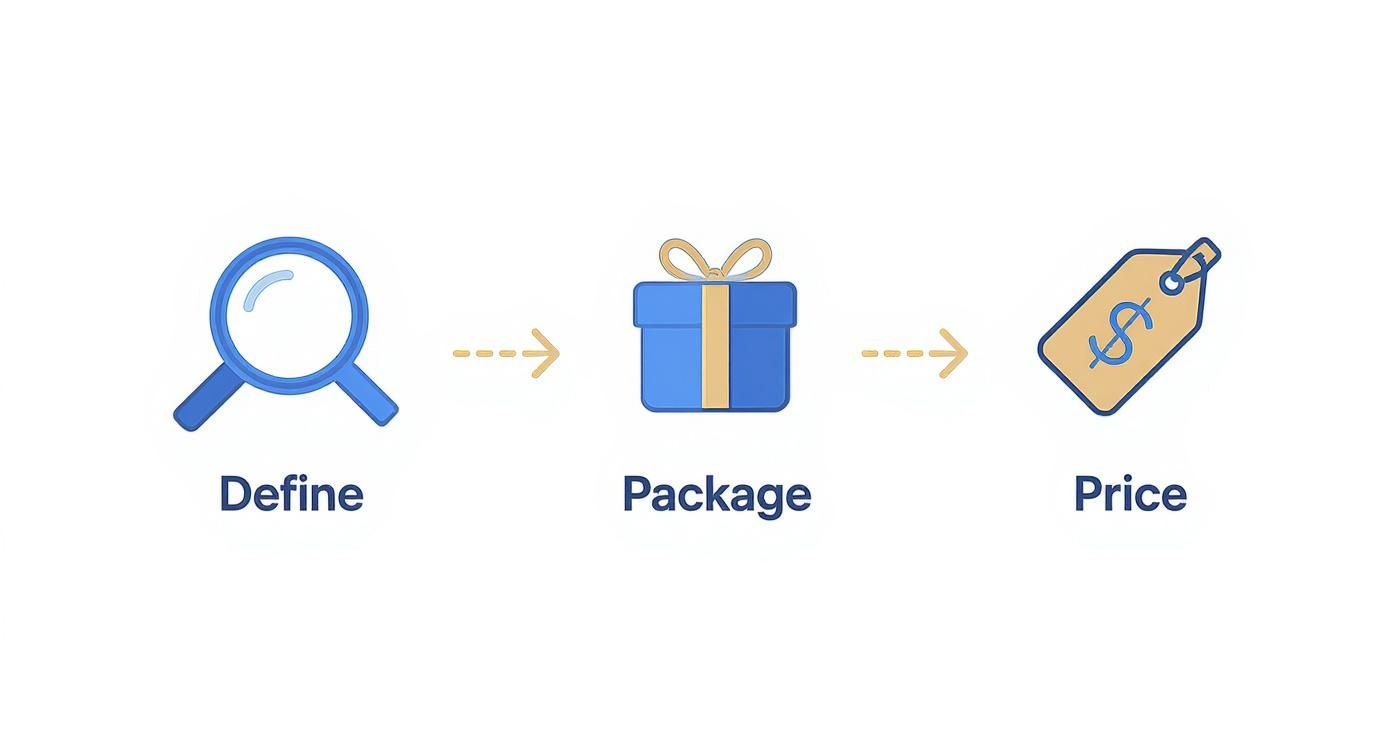
Each step builds on the last, creating a freelance offer that’s not just compelling, but coherent.
Price Based on Value, Not Hours
Okay, you've got your packages. Now, how do you price them? While hourly rates feel safe when you're starting out, the top-earning freelancers live and breathe value-based pricing. This means you set your fees based on the direct, measurable impact your work has on a client’s business.
The goal is to anchor your price to the client's return on investment. If your SEO package can generate an estimated $10,000 in new leads for a client, charging $2,500 is a clear and justifiable value proposition.
Specializing is your fast track to higher earnings. A freelance marketing expert, for example, can charge a premium because their skills are in high demand. In fact, 58% of them expect to earn more in the coming year, with top-tier UK marketing freelancers pulling in daily rates up to £788 (around $963).
That's the power of being a specialist who solves expensive problems, not a generalist who just clocks hours.
Proven Channels for Finding High-Quality Leads
Alright, you've got your foundation set. Now it's time to actually go where the clients are.
The real key here is to stop scrolling aimlessly and start engaging strategically in the places where your ideal clients hang out. This isn't about being everywhere at once; it's about being incredibly effective in a few key spots.
Think of it this way: a diversified client acquisition strategy is your best defense against the dreaded "feast or famine" cycle. Relying on a single source for leads is just asking for trouble. What you really want is a system with multiple streams, ensuring you've always got opportunities in the pipeline.

Dominate Your Niche on LinkedIn
For any B2B freelancer, LinkedIn is non-negotiable. Seriously. It's not just a digital resume anymore; it’s a powerful engine for pulling in inbound leads and connecting directly with decision-makers. The goal is to shift your mindset from having a passive profile to building an active, value-driven presence.
Start by optimizing your profile to speak directly to your ideal client. Your headline needs to scream the problem you solve, not just your job title. Think "I help SaaS founders reduce churn with targeted email marketing" instead of just "Freelance Writer."
From there, consistency is your greatest weapon.
- Share valuable content: Post short-form insights, tips, and case studies related to your niche 2-3 times per week.
- Engage with intention: Don't just "like" posts. Leave thoughtful comments on content from your ideal clients and industry leaders.
- Connect strategically: Ditch the generic connection request. Send personalized notes that reference a shared interest or a recent post they made.
This approach positions you as a helpful expert, not a desperate seller. Before you know it, clients will start coming to you. If you want to go deeper, our guide on how to generate leads on LinkedIn breaks the whole process down.
The Art of Warm Cold Outreach
The term "cold outreach" probably makes you think of spammy, generic templates. I get it. But when it's done right, it’s one of the most effective ways to start conversations with companies you genuinely admire. The secret is to make your cold emails feel warm and personal.
Before you even think about hitting "send," do your homework. Spend ten minutes researching the company and the specific person you're contacting. Find a recent company win, a podcast they were on, or a specific point from an article they wrote.
A great cold email shows you've done your research. It should be short, focused on their needs, and make a clear, low-friction ask—like a brief 15-minute chat to share an idea.
This personalized approach shows you actually care and immediately sets you apart from the 95% of generic emails flooding their inbox.
Cultivate a Powerful Referral Network
Your best future clients almost always come from your happiest current and past clients. Referrals are the absolute gold standard of freelance leads because they show up with trust already built-in. But they don't just happen by magic; you have to actively cultivate them.
Make it a habit to ask for referrals at the right moments—usually right after you've delivered great results or received glowing feedback. You don't have to be pushy. A simple message works best: "I'm so glad you were happy with the project! I'm looking to partner with a few more clients like you. Is there anyone in your network who might benefit from similar results?"
That simple question can turn one great project into three.
Stand Out on Freelance Marketplaces
Platforms like Upwork and Fiverr get a mixed reputation, but they can be a fantastic source of clients, especially when you're just building momentum. The trick is to avoid the race to the bottom on price. Instead, you need to compete on value and expertise.
Let's be real, client acquisition is a huge hurdle for many, especially in creative fields. A recent study found that 30.5% of freelance writers see it as their biggest challenge. And how do they find work? Nearly 49% use freelance platforms as their main channel, which is far more than referrals or cold pitching.
To actually succeed on these platforms, you need to play by a different set of rules:
- Create a niche profile: Don't be a generalist. Specialize in a specific service for a specific industry.
- Write custom proposals: Read the job post carefully and address the client's specific pain points.
- Showcase relevant work: Attach portfolio samples that are directly related to their project.
When you position yourself as a specialist who gets their business, you can command higher rates and win projects based on your quality, not just your cost. For more ideas on finding work, this guide offers some great actionable strategies for finding clients online that apply to all kinds of freelancers.
How to Write Pitches and Proposals That Convert
Getting a potential client on the hook is just the first step. Think of it like getting a ticket to the big game—it gets you in the door, but it doesn't guarantee a win. Your pitch or proposal is your actual game plan. It's the one document that has to convince a prospect you're not just another freelancer, but the exact solution they’ve been looking for.
A great proposal stops the conversation from being about cost and starts it being about value. It shows you've actually taken the time to understand their business, their headaches, and where they want to go. When you nail it, it feels less like a sales pitch and more like a strategic recommendation they can’t afford to pass up.
Anatomy of a Winning Pitch
Whether you're sending a cold email or a full-blown proposal, the best ones all follow a similar blueprint. The goal is to build trust and show off your expertise, fast. It’s all about being concise, focusing on them, and making the next step a no-brainer.
Here’s how to break your pitch down:
- The Hook (Your Opener): This has to grab their attention immediately and feel personal. Ditch generic subject lines like "Freelance Writing Services." Instead, try something specific like, "An idea for the [Company Name] blog" or "Quick question about your recent post on X."
- The Problem You've Spotted: In just a sentence or two, prove you did your homework. Mention a specific pain point you noticed, a recent company announcement, or an opportunity you see for them.
- Your Solution (The 'Aha!' Moment): This is where you connect their problem directly to what you do. Frame your service as the bridge that gets them from their current challenge to their desired outcome.
- The Proof: Show, don't just tell. Drop a link to a relevant case study, a portfolio piece, or a killer testimonial. Social proof does all the heavy lifting for you.
- A Simple, Clear Call to Action (CTA): End with an easy next step. Instead of a vague "Let me know what you think," propose a "brief 15-minute call next week to walk you through this idea."
This structure keeps your message tight and zeroed in on what the client actually cares about: their business.
From Initial Contact to Formal Proposal
That first email is often just the beginning. Once you've sparked their interest, you'll probably need to draft a more detailed proposal. This document moves past the initial idea and lays out a concrete plan of action. For a masterclass on this, check out this guide on how to write a business proposal that actually wins deals.
A solid proposal usually covers these bases:
- Your Understanding of the Project: Kick things off by summarizing their goals and challenges in your own words. This immediately shows you were listening and get what they need.
- The Proposed Scope of Work: Clearly spell out the deliverables. Get specific about what's included (and just as importantly, what's not included) to avoid scope creep down the road.
- Timeline and Milestones: Break the project into phases with estimated delivery dates. This gives them a clear picture of the process and manages expectations from day one.
- Investment and Terms: Lay out your pricing clearly. Whether it’s a flat project fee, a monthly retainer, or an hourly rate, make sure there are absolutely no surprises.
The best proposals don't just list services; they tell a story. They paint a clear picture of what success looks like for the client after they’ve hired you.
Message Templates You Can Adapt
Templates are a solid starting point, but they're useless without personalization. Use these as a foundation, but make sure you customize them heavily based on your research.
Responding to a LinkedIn Job Post
Subject: Regarding the Freelance Content Strategist role
Hi [Hiring Manager Name],
I saw your post looking for a content strategist to help scale your B2B SaaS blog. For the last three years, I've been helping companies just like [Similar Past Client] boost their organic traffic with the right kind of content.
I noticed your blog is heavily focused on product features right now. I have a few ideas for how you could layer in some top-of-funnel content to start attracting brand-new audiences.
Here’s a quick case study showing how I helped a similar SaaS company grow their blog traffic by 70% in six months: [Link to Case Study]
Are you open to a quick 15-minute chat next week to discuss?
Best,
[Your Name]
Positioning Yourself as an Expert on LinkedIn
Beyond sliding into DMs, your public content is a powerful, 24/7 pitch. Dropping valuable insights on LinkedIn is a fantastic way to attract inbound leads because it puts your expertise on full display. For more on this, our guide explains how to write LinkedIn copy that actually wins clients instead of confusing them.
Imagine a content strategist posting something like this:
"Most B2B companies treat their blog like a product manual. Huge mistake.
Your blog isn't for you—it's for your customer before they even know they need you.
Instead of another '5 New Features' post, try writing about:
→ The industry trend making their job harder
→ A common mistake their team is probably making
→ A simple framework to solve one of their daily headaches
When you solve their problems for free, you become the only person they think of when they're finally ready to buy. #ContentStrategy #B2BMarketing"
This kind of post delivers instant value and positions you as a strategic thinker. It makes potential clients want to learn how you can help them directly.
Turning a New Client into a Successful Partnership
Landing a new client feels great, but that "yes" is just the starting line. The real work—the work of building a lasting partnership—begins the moment they agree to hire you.
Those first few weeks are everything. They set the tone for the entire relationship. A clunky, disorganized start plants seeds of doubt, but a smooth, professional onboarding experience builds immediate trust. It shows them they made the right call.
Think of your onboarding as the very first product you deliver. It’s your chance to prove your value before you even touch the main deliverables by showcasing your organization, communication, and strategic thinking. A seamless start doesn't just prevent future headaches; it turns a one-off project into a long-term, profitable relationship.
The First 48 Hours: Your Post-Agreement Playbook
The moment a client verbally agrees to move forward, the clock is ticking. Your goal is to make the jump from prospect to paying client completely frictionless. Any hesitation or delay on your end gives them time to second-guess their decision. You need to move fast.
Here’s what to do immediately:
Send the Contract: Don't wait. Have a template ready to go. I use tools like PandaDoc or HelloSign to make it dead simple for them to review and sign electronically. Make sure it clearly outlines the scope, timeline, payment terms, and who owns what.
Issue the First Invoice: Most successful freelancers I know require an initial payment before a single minute of work begins. This is usually 50% of the project fee or the first month's retainer. Send this invoice right along with the contract. It solidifies their commitment and, frankly, protects your time.
Schedule the Kickoff Call: Propose a few specific times for an official project kickoff call. This shows you're eager to get started and respects their calendar. This call is all about aligning on goals, nailing down any final questions, and agreeing on how you'll communicate.
This quick one-two-three punch shows you're a pro who's in control of the process. For a new client, that kind of confidence is incredibly reassuring.
Setting Crystal-Clear Expectations
I’ll say it again: the single biggest cause of client friction is mismatched expectations. The kickoff call is your golden opportunity to get everyone on the same page and sidestep future drama, especially around communication and scope.
A successful partnership is built on clear boundaries and shared understanding from day one. Don't assume anything; over-communicating at the start saves you from difficult conversations later.
Use your kickoff to establish firm ground rules for how you'll work together. Talk about preferred communication channels (is it Slack or email?), expected response times, and the exact process for giving feedback and handling revisions. This is your best defense against the dreaded "scope creep," where a project slowly balloons beyond the original agreement.
Essential Client Onboarding Checklist
To make sure nothing ever slips through the cracks, you need a system. A consistent onboarding checklist for every new client makes you look sharp and ensures you have everything you need to knock their project out of the park.
A simple, repeatable checklist is the foundation of a smooth onboarding process. It guides the client, keeps you organized, and makes sure all the administrative and strategic bases are covered right from the start.
Here’s a straightforward checklist you can steal and adapt for your own process.
Essential Client Onboarding Checklist
| Phase | Task | Purpose |
|---|---|---|
| Admin & Legal | Send contract and initial invoice. | Formalize the agreement and secure financial commitment. |
| Discovery | Hold a kickoff meeting. | Align on goals, KPIs, and the definition of "success." |
| Access & Assets | Request access to necessary tools/platforms. | Gain entry to systems like Google Analytics, CMS, or brand assets. |
| Communication | Set up a shared folder and communication channel. | Establish a central hub for all project-related files and discussions. |
| First Steps | Confirm the project timeline and first milestone. | Reiterate the immediate next steps and delivery dates to build momentum. |
By following a structured process, you’re not just starting a project—you're leading it. This proactive approach makes your life easier and, more importantly, reinforces their decision to hire an expert. A strong start is the absolute best way to get freelance clients to stick around for the long haul.
How to Keep Clients Coming Back for More

The constant chase for new leads is exhausting. It’s the freelance hamster wheel. The most successful freelancers I know aren’t just good at finding clients—they’re masters at keeping them. This shift from pure acquisition to smart retention is how you build a stable, predictable business.
Turning a one-off project into a long-term partnership isn't luck. It's about being proactive, proving your value over and over, and making yourself an indispensable part of their team. Get this right, and your best clients won't just stay; they’ll become your #1 source for new, high-quality referrals.
Go from Order-Taker to Strategic Partner
The fastest way to become a replaceable commodity is to just do what you're told. Clients pay invoices for completed tasks, but they build lasting relationships with freelancers who think ahead and actively help them win. Your goal? Evolve from being a "doer" to a strategic advisor.
Don't just deliver the work—deliver insights. After a project wraps up, send a quick performance report. Show them the tangible results your work generated, like a 25% boost in blog traffic or a 10% jump in email open rates. This simple step reframes your work in terms of real business impact, not just words on a page.
But don't stop at reporting on the past. Look to the future.
- Pitch new ideas proactively. If you're a writer, suggest a new content series based on an industry trend you've spotted.
- Find opportunities to improve. If you're a designer, point out their outdated landing pages and suggest a refresh.
- Connect the dots. Show them how another one of your skills could solve a new problem they’re facing.
When you consistently bring valuable ideas to the table, their perception of you completely changes. You’re no longer just the "person who writes our blogs"; you're the "person who helps us grow."
Master the Art of the Upsell and Retainer
"Upselling" gets a bad rap, but done right, it's a win-win. It's not about pushing services they don't need; it's about spotting genuine needs and offering a solution that makes their life easier and their business better. This is where truly knowing a handful of clients pays off big time.
Here's a secret: working with fewer clients often leads to making more money. When you focus on 3-5 high-value clients, you gain the deep knowledge needed to anticipate their needs and propose meaningful expansions of your work.
Instead of thinking in one-off projects, look for ways to transition clients to retainers. A retainer gives them guaranteed access to your expertise and gives you that sweet, predictable monthly income.
For instance, a single project for four blog posts could easily evolve into a monthly content retainer that also includes:
- A monthly strategy call to plan content.
- Repurposing blog content into LinkedIn posts.
- Writing and scheduling a bi-weekly newsletter.
This package takes more off their plate, embeds you deeper into their marketing engine, and makes you far more valuable. You become a fixture in their budget, not a one-time expense.
Build a System for Referrals and Testimonials
Your happiest clients are your most powerful marketing channel. Period. Referrals come with built-in trust, which makes them way easier to convert than any cold lead. But you can't just cross your fingers and hope they happen. You need a system.
The best time to ask is right after you've delivered great results or they've sent some glowing feedback. Don't make it weird. A simple, direct approach works wonders.
Here's a quick email script you can steal:
Subject: So glad you loved the recent work!
"Hi [Client Name],
I’m thrilled with the results from our latest project, and your feedback meant a lot.
I'm currently looking to partner with a few more great companies like yours. Do you know anyone in your network who might benefit from similar [mention the specific service, e.g., content strategy or website design] help?
I'd be grateful for any introduction. Thanks!"
Similarly, make collecting testimonials a standard part of your project wrap-up process. A powerful quote on your website or LinkedIn profile is the social proof that convinces new prospects you're the real deal. By mastering retention, you can finally hop off the client-chasing hamster wheel and start building a stable, rewarding business on a foundation of trust.
Got Questions About Landing Freelance Clients?
Every freelancer has been there. You're wrestling with pricing, wondering where the heck to find that first client, or trying to figure out how to scale without completely burning out. You're not alone in this.
Let's cut through the noise and tackle some of the most common hurdles freelancers face. I want to give you direct, actionable answers so you can spend less time second-guessing and more time landing work you're excited about.
How Many Clients Do I Actually Need?
It’s easy to fall into the "more is more" trap. The thinking goes that a dozen clients means more security, but in my experience, it's usually the opposite. Juggling a ton of small, low-paying gigs is a surefire recipe for burnout. Your days get eaten up by project management and chasing invoices, not doing meaningful work.
Here’s the counterintuitive truth: focusing on fewer, better clients almost always leads to a higher income and way less stress. While nearly 60% of freelancers say they have more than five clients, the goal should never be volume—it's value.
A much better strategy is to aim for 3-5 high-quality, long-term clients. This lets you go deep, understand their business inside and out, and become a strategic partner they can't imagine losing—not just a task-doer they can easily replace.
When you work this closely with a handful of clients, you build real trust. That trust is the bridge from one-off projects to valuable monthly retainers, which is how you create the stable, predictable income every freelancer dreams of.
Where Should I Look for My First Client?
Okay, so you have zero portfolio pieces and no testimonials. The hunt for that first client can feel like a massive, impossible task. The key? Start small and build momentum. Forget about landing a huge dream client right out of the gate. Just focus on getting one win, any win, on the board.
Here are the best places to start that search:
- Your Personal Network: Seriously, don't sleep on the people you already know. Tell your friends, family, and old colleagues you're freelancing. More often than not, your first project comes from someone who already knows and trusts you.
- Freelance Marketplaces: Platforms like Upwork can get a bad rap, but they're gold for beginners. They give you a structured place to build your portfolio and rack up your first few positive reviews. The trick is to sidestep the race to the bottom on price by writing hyper-personalized, thoughtful proposals.
- Niche Online Communities: Go where your ideal clients are already hanging out. This might be a specific Slack group, a tight-knit Facebook community, or a niche subreddit. Show up, participate genuinely, and offer value without asking for anything. You'll quickly become known as the go-to expert.
Your first client is all about proof of concept. Do an amazing job, get a glowing testimonial, and then use that success story as leverage to land the next, even better client.
How Do I Handle Rejection from a Potential Client?
Rejection is just part of the game. It happens to everyone, no matter how long they've been freelancing. The secret is to not take it personally and—more importantly—to treat it as data. Every "no" is a chance to learn something.
When a prospect decides to pass, it's rarely a reflection of your skills. It could be about their budget, internal politics, or timing issues you have zero control over. Thank them for their time, and if it feels right, politely ask for feedback. Sometimes you'll get a nugget of insight that makes your next pitch ten times stronger.
The most important thing? Keep moving. The absolute best way to get over a lost opportunity is to get busy finding the next one. Confidence is everything in this business, and the only way to build it is to consistently put yourself out there.
Ready to stop guessing and start building your brand on the world's largest professional network? PostFlow gives you an AI content strategist that helps turn your ideas into a steady stream of high-impact LinkedIn posts. Let Emilia help you attract your ideal clients and grow your freelance business.