
Before you even think about outreach, your LinkedIn profile needs to do the heavy lifting. I've seen it a hundred times: a brilliant outreach strategy falls flat because the profile it leads back to is a ghost town. Think of your profile as your digital storefront—it has to build instant credibility and scream "I can solve your problem" before you send a single message.
Getting this foundation right is what separates frustrating, dead-end outreach from a pipeline that actually works.
Turn Your Profile Into a Lead Generation Machine
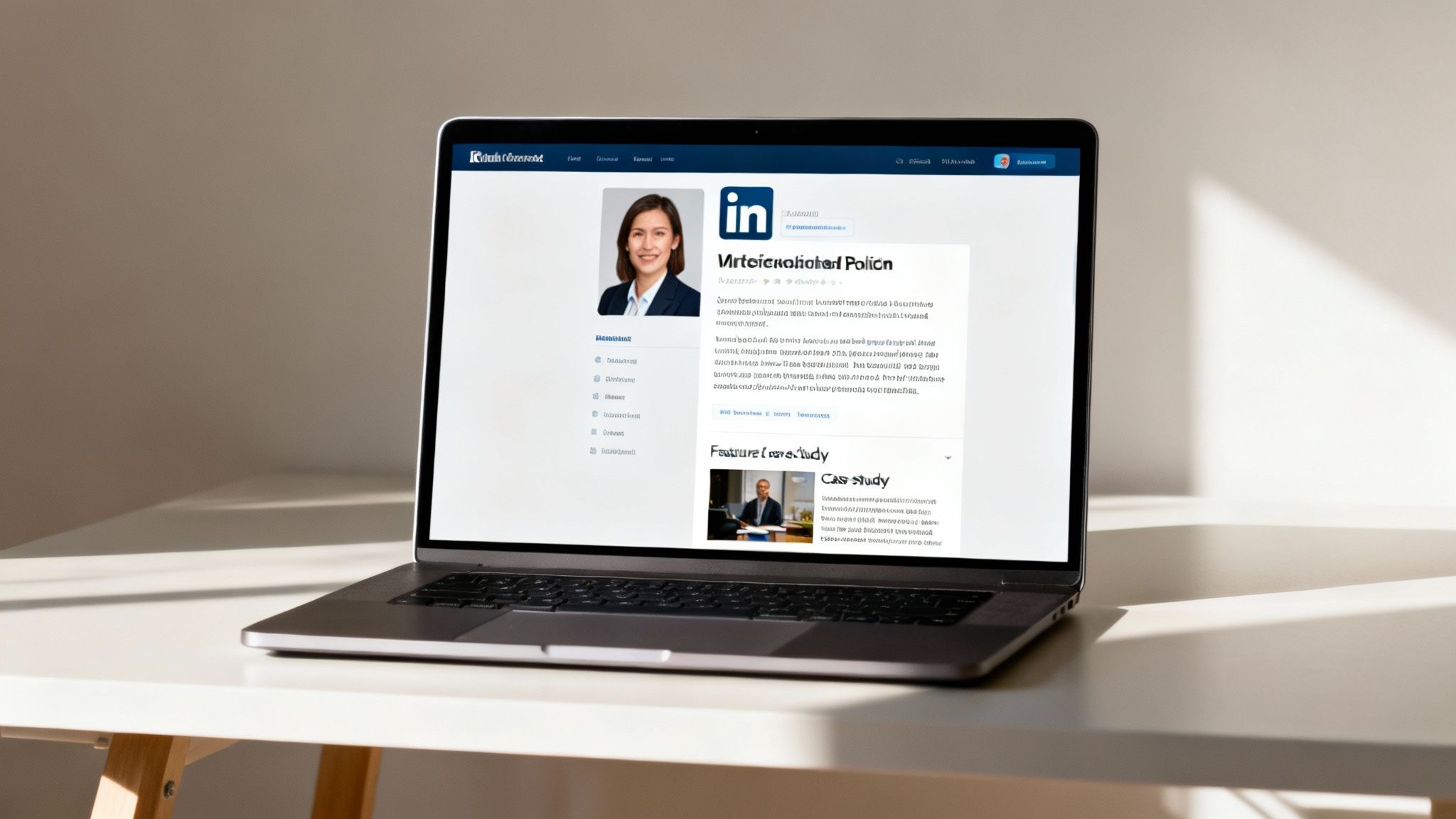
Your LinkedIn profile isn't just a dusty old resume; it's a strategic asset in your sales funnel. Every single element, from your headline to your 'About' section, should be laser-focused on attracting, engaging, and converting your ideal prospects.
If someone gets a message from you, their first move is almost always a click back to your profile. An incomplete or confusing page creates immediate distrust and kills the conversation before it even starts.
From Resume to Resource
The biggest mental shift you need to make is moving from a job-seeker profile to a lead-gen profile. This means every section must speak directly to your target audience's problems, not just list your past jobs and accomplishments.
For any potential lead landing on your page, your profile needs to answer three questions instantly:
- What problem do you solve?
- Who do you solve it for?
- What makes you credible and different?
Nail these, and your profile transforms from a passive document into an active tool that works for you 24/7. It warms up prospects and gives them a compelling reason to accept your connection request and actually reply to your messages.
Your profile isn't just a summary of your past—it's a promise of the value you can deliver in the future. Frame it as the solution your ideal customer has been searching for.
The Non-Negotiable Profile Elements
To help you get started, I've broken down the key elements to focus on. These are the core components that create a powerful first impression and lay the groundwork for all your lead-gen efforts.
Key Elements of a Lead-Generating LinkedIn Profile
Focus on these core components to turn your profile into an effective tool for attracting and converting prospects.
| Profile Element | Optimization Goal | Key Action |
|---|---|---|
| Headline | Grab attention & state your value | Go beyond your job title. Use a client-focused formula like: "Helping [Ideal Client] achieve [Specific Result] with [Your Method]." |
| Profile Photo | Build trust & professionalism | Use a clear, high-quality headshot where you look approachable and professional. No vacation photos or cropped group pictures. |
| Banner Image | Reinforce your value proposition | Create a custom banner that visually communicates what you do. Include social proof (logos, testimonials) or a call to action. |
| 'About' Section | Tell a compelling story | Structure it like a mini-sales page. Hook them with their pain point, introduce your solution, and provide a clear next step. |
Dialing in these sections is where the magic happens. It’s what primes people to see you as an expert, not just another salesperson.
The data backs this up. LinkedIn is reportedly 277% more effective for lead generation than Facebook and X (Twitter), with an incredible 80% of high-quality B2B social media leads coming from the platform. If you want to dive deeper, you can learn more about LinkedIn's lead generation power here.
Finding and Targeting Your Ideal Prospects
Let's be honest, randomly connecting with people on LinkedIn is a huge waste of time. It's a recipe for zero results. The real secret to generating leads isn't about blasting out a million connection requests; it's about precision. Success starts when you know exactly who you need to talk to, what keeps them up at night, and where they hang out on the platform.
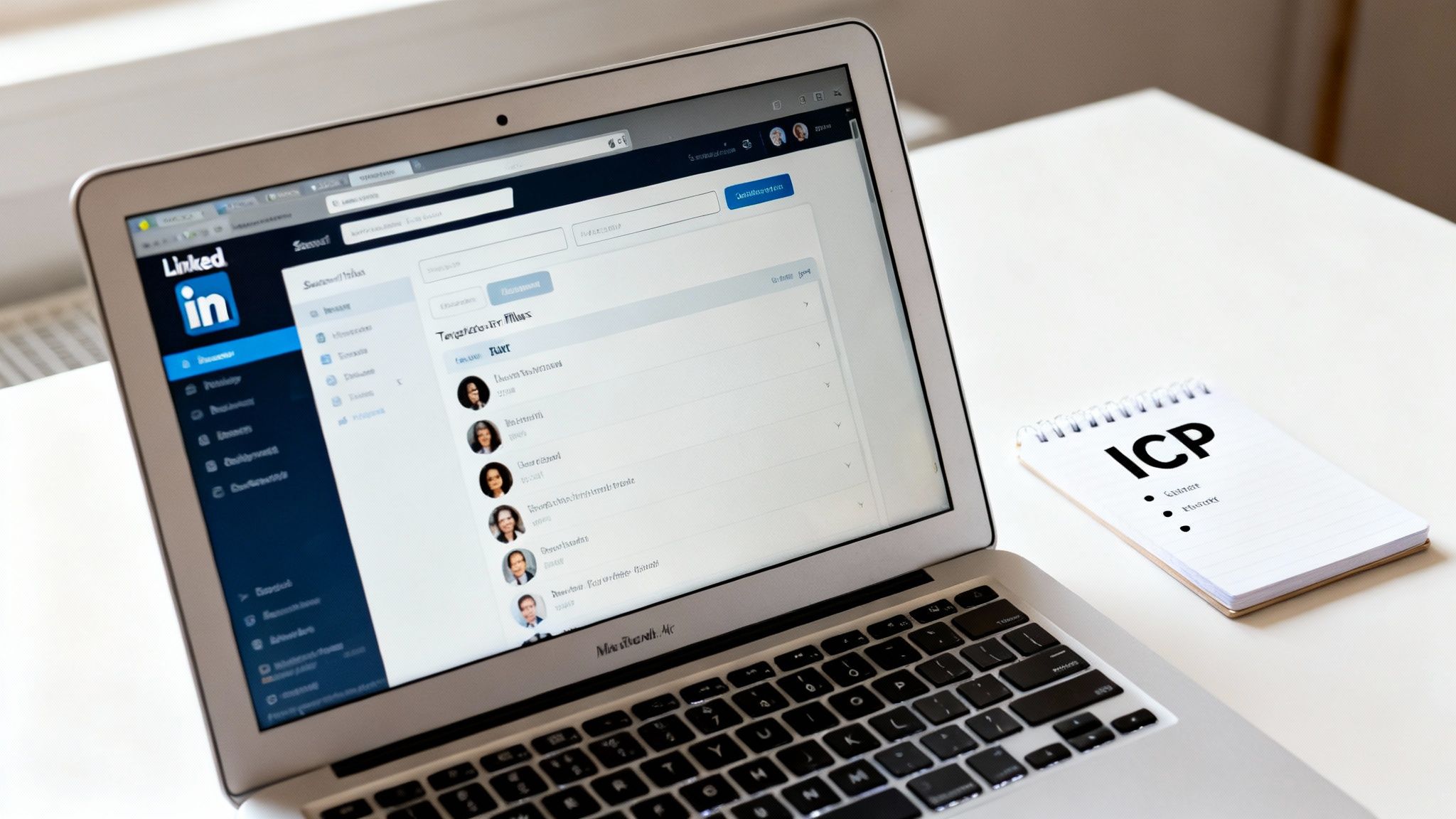
This all begins with getting way more specific than surface-level demographics. You need to build a detailed Ideal Customer Profile (ICP) that feels like a real person. Don't just stop at job titles and company size. You've got to dig deeper to uncover their actual challenges, their career goals, and even the specific words they use to describe their problems.
Defining Your Ideal Customer Profile
Think of your ICP as your North Star for everything you do on LinkedIn. It dictates the content you create, the outreach messages you write, and makes sure you're spending your valuable time engaging with the right crowd. Without this clarity, your lead gen efforts will feel scattered and, frankly, ineffective.
Start by asking yourself some pointed questions:
- What specific pain points are causing them real headaches? Go beyond the business challenges and think about their personal frustrations in their role.
- What does a "win" look like for them? Are they gunning for a promotion, trying to make their team more efficient, or under pressure to cut costs?
- Where do they spend their time online? What industry influencers do they follow? What LinkedIn Groups are they actually active in?
Getting this level of detail is what transforms your approach from generic to personal. You stop being just another salesperson and start becoming a relevant problem-solver.
Mastering LinkedIn Search and Filters
Once you have a crystal-clear ICP, you can start using LinkedIn’s search function like a pro. The standard search bar is way more powerful than most people give it credit for, especially when you bring Boolean operators into the mix. These simple commands let you build hyper-specific lists of prospects.
For example, a search for "Marketing Manager" AND ("SaaS" OR "Tech") NOT "Director" will instantly pull up a list of marketing managers in SaaS or tech companies, while filtering out anyone with "Director" in their title. A simple string like that can save you hours of mind-numbing manual sorting.
A well-defined Ideal Customer Profile combined with smart search techniques is the foundation of any scalable LinkedIn lead generation system. It ensures every action you take is targeted and purposeful.
Now, while LinkedIn is a powerhouse, it's always smart to have a multi-channel game plan. Exploring a wider array of proven B2B lead generation strategies can seriously diversify your lead sources and make your overall sales pipeline much stronger.
And if you're really serious about scaling this up, investing in LinkedIn Sales Navigator is a total game-changer. It unlocks advanced search filters like company headcount growth, technologies used, and recent job changes. This means you can pinpoint prospects who are most likely in a buying cycle, giving your outreach a massive advantage right from the start.
Creating Content That Starts Conversations
Alright, you've polished your profile and know exactly who you're talking to. Now for the fun part: bridging the gap from silent observer to a trusted voice in your industry.
This is where you start creating content that actually gets people talking. Forget the dry corporate updates and sterile press releases. We’re aiming to create content that pulls your ideal customers in and makes them want to engage with you.
Think of every post as your digital salesperson, working 24/7 to build trust and show off what you know. Each piece of content is a chance to solve a tiny problem, share a unique take, or tell a story that hits home with your audience's struggles. This is how you generate leads on LinkedIn without ever sending a cold DM.
The Foundation of a Lead-Generating Content Strategy
Before you type a single word, you need a game plan. A solid content strategy that generates leads really just boils down to three core themes. Nail these, and you'll consistently pump out posts that grab attention and, more importantly, drive real business results.
These content pillars should speak directly to the biggest headaches of your Ideal Customer Profile. They're the topics you'll circle back to, time and time again.
- Educate and Solve: Post content that genuinely teaches your audience something. This could be a quick "how-to," a breakdown of a common mistake to avoid, or your take on a complex industry trend.
- Share Unique Perspectives: Got an opinion on industry news? Challenge a common assumption or share a viewpoint that goes against the grain. This is what separates thought leaders from everyone else just echoing the same old stuff.
- Tell Relatable Stories: Share your own experiences, a client win, or even a failure you learned from. Stories create an emotional hook and make you and your expertise feel more human and approachable.
Your content's number one job is to prove you get your audience's world better than anyone else. When they see their own challenges reflected in your posts, that’s when the trust starts to build.
Turning Content Into Conversations
Putting great content out there is only half the battle. You need to gently guide your audience toward taking some kind of action. No, this doesn't mean a hard sales pitch in every post. It’s about crafting natural calls-to-action (CTAs) that encourage a real discussion.
For example, a simple text post about a common frustration in your field could end with a question like, "Anyone else run into this? How did you handle it?" This simple prompt invites comments and kicks off a conversation.
Or, a more detailed carousel post explaining a process could wrap up with, "If this was useful, shoot me a DM with the word 'GUIDE' and I'll send you the full checklist." This moves the conversation into a private channel, turning an engaged follower into a warm lead.
It's no secret that LinkedIn is the place to be for B2B, with 89% of B2B marketers using the platform to find new prospects. And since buyers look at an average of 10 pieces of content before they even think about making a purchase, a steady stream of valuable posts is non-negotiable. If you want to dig into more data, check out these insightful LinkedIn lead generation statistics.
Getting this right is a process of testing, learning, and refining. For a much deeper dive into the nuts and bolts of writing posts that stop the scroll, take a look at our guide on how to write effective LinkedIn posts. It's packed with specific frameworks to help you turn your expertise into content that connects and converts.
Mastering Outreach That People Actually Reply To
Let's be honest: generic, automated connection requests are the fastest way to get ignored on LinkedIn. We’ve all gotten them. If your outreach feels like a copy-paste template, it’s already on a one-way trip to the digital trash bin.
To actually get leads, you have to stop "selling" and start "helping." The goal isn't to book a meeting with your very first message. It's to kick off a genuine conversation by showing you’ve actually done your homework. A truly personalized connection request is your golden ticket.
The Art of the Personalized Connection
Forgetting the generic "I'd like to connect" default message is non-negotiable. Instead, you need to craft a short, specific note that points to something you have in common. This small step instantly shows you see them as a person, not just another name on a prospect list.
A simple framework I’ve seen work time and time again involves finding a relevant hook:
- A recent post: "Hi [Name], I really enjoyed your post on [topic]. Your point about [specific insight] was spot on. Would love to connect."
- Shared interest or group: "Hi [Name], I noticed we're both in the [Group Name] group. I'm also passionate about [shared interest] and would be great to connect."
- A mutual connection: "Hi [Name], I see we both know [Mutual Connection's Name]. They've spoken highly of your work in [their industry], and I'd love to connect."
This little bit of effort makes a world of difference. It proves you're a human who pays attention, which immediately separates you from the automated noise flooding everyone's inbox.
Your outreach should feel like you're starting a conversation at a conference, not sending a mass email. Personalization is the key that unlocks meaningful dialogue and builds the foundation for trust.
Following Up Without Being a Pest
Once you're connected, the real work begins. The follow-up is where most people completely drop the ball—they either disappear or immediately launch into a hard pitch. Your objective here is to add value and stay top-of-mind.
This is where your content strategy, the one we talked about focusing on solving problems and sharing insights, really comes into play. It builds the authority you need for your outreach to land.
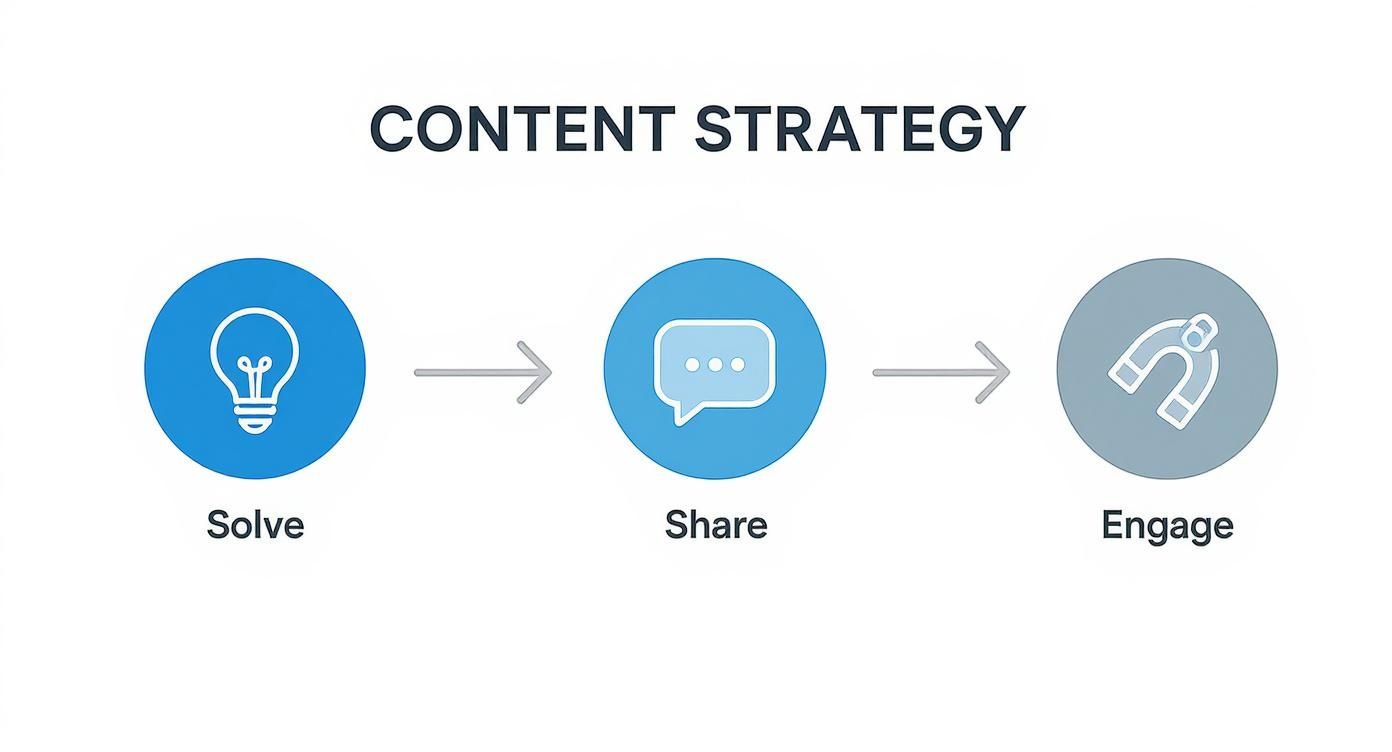
This flow—from solving problems to sharing what you know and engaging your network—is what warms up your connections for future conversations.
A great follow-up message might reference a piece of your content: "Hey [Name], following up on our connection. I just published a post on [a pain point relevant to them] that I thought you might find useful. No pressure to read, just thought I'd share!"
This approach is so powerful because you aren't asking for anything; you're giving something. The results speak for themselves. The average reply rate to LinkedIn messages is an impressive 85%, which is three times higher than email. Plus, when you get this right, a highly personalized outreach strategy can hit a 45% connection acceptance rate, often leading to real leads within just two days.
By consistently providing value and showing genuine interest, you turn cold outreach into warm conversations. To see a real-world example of how this works, check out our guide to crushing LinkedIn cold outreach with a 23% success rate. This method dramatically increases your reply rates and, more importantly, the number of qualified meetings you book.
Tracking and Scaling Your LinkedIn Success
Look, putting in the work to generate leads on LinkedIn is one thing. But how do you actually know if any of it is paying off? If you’re not tracking the right data, you’re just throwing spaghetti at the wall and hoping something sticks.
To really scale your efforts, you have to stop obsessing over vanity metrics like likes and follower counts. Those feel good, but they don't pay the bills. It's time to focus on the numbers that directly impact your pipeline.
Think of your LinkedIn strategy as a machine. To get it running smoothly, you need to know which parts are firing on all cylinders and which ones are causing friction. That’s where a few critical KPIs come into play.
The Metrics That Truly Matter
Forget drowning in a sea of analytics. When your sole mission is to generate leads, only a handful of metrics give you a clear, honest picture of your pipeline's health. These are the numbers that tell you if your profile, your content, and your outreach are actually connecting with the right people.
Start tracking these on a weekly or bi-weekly basis. Keep it simple.
- Connection Acceptance Rate: This tells you how strong your first impression is. A low rate (anything under 20-30%) is a huge red flag. It usually means your headline isn’t compelling enough or your connection request message feels canned and salesy.
- Message Reply Rate: So they connected. Great. But are they talking back? If your reply rate is in the gutter, it’s a sign your follow-up messages are either providing zero value or you’re jumping into a hard pitch way too soon.
- Meetings Booked: This is it. The bottom line. How many of these conversations are actually turning into qualified sales calls? This is the clearest, most direct indicator of your ROI on the platform.
A Quick Look at the Numbers That Count
To keep things organized, here's a breakdown of the metrics you should be living and breathing. This isn't about creating more work; it's about making your work smarter.
Essential Metrics for LinkedIn Lead Generation
| Metric | What It Measures | Why It Matters |
|---|---|---|
| Connection Acceptance Rate | The percentage of connection requests that are accepted. | Measures the effectiveness of your profile (headline, photo) and initial outreach message. |
| Message Reply Rate | The percentage of people who reply to your first follow-up message after connecting. | Indicates how well you're transitioning from a connection to a real conversation. |
| Meetings Booked | The total number of qualified sales calls or demos scheduled from LinkedIn conversations. | The ultimate measure of lead generation success and direct ROI. |
| Profile Views | The number of people who have viewed your profile in a given period. | A good indicator of brand awareness and how well your content is driving curiosity. |
| Lead-to-Meeting Rate | The percentage of conversations that result in a booked meeting. | Helps you understand the quality of your leads and the effectiveness of your messaging. |
By focusing on these specific data points, you move from guessing to knowing exactly where the bottlenecks are in your process.
Using Data to Sharpen Your Approach
Once you start consistently tracking these numbers, patterns will emerge. Is your connection rate sky-high but your reply rate is terrible? That tells you your initial hook is solid, but your follow-up is falling flat. Time to rewrite those messages.
Use this intel to A/B test everything.
- Tweak your connection message.
- Experiment with different content formats.
- Refine the call-to-action in your outreach sequence.
Even tiny adjustments, when guided by data, can lead to massive improvements over time.
A data-driven approach transforms your LinkedIn activity from random acts of outreach into a predictable, repeatable system for generating leads. Measure what matters, ditch what doesn’t, and double down on what works.
This cycle of tracking and refining is how you build a real lead generation engine. As you gather more data, you’ll get an almost psychic sense of what it takes to turn a cold connection into a warm lead. For a deeper dive into making this system work, check out how to build a scalable sales funnel for LinkedIn personal branding success. It’s all about putting your time and energy where they’ll deliver the biggest returns.
Your LinkedIn Lead Generation Questions Answered
Even with a killer strategy, you're bound to hit a few roadblocks when you're in the trenches generating leads on LinkedIn. Let's tackle some of the most common questions I hear, with straight-up, actionable answers to help you push through the tricky spots and keep the momentum going.
How Often Should I Post on LinkedIn?
Look, consistency will always beat frequency. I see this all the time: someone posts like a machine for a week, then vanishes for a month. That's a great way to kill your momentum. The algorithm—and more importantly, your audience—prefers a steady, reliable presence.
For most of us, aiming for 3 to 5 high-quality posts per week is the sweet spot.
It’s enough to stay on your network's radar without flooding their feeds or burning yourself out. The key is to focus on delivering real value with every single post, not just posting to check a box.
Is LinkedIn Sales Navigator Worth the Investment?
If you're serious about lead gen on LinkedIn, the answer is an absolute, unequivocal yes. The free version is fine for casual networking, but Sales Navigator is a different league. It's like upgrading from a paper map to a military-grade GPS.
Its advanced search filters let you zero in on your Ideal Customer Profile with stunning precision. You can filter by things like:
- Company headcount growth
- Specific tech a company uses
- Prospects who just switched jobs
This kind of targeting saves you hours of manual digging and makes sure your outreach lands with people who are actually a good fit. Think of it as an investment in pure efficiency.
Sales Navigator doesn't just find you more leads; it finds you the right leads, and it does it way faster. The time you get back from prospecting alone easily justifies the monthly cost.
How Do I Follow Up Without Being Annoying?
The golden rule of the follow-up is simple: always lead with value, never with a request.
That pushy, "just following up" message is a dead end. It adds zero value and instantly puts the other person on the defensive. Flip the script and re-engage by giving them something useful instead.
A much better follow-up sounds something like this: "Hey [Name], I was thinking about our chat and stumbled on this article about [relevant topic]. Figured you might find it interesting. Hope you're having a great week!"
This simple switch positions you as a helpful resource, not a nagging salesperson. It keeps the conversation alive and leaves the door open for them to get back to you when the time is right.
And hey, if you want to broaden your horizons beyond just LinkedIn, it's always smart to see how other channels can work together. Check out these 10 proven B2B lead generation strategies for a bigger-picture view.
Ready to stop guessing and start posting consistently? PostFlow is your AI content strategist, turning your ideas and expertise into a steady stream of high-quality LinkedIn content. Let our AI, Emilia, help you build your presence and generate leads without the stress. See how it works at https://gopostflow.com.